Showing posts with label Vermont history. Show all posts

Sunday, October 19, 2025

What If Aging Means Less Juggling? Novels, Poems, Feature Articles, History ...


I have never learned to juggle. I've watched a few people learn it, and it didn't seem terrible -- but as someone who can barely catch a basketball, grabbing smaller items out of the air isn't likely. Actually I don't throw very well, either. (Don't ask about the company baseball team, back in 1973 or so.)

Maybe you have read the "how" of juggling? I leaned on such book-learning for writing "Juggling Parenthood at Seventy," which is in the most recent issue of New Feathers Anthology - you can read it here (it's short). I was thrilled that New Feathers asked for a second poem, too, which again is set in my part of parenting "adult children." (Yes, it's here.)

With the onset of my seventies, I notice changes in how I move, which is no surprise. I'm losing some speed and coordination, but not, thank goodness, determination.

What scares me more than the physical changes are mental ones. I worry each time I can't pull up a word or remember why I was headed into another room. It seems that most of my similar-aged friends have the same worry ... none of us want to become dependent on others for basic life, and that's what those little glitches seem to threaten.

But I can't live under threat as a mood. It's terrible for writing. So I'm trying to be practical, the way I was when I got rid of the last throw rug (I loved it, but throw rugs are a Big Problem in terms of falling, "they" say.)

For writing, that means sometimes narrowing the range of what I'm working on. With the gracious collaboration of editor/publisher Justin Lavely, I'm taking a break from feature articles for The North Star Monthly for a few months at least, and I'm not rushing to write another novel. Instead, I'm making a lot of room for poems. There are scraps and Post-it notes and lists all over this home, with metaphors, bits of lines, ideas for structure. It's working! Maybe I should have tried this sooner.

Meanwhile, though, I'm watching how the novels are reaching readers. If you live in Vermont's Northeast Kingdom, you can buy a copy of The Bitter and the Sweet easily in St. Johnsbury or Lyndonville (thank you, Boxcar & Caboose, and Green Mountain Books). But you might not have heard: I was able to regain rights to the first two books in the series, The Long Shadow and This Ardent Flame, and Speaking Volumes has them back in print, with covers that match the ebooks. You can get the lovely softcovers at those same two bookstores -- and of course, order them in any other bookshop, in person or online.

There's some relief in not juggling as much: I don't worry about hard rubber balls landing on my head. But can I stick with just poetry? Umm, no. Watch for news about a huge historical research project in the wings. 


Tuesday, September 2, 2025

How the WINDS OF FREEDOM Series Reached Book 3


Both softcover and ebook available!


Blame it on that heirloom gold locket that my dad gave to me, after my house burned to the ground. The midwinter fire devoured all the jewelry my mother gave me over the years, all her knitting projects, a half-made crocheted bedspread for my youngest brother that I claimed after her sudden death a few years earlier, saying, “I’ll finish it for you.” Raging on a twenty-three-degrees-below December night, the fire took our clothes, my work, the children’s new Christmas toys. None of that compared to the importance of the three of us escaping, with burns on our faces and frostbite on our toes, from sock-footed hike a third of a mile to the nearest neighbor.


Dad drove north to check on us, a day later. He brought some family photos, thoughtfulness that impressed me; he brought my youngest brother the contractor, who’d never receive that bedspread after all, but who brought me boxes of his spare tools; and he brought the locket. Gold, shaped like a tiny box on a short chain, it opened to emptiness. No photo of anyone inside, but I saw an intricate gold grating that flipped outward. “It’s a hair locket,” he explained. “You put a lock of hair of your beloved into it.”


During the night of the fire, a mile from where my ex-husband lived, the only “boyfriend” in my life was playing music in New Orleans. He got a busy signal when he tried to phone me, and bitterly assumed I’d taken the phone “off the hook” to silence it during a date with someone else. Days later, he’d finally phone a neighbor and learn that a fire burns through phone and electric lines. I didn’t put a lock of his hair into the locket; he left not much later, for a dancer he’d formed a crush on.


When I turned fifty, in accordance with the answer a prayerful friend of mine had received, I met and fell joyously in love with my soulmate. By then, the kids were grown and gone, but on their rare visits home, they agreed I’d finally found the right partner. Next time my darling got his hair trimmed, I collected a curl and popped it into the locket.


Historical fiction already meant a lot to me; a lifelong history writer, and a fumbling novelist, I found the combined threads satisfying. And I wanted very much to give readers a vicarious experience of Vermont’s approach to the Abolition movement and to diverse settlers (setting aside for the moment the state’s sometimes cruel treatment of Native Americans; I’d addressed that in my first work of historical fiction, and the book is a classic, The Darkness Under the Water, but also controversial). I figured, if readers followed along with the teens in my new story, they’d discover for themselves that Black people in Vermont in the 1850s were “free and safe,” as one of the state’s great historians puts it.


If you haven’t yet written a novel, this might surprise you: Often the characters stubbornly diverge from where you thought they were going. So did the girls in The Secret Room: One morning, halfway through writing, I realized at least one of them would head into a dark collapsing tunnel, in a desperate rescue effort. As dirt fell into her eyes and mouth and she moved resolutely forward, one hand landed on an object that she reflexively tucked into a pocket. Later, in daylight, she discovered it was an antique locket.


Yes, there you have it: Dad’s little locket had crept right into my story. So it felt obvious, later, that I’d write another novel, this time set in 1850, when that locket first hung at the throat of a Vermont teen. That turned into The Long Shadow, a book I’d never imagined would be the first of a series.


Yet when I turned it in for publication, the cheerful editor said, “I hope we’ll be hearing more from these characters!” Shaken, I asked, “You mean a series? How long?” She replied, “How about until everyone is free?”


It doesn’t take a lot of American history to recognize that “when everyone is free” probably means the end of our Civil War: 1865. If I wrote a book for each year from 1850 until then, there’d be 15 books in the series. A nifty idea! However: My teenaged characters from the first book would be in their thirties. That wasn’t an age I wanted to write about – I love the voice of a teen observing her world. How could I solve this?


It took another week for the idea to arrive: If the teens had a reason for vanishing from the village at the end of each book, or maybe each second book, and the next book’s protagonist became a girl who’d been younger at the start, and I kept passing it along that way — well, you see how it would work, right? Sort of a relay race, passing along the Vermont fight for human liberty to each new girl, or set of girls. Yes! On the spot, I decided (since I’m far from young) that there would be two-year jumps between the books in the series. That meant seven or eight titles, which seemed workable, as long as I took my vitamins and avoided any repeat of the disastrous housefire.


Now we are in book 3 in what the editor and I decided to call the Winds of Freedom series. Almyra Alexander, who showed up in book 2 as a fashionable girl from Boston, longs to be a minister, a difficult if not impossible path for a woman in 1854. The Vermont village, with its changing ideas about people and their roles, may give her a way forward toward her dream.


But first she’ll have to puzzle out several newly arrived women at the local tavern, what they are carrying around the county, how to handle an aging criminal who arrives while her uncle the minister is out of town, and whether she can effectively assist the cause of Abolition.


If you’re ready to find out whether Almyra is up to those challenges, and what the risks are, and what allies she’s recruiting — get ready to read The Bitter and the Sweet.

Tuesday, August 26, 2025

Majoring in Art? Counterfeiting in the 1800s Offered You a Good Income


I've always enjoyed historical fiction. It's the classic "spoonful of sugar" for the facts of our past. As a writer of historical novels, I'm responsible for getting the underlying details—skirt fashion, maple sugaring, weather extremes, and famous persons like Harriet Beecher Stowe (real-life author of Uncle Tom's Cabin)—all correct in the stories I spin. My goal is to give readers an enjoyable ramble through Vermont's 1850s in my Winds of Freedom series, while making sure their experience in the lives of the characters is true to life.

The Long Shadow, This Ardent Flame, The Bitter and the Sweet: These are adventures of teens in the village of North Upton (based on our real North Danville), and each one explores the level of risk the teens undertake. There are scary threats around them, and as anyone who's lived in snow country knows, winter can be the most potent threat of all.

But each book also handles the dangers of 1850s life, from bounty hunters to deadly disease to unquenchable fires that take down houses, barns, and life itself.

In The Bitter and the Sweet, one of the scary aspects is counterfeiting. It took decades for the American system of coins, paper money, and banks to develop. Rampant counterfeiting took place in the 1820s and 1830s, and the effects still made problems for anyone dealing in Big Money in 1854, the year of this novel.

Historians divide written evidence of the past into two kinds: primary, written by the people alive then, and secondary, the books that the historians then write, where they line up the details and pull together the themes. For The Bitter and the Sweet, I used a "secondary" source called A Nation of Counterfeiters: Capitalists, Con Men, and the Making of the United States, by professor Stephen Mihm. (He also kindly answered some correspondence as I narrowed the details I'd be using in my story.)

I already knew about Vermont counterfeiter Christian Meadows, whose history is repeatedly rediscovered for popular articles (here's one). A skilled engraver and silversmith, he strayed from his daily work into counterfeiting, applying his skills to the design and crafting of printing plates. He was captured, convicted, and imprisoned -- but did such elegant design work that Daniel Webster spoke up for him, and Vermont governor Erastus Fairbanks in 1853 pardoned him so he could return to the legitimate side of his engraving.

Devouring the well-written pages of Mihm's comprehensive book A Nation of Counterfeiters, I discovered an even more fascinating fellow: Seneca Paige, who led a major collaborative of "money makers," including multiple artists, just across the Canada border from Vermont's Northeast Kingdom. In his later years he "reformed" and his grave in Bakersfield, Vermont, praises his life, saying, “His Loss will be felt by many; particularly by the poor. He was truly the poor man’s friend.”

I wanted my characters to meet this man (under a new name, of course, for the novel: Foster Pierce). But by 1854, the year of The Bitter and the Sweet, he was already that reformed character that won such acclaim. How could I include him in a way that would be true to the facts, but also potentially terrifying to the teens meeting him in their village?

Yes, I solved it. I won't spoil your fun by saying how! But I loved writing this book, and now that it's in print (softcover and ebook), it's a great joy to share the lives of "my" people with readers.

And I remind the artists I meet: 125 years ago, your precision skills could have been making you an excellent living ... as long as you didn't get caught. 

Friday, June 27, 2025

A (Vermont) Romance of the Revolution: DEAREST BLOOD by Jessie Haas


Ready to detach from the politics of the moment, to celebrate the American Revolution? Although the big national festivities will blossom next year, when we reach 250 years from the Declaration of Independence, this past April marked a quarter century from the Battles of Lexington and Concord. In many ways the push for independence was already "old" by 1775, with initial historical moments coming in 1763 (end of war with the French) and 1765 (protests begin).

Vermont author Jessie Haas, an expert in the history of the Vermont towns of Westminster and Westminster West, provides an exciting, enjoyable, and yes, romantic way to step into the flow of revolution in her newly self-published novel DEAREST BLOOD. (I bet some traditional publishers are hating that they missed out on this!) Cleverly, she positions her 250-page tale on the very edge of the young adult/adult reading line: Fifteen-year-old Fanny Montresor is the daughter -- well, that's complicated, because neither of her parents in Westminster is her birth parent -- but let's keep this simple for now and say that, as the townspeople see her, she is the daughter of a British-loyal civil servant whose wealth is mostly in land, and a lovely and skilled mother who's even more loyal to The Crown. In a town and state on the verge of armed rebellion, that's not a helpful heritage. And it's a shock to Fanny when her mother prescribes marriage to a man of means, locally, as a way to keep Fanny safe in the likely dangerous times ahead.

But there's little time for Fanny to seek other options: "War was normal in America, and left its long trail of debris and grief." Whether battling Abenaquis or the French or pestilence, Fanny's seen enough to believe her mother's insistence that an arranged marriage is suddenly a must.

Armed conflict breaks out far sooner than either expects, and surrounds Fanny's home; she witnesses the death of a young man her own age, and there's ample reason to fear she and her mother could be attacked soon. Her discoveries quickly shatter her worldview, even bringing her toward the rebel cause in her own reasoning.

Haas is a seasoned author, noted for both her often horse-focused children's and adult fiction, and her dedicated historical research that bore fruit in her 2011 book Revolutionary Westminster. Scene by exciting scene, she draws Fanny into deeper understanding of what freedom and liberty might mean, personal and national. Sharp-eyed readers will spot the potential romance that will become a force in the second half of the novel, which jumps to the year 1783, when the Treaty of Paris affirmed America's liberation and (more or less) safety. 

But it is also a time of grief for Fanny, who's endured multiple large losses in the meantime. Returning to Westminster with her mother, she visits the grave of the man she saw killed, and here is the source of the book's title -- on his marker stone, "For Liberty and his Countrys Good / he Lost his Life his Dearest blood." Fanny reflects, "His dearest blood. In my mind's eye I saw that dark smudge on [friend] Isaac's handkerchief. The lump in my throat grew."

How Fanny will resolve her compromises and take agency in her own life becomes a delightful background to a much happier situation than an arranged marriage "for safety." The sweetness and cleverness of the remaining plot -- based on real people and events -- make this novel of the American Revolution into a swift and uplifting read. 

And that, in short, is why historians like Haas sometimes bring their deep knowledge around the corner to a fictional approach. Lucky readers: Those who love American history, Vermont history, historical fiction, and a true-life romance can all savor this book. Do you know a dreamer who's paying attention to friendship and maybe the scary edge of current events, and wish you could draw that person's eye to what this nation has achieved in the past? Here's a great gift, then. Order two copies, because you'll want to hold onto your own. 

DEAREST BLOOD can be ordered by bookstores, or online; read more about the author and her other publications at her website, https://www.jessiehaas.com.

PS: Watch for family names of people who settled much of Vermont; Haas writes that her "work of fiction" is "closely based on historical people and events." Maybe you will spot some relatives or familiar neighbors among the names. I did! 

Thursday, June 26, 2025

Historical Erasure: Far From New!

https://commons.wikimedia.org/wiki/File:Westminster_Town_Hall.jpg

Earlier this week I shared some resources for parts of New England history that are often buried in the rush to "explain" who we are and what has happened. In this season of thinking about the early battles of the American Revolution, 250 years ago, I've been mulling over that sharply uncomfortable phrase, "History is written by the victors."

According to Slate.com, although the line is often attributed to Winston Churchill, it has earlier and maybe more authentic roots. Remember my mention of the Battle of Culloden in Scotland, with a survivor who came to my part of Vermont and has an extensive tribute on his burial stone? Check this out: 

"One biographer’s description of the 1746 Battle of Culloden in Scotland laments that we will never know how many members of his subject’s clan died on the battlefield, because 'it is the victor who writes the history and counts the dead.'"

That's what Matthew Phelan wrote at slate.com (https://slate.com/culture/2019/11/history-is-written-by-the-victors-quote-origin.html).

As we work hard to sort out the most credible parts of each day's global news now, this second example from Phelan may be equally important: 

"Two years later, the saying was in use in United States. In 1891, Missouri Sen. George Graham Vest, a former congressman for the Confederacy who was still at that late date an advocate for the rights of states to secede, used the phrase in a speech, reprinted by the Kansas City Gazette and other papers on the next day, Aug. 21, 1891. 'In all revolutions the vanquished are the ones who are guilty of treason, even by the historians,' Vest said, 'for history is written by the victors and framed according to the prejudices and bias existing on their side.'"  (https://slate.com/culture/2019/11/history-is-written-by-the-victors-quote-origin.html)

The next post here will be, accordingly, an invitation into a newly published novel of the American Revolution, by Vermont's own Jesse Haas and set in Westminster, Vermont. 

Sunday, November 3, 2024

The Winds of Freedom, Book 3: It's the Money, Honey


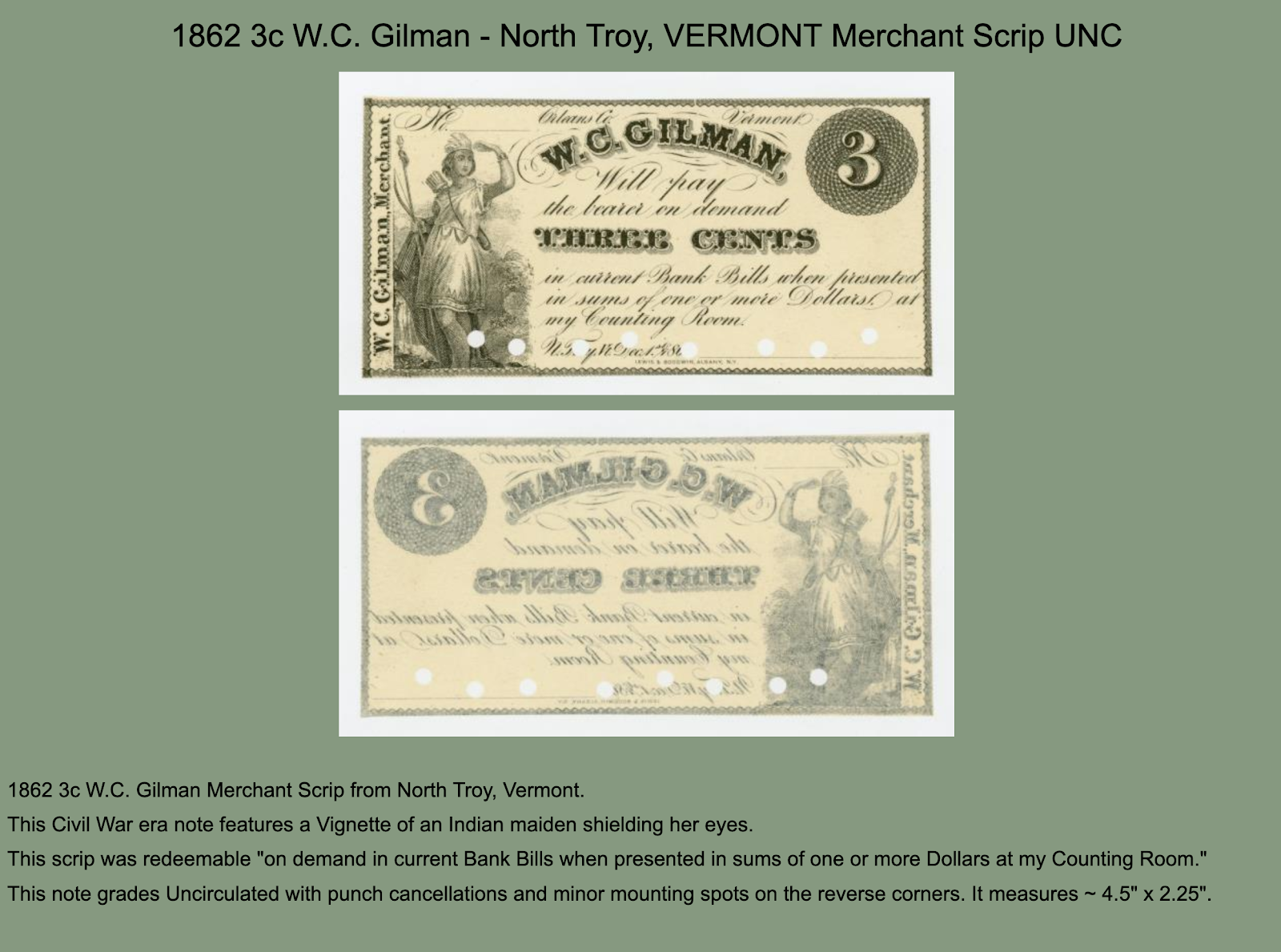
Merchant "scrip" from North Troy, Vermont.

Realizing that the teenaged girl leading the action in THE BITTER AND THE SWEET (Winds of Freedom book 3) would not be either Alice or Caroline -- the teens we follow in the preceding book, This Ardent Flame -- happened well before I started writing book 3. With a two-year jump for each novel in the series, the next protagonist would have to be Almyra Alexander.

Almyra intrigues me for several reasons: She's from Boston, a transplant to the Vermont village of North Upton (aka North Danville), so she's seen more of the sophisticated scenes than either Alice or Caroline. As a result, she brings with her some fashionable clothing and, more importantly, an assertiveness that goes with her outward confidence. That makes her a contrast to the other teens.

But her confidence is a  bit rocky, because she's almost an orphan: Her mother died young, and her father, a political operative, is way too busy to parent his lonely daughter. So when her North Upton aunt and uncle bond with her, and give her the opportunity to stay in the village instead of returning to the city, she's relieved to experience the first real sense of family support she's had in a while.

That's the underlying emotional pin for the book. Add to that her curiosity and unquestioning embrace of the social issues of the day, namely, the abolition of slavery, rights for women, and ending alcohol abuse, and I had the resonant situation that I wanted to write from.

But of course a historical novel is almost always threaded around an urgent plot of some sort, whether it's an adventure, a crisis, or a mystery. Choosing the one for THE BITTER AND THE SWEET came with the discovery of Professor Stephen Mihm's book A Nation of Counterfeiters: Capitalists, Con Men, and the Making of the United States. Not only is this book full of tales of criminal and law enforcement action in our nation's early years, but -- to my astonishment -- one of the major locations for counterfeiters in the early 1800s was our own borderlands of the Northeast Kingdom and Canada's Eastern Townships.

Professor Mihm even replied to some emailed questions, and soon I was on my way, deep into the new manuscript.

MARK YOUR CALENDAR: We'll have a party for THE BITTER AND THE SWEET at Kim Crady-Smith's Lyndonville, Vt, shop, Green Mountain Books, on Saturday Nov. 23 at 11 am. Later the same day, at 2 pm, I'll talk about the book at the North Danville Brainerd Memorial Library, and explain Danville's own connection to the counterfeiting landscape!


Monday, September 23, 2024

The Winds of Freedom: How Vermont's Northeast Kingdom Approached Abolition


In this presidential election season, I think it's been clear that the effects of the American Civil War continue to affect beliefs around the country. President Lincoln's long approach to the abolition of human enslavement in America gave us a fundamental piece of today's view of human citizenship in our nation. At the same time, the long delay in getting there, with some 250 or more years of enslavement behind that, contributes to an awareness that we are not always as "good" or principled as we ought to be. And now we have a nation divided on what goodness and principle mean.

In the 1990s, when I began writing my historic novels, I came face to face with prevailing myths in Vermont history that dismayed me. Many of them revolved around the Underground Railroad, one of the heroic efforts in America in the early to mid 1800s. What we know today, historically, is that the Underground Railroad in Vermont might as well have been called the Aboveground Railroad -- because in the theme noted now at Rokeby in North Ferrisburgh, Vermont, if you were Black and reached Vermont in the 1850s (or had lived here for many years already, like the Mero family of Coventry), you were "Free and Safe." No need for hiding places.

But many people couldn't process that idea when I talked about it. So, based on my personal connection with historic fiction, I opted to write about the 1850s here through the voices and experiences of local people, hoping that readers could internalize that experience and reshape their own vision of what happened.

That led to THE LONG SHADOW, book 1 in the Winds of Freedom series, set in North Upton (aka North Danville) in 1850, from the points of view of teenagers enmeshed in adventures there. At the moment, the printed version is out of stock, but you can get the ebook here. Also ask Kim at Green Mountain Books to watch for a gently used copy for you!

More about that story later this week ... and then about books 2 and 3.

If you'd like to hear how the abolitionists of St. Johnsbury, Vermont, and the surrounding towns saw their world in the 1850s and how they entered the movement toward abolition, here's my talk recorded at the St. Johnsbury Athenaeum. I hope you find some fascinating discoveries when you listen/watch it.


Thursday, August 8, 2024

Winds of Freedom Book 3 Is Coming This Autumn!


The Bitter and the Sweet, the third book in my Winds of Freedom series (after The Long Shadow and This Ardent Flame), should be in print by early November -- maybe sooner! -- from All Things That Matter Press. I know it's been a long wait (thanks to, you know, COVID). So I thought I'd give you a bit of a recap of what the young ladies of North Upton (in real life, North Danville) Vermont have been doing in the 1850s, as Vermont is seized by a passion for Abolition ... that is, the legal abolition of slavery in a nation that had profited in many ways from enslavement for two centuries.

But of course, for northern Vermont teenagers, that's not initially the focus of their attention!

Here's what went on in 1850 in The Long Shadow (can be ordered here or as an ebook here):

THE LONG SHADOW Synopsis


            ALICE SANBORN, age 15 in March of 1850, is the youngest member of her family and the only one not taking a stand on Abolition. In her Vermont village of North Upton, she and her best friends – JERUSHAH, whose family owns the tavern, and SARAH, a younger black girl who is waiting in Vermont for negotiations to free the rest of her family from slavery down South – are more interested in maple sugaring and the arrival of spring than in politics. Still, Alice sees enough to guess that her married brother WILLIAM is conspiring with messenger SOLOMON McBRIDE to protect fugitive slaves. 

            When a slave-hunter reaches the area, Alice’s father sends the three girls, driven by Solomon, to a nearby large town to stay briefly with the elegant MISS FARROW, herself a former slave.  But the slave-hunter spies on Solomon and follows them. The girls elude danger, as Alice starts their horse and carriage north. Solomon sends the slave-hunter on a false trail, catches up with the girls, and drives them farther, despite snow, bad roads, and a catamount.

            By the time the girls reach sanctuary with the HAYES family of Free Blacks near the Canadian border, Jerushah and Sarah are desperately ill. Solomon leaves on his own mission. Alice meets the challenges of helping Mrs. Hayes nurse her friends. CHARLES HAYES startles Alice by laying hands in prayer onto Sarah; he offers the same for Jerushah, but Alice declines on her behalf, unsure her friend would want this.

            Sarah recovers and is happy to stay with the Hayes household to await her own family. But Solomon visits and persuades Alice that Jerushah, still fretful and frail, needs to return to her own mother. Solomon, Alice, and Jerushah endure a storm, flooding, and wolves to drive home. Along the way, Alice learns about Solomon’s freedom-fighting work and considers becoming an active Abolitionist herself – a role that won’t fit her father’s view that the Union of states is more important than freeing slaves.

            The return proves disastrous: Jerushah suffers a relapse, and blame falls on Alice. Although Jerushah’s family won’t let Alice visit, there is an almost-forgotten tunnel that links Alice’s home to the tavern. With help from Jerushah’s brother MATTHEW, the two girls reconnect and begin to leave messages for each other. Alice is dismayed to realize that Jerushah’s friendship for her includes expectations of long-term affection and living together as “spinsters,” a situation Alice does not desire. At the same time, the girls’ brothers – William and Matthew – ask Alice to help in the risky transport of documents that Solomon needs for men escaping slavery and headed to Vermont.

Alice learns to navigate the tunnel even in the dark. But Jerushah’s too fragile to do that, and when she tries to, she takes a terrible fall. Is it Alice’s fault again? All this guilt burdens Alice, and being part of Solomon’s righteous efforts can’t dispel the darkness.

  * * *         

 To learn how it all works out, of course, you need to read the book! (If I told you here, that would really be a spoiler, wouldn't it?)


Watch for news about The Bitter and the Sweet, coming soon!


Monday, March 7, 2022

Passumpsic Photos Lasting a Century—and More (Ernest Skinner)


The other day I pulled out a cardboard folder labeled "SKINNER Postcards Passumpsic," to delve into the images DK* collected that were photographed by Ernest F. Skinner, a farmer who lived a few miles south of St. Johnsbury in the Barnet village of Passumpsic.

DK provided several notes on the most formal image—one that was clearly marketed as a postcard, with a line down the center of its reverse, and the two sides of the line labeled "This Space for Correspondence" and "This Space for Address." The photo on the front is helpfully labeled "Passumpsic, Vermont" and "Ernest F. Skinner, Barnet History, 1923." That snippet that says "Barnet History" indicates Mr. Skinner provided his photo to Frederick Palmer Wells for use in the massive volume of town history.

The covered bridge is obvious in the photo, along with the prosperity of this little village at the time. DK noted that Ernest F. Skinner (1885-1978) was a farmer in Passumpsic and had become a naturalized citizen of the United States in March 1922. His wife was Nellie M. Skinner, 1866-1965.

There are many postcard-size images today that indicate that Vermonters in the 1920s, and probably for a decade before that, enjoyed having their portraits or home portraits turned into cards that they could mail at low cost. Mr. Skinner clearly expected the photos he prepared of his village and adjacent East Barnet to be shared. It's likely that local shops sold them.

This image is labeled "Cobbler Shop Tea Room Passumpsic, Vt." and I remember when DK and I were tracking it down. He dates the card to 1920 with a mention of "4 Squares." His notes add that the house, owned in 2018 by Jeremy and Roxanne Roberts, is next to the one then owned by Craig Beck.

There are two copies of the next image, differing a bit in how dark they are. I like the evidence of local historians collaborating, since DK's first note attached says "Paul Chouinard says this in an Ernest F. Skinner Photo." It shows the wooden covered bridge in Passumpsic, built in 1898. The bridge was destroyed by the Great Flood of Nov. 3-4, 1927, and DK notes there were 1285 bridges lost in that flood. "Looking South, Passumpsic River Bridge 1898, Passumpsic, Vermont. Looking closely at the farm house on the top of Mill Hill. In 2000 the house and large barn were still present. (Info Bruce Filgate)" says DK's added note, crediting another local historian.


Among the notes connected with this Skinner photo of the East Barnet covered bridge is a printed scrap without the source: "This is a photograph of the East Barnet covered bridge over the Passumpsic river which was taken out by the flood of 1927. Note the elevation of the bridge over the river which provides a reference point regarding the height of the raging flood waters during the flood of 1927. It started raining on the evening of November 2, 1927 and by the time the rain ended on November 4th, nine inches of rain had fallen in a 36 hour period. The ground was already saturated from heavy rains during the month of October and was not capable of absorbing mo[r]e moisture. The damage from flooding was devastating to all of the towns and villages located along the Passumpsic river."


This next Skinner image is of those flood waters. The photographer's caption reads "Passumpsic Vt. Nov. 4, 1927" and DK notes that the image is included in the book "Lights and Shadows" on page 56, labeled "The Uncontrolled Flood Waters at Passumpsic."


The flood did more than tear out the bridge—it also wrecked the train station and rail lines. Mr. Skinner's photo postcard is marked "Flood Nov. 4, 1927, Passumpsic, Vt." I wonder how the milk was moved, while both the river and the rail were impasssible.


For another perspective on the damage, here is the depot itself; look closely to see the footings washed away. Mr. Skinner's label is "C.P.R. [Canadian Pacific Railway] Depot, Passumpsic Vt. Flood Nov. 4, 1927."


This very full image is marked "Passumpsic, Vt. #2" by the photographer. DK's note reminds us that it shows the village corner on Route 5. He describes the card as a Velox (an image created by adding a screen to a photo), dating it to 1907-1914. Paul Chouinard has written about the store at this corner and the nearby residents, from his experience growing up in the village in the 1950s.


Inspect "The Ferry Passumpsic Vt. Apr. 25, 1928 (card number) 41" and see the 10-gallon milk cans crossing the river; the ferry operator is using a cable to pull the flat-bottom vessel along. DK points out the engine and railroad freight cars in the card also, and commented that the ferry is "listing or tilting." The milk cans prompted him to add notes on the Passumpsic Creamery, operated by the Passumpsic Creamery Association, M. K. Bruce, Mgr; operations were 1879-1964. A second note mentions Mountain View Creamery in the area's 1930 directory, with J. J.  Richie Mgr.; O. [Ollie] B. Exley was the foreman in West Barnet [his daughter was teacher Miss Karlene Exley—BK].

I'm glad to have taken time to type up DK's notes and present these cards. I anticipate more Passumpsic Village history from Paul Chouinard in the future.

*DK is my late husband David Kanell -- as he would ink in, 1952-2019.


Thursday, June 24, 2021

How Magical!: THIS ARDENT FLAME and Harriet Beecher Stowe

This Ardent Flame is now in print, and the magic continues. 


This is the second in my Winds of Freedom series of historical mysteries, seeing the approach to the Civil War through the eyes of Vermont teenaged girls. In 1852, to be 14 was to be on the verge of womanhood—and to contemplate big questions, like Abolition, Temperance, and votes for women. Also, if you are Alice Sanborn, to confront the wickedness of a man who beats a horse and probably does the same to humans.

Writing This Ardent Flame became magical for me as Alice and her bosom buddy Caroline, deaf from childhood and newly home to Vermont after years of boarding at the School for the Deaf in Hartford, CT, were riding the train north from Boston. Their mission at that moment was to help provide a merry family distraction around two Black men traveling with Alice’s brothers. The men were freemen, but still at risk even in New England, due to the horrors of the Fugitive Slave Law.

As the girls were “conversing” in their adapted language of American Sign Language, lip reading, and already being well attuned to each other’s thoughts, a woman paused to observe and then to ask them about the exchange of Sign. Fascinated, she assured them she’d be following up on this, then leapt off the train for her connection to Maine.

I suddenly knew who it was, before the girls were aware, of course: Harriet Beecher Stowe, author of Uncle Tom’s Cabin, a woman who would later meet President Abraham Lincoln, who supposedly said to her, “So this is the little woman who started this big war.”

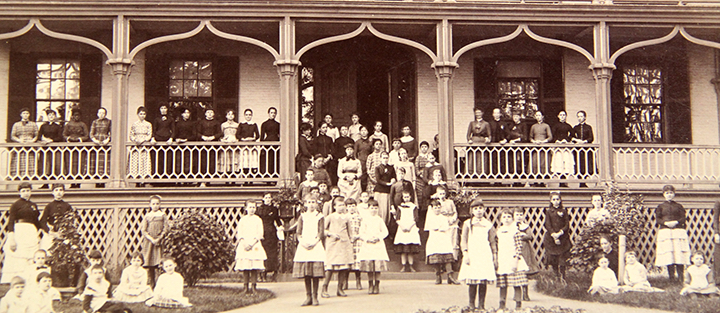
Students and teachers at the American School for the Deaf

Abashed at my own hubris in walking such an important person into the scene, I emailed one of my consultants: the historian at the American School for the Deaf. “Do you mind,” I asked with shaking typing fingers, “if Harriet Beecher Stowe walks through a scene? Could that be historic?”

The quick reply was basically: “Go for it!” Harriet Beecher Stowe and her sister Catherine, it turned out, had been close friends of Alice Cogswell, who ran the school! And in Alice’s scrap book was (gulp) an unpublished poem by the famed Hartford author of Uncle Tom’s Cabin! Here is the actual response from the school historian:

Alice Cogswell kept a scrap book, which we [were] fortunate to inherit from one of her relatives back in 1936.  The scrap book is a collection of poems, letters, and drawings from friends and family members.  She certainly did have a connection with the Beecher family because her scrap book includes a poem from Harriet Beecher Stowe and one from Catherine E. Beecher.  I have no documentation of the circumstances, but it stands to reason.  Both families were prominent in the same Hartford circles, and both women were activists in their own right.  Especially Catherine’s crusade for the education of women.  I imagine Alice’s education at ASD would have been of particular interest to Catherine.

And that, my friends, is the magic of writing historical mysteries—that every now and then, an unexpected guest walks into the scene, and turns out to uncover a real-life revelation.

Sunday, February 21, 2021

Vermont History Comes Alive -- on the Pages, and in Short Videos

Photo by Darcie McCann

A huge joy in my writing life is researching and writing articles for the North Star Monthly that focus on remarkable people of this region of Vermont, whose lives and adventures have become part of our history.

Many people ask me, "How did you get the idea to look into that one?"

So I've started a series of short videos on "where this story came from." If you're curious, you can check them out at my YouTube page, or go directly to one of these:

The Fur Farms of Vermont

Pioneering Aeronauts of the NEK (Northeast Kingdom of Vermont)

I'll add another each month. Hope you enjoy these!

Monday, November 16, 2020

"Aging in Place": Eliza Ann Ide Henry, Wife of a Timber Baron


Because I live on the Vermont side of the Connecticut River, I focus more on the history of the Green Mountain State. But when we're talking about the decades of timber harvesting, both sides of the river have complex and fascinating stories to tell.

For the Vermont side, the books by Waterford native Robert E. Pike, Tall Trees, Tough Men and Spiked Boots, narrate the winter lives spent in the northern forests, followed by the perilous spring adventures of bringing the logs down the swollen rivers. River log transport ended on the Connecticut as Waterford watched construction of the Comerford Dam in 1930. It can still be witnessed on occasion in Maine, but the risks outweigh the benefits and need most of the time.

 On the New Hampshire side, J. E. (James Everell) Henry undertook construction of railroads that penetrated deep into the forested landscape. Not only did his timing mesh with the willingness to spread out the rail network, but it also coincided with the use of shorter logs that could fit onto rail cars.

Littleton, NH, author Mike Dickerman compiles material on Henry, along with a vast knowledge of the high peaks of northern New Hampshire. In August 2014, he visited the Waterford Historical Society to talk about Henry and his own book on this ambitious and accomplished leader.


Today, as Dickerman prepares a new book on history of the high peaks, he shared a photo of the Waterford woman who would marry J. E. Henry: Eliza Ann Ide (daughter of Joseph and Almira), who was 20 years old when this photo was taken. Her marriage would follow two years later.

Eliza Ann Ide, 1912, before marrying J.E. Henry.

Since the photo was taken in 1852, it's a perfect mesh with the historical fiction series I'm writing, Winds of Freedom. I can absorb from this image of Eliza's face a reminder of both the lack of experience and the determination to enfold life that so many of our New England young women combined at age 20 in the nineteenth century. It reminds me, too, of my own early adult years, the mistakes and successes, the surprises, the constant learning, from kitchen to garden to babies to how a marriage works and how to sustain love over the long term. (That takes a lot of learning!)

Mike Dickerman also shared this photo of Eliza (Ide) Henry taken 60 years later, in 1912 -- I think she looks younger than her 80 years in the photo, and clearly she's still industrious and creative.

Eliza Ann Henry, 1912, after her husband's death.


It seems to me that in this pandemic year, as we shelter in place while waiting for medical science to develop the vaccines we so desperately need, we mustn't overlook that we are also "aging in place." Such a close relationship with place is a traditional resource and value of this northern area, where family roots may go back a century and more, and even newcomers begin to bond with the terrain, the light, the plants and animals, as they struggle through their early seasons here. It's been a joke to "city folks" that we in rural areas talk about the weather so much ... but it defines each day's opportunities and necessities. So we have to pay attention.

Living beyond the years of a beloved spouse or child also change our relationship with time, in my observation. Instead of the calendar being significant for upcoming milestones, it has more to say about counting from major events: I am in my second year after my husband Dave's death. Through the long powerful rope of love and "missingness," I am tethered to what has been an anchor for me. 

 In the 1912 photo, Eliza had been a widow for only days or months. I wonder how she saw her past, and how she looked ahead. She would live nearly 20 years longer, dying at age 99 in Pasadena, California, so at some point she clearly decided to stir up excitement in her golden years, and travel across the nation (by rail, I trust!). 

That's a good reminder for today: We are sheltering in place, and aging in place -- but the years ahead will include freedom from the pandemic, and amazing adventures, if we choose. 

[Hope you'll make time to browse more of my tales here of historical research, writing, and life! Tap the link to reach the rest of the material: https://bethkanell.blogspot.com]

Saturday, July 4, 2020

The Fourth of July in America's Past—and Today

Daniel Webster in 1835, portrait by Francis Alexander, courtesy of the National Portrait Gallery.
An 18-year-old country boy studying at Dartmouth College in 1800 was asked to give a speech at the Hanover, New Hampshire, Independence Day ceremonies. His words and his passionate delivery rocked the crowd, and the speech began his national career of service to the nation and summoning vivid language and performance, to in turn call people to action. Here is a bit of Daniel Webster's first public speech:
It becomes us, on whom the defence of our country will ere long devolve, this day, most seriously to reflect on the duties incumbent upon us. Our ancestors bravely snatched expiring liberty from the grasp of Britain, whose touch is poison... Shall we, their descendants, now basely disgrace our lineage, and pusillanimously disclaim the legacy bequeathed to us? Shall we pronounce the sad valediction to freedom, and immolate liberty on the altars our fathers have raised to her?
My second book in the Winds of Freedom series, This Ardent Flame, reveals how Vermonters took on this challenge after Webster betrayed their abolitionist goals, in forging the Compromise of 1850. It's fair to say that his legal maneuvering that year cost America dearly, in delaying the end of chattel slavery in the nation.

But the impact of giving speeches on the Fourth of July has been embraced by many another American leader. I reflect today on Abraham Lincoln's proclamation of war on behalf of the Union of American states -- which he gave on April 16, 1861, after Fort Sumter was seized by the Confederacy forces. Knowing the strands among the states were ever fragile, Lincoln deliberately called Congress to gather on July 4 to endorse his action.

In hindsight, it can feel like an intolerable delay, from April 16 to July 4. But Lincoln, portrayed by historian Doris Kearns Goodwin as a master in politics (giving, giving, and giving, until he'd call all to gather and get a task done), calculated that the patriotism of the Fourth of July would move the fragmented Congress to stand together. And he was exactly right.

The Ardent Flame was scheduled for autumn publication this year, but the COVID-19 pandemic has delayed the release until June 2021. Even so, I'm already grappling with book 3, Kindred Hearts, set in 1856 in "North Upton" (a pen name for North Danville, Vermont). In every page, in every shift of plot and character, is my own awareness that the nation was a mere five years from the war that would devastate it, far beyond any initial guesses. And I am walking with my protagonists, especially the teenagers, as they wake up to the cost of having deferred the abolition of slavery.

We, like they, are challenged to take action to address the damage done. It's a good thing to ponder on this 246th anniversary of the Declaration of Independence. May God bless our efforts to unite this land and people in liberty and justice for all.
This portrait by Joseph Alexander Ames, believed to also be of Webster, hangs a mere 6 miles from my writing desk, at the St. Johnsbury Athenaeum.

Tuesday, March 17, 2020

Irish Soda Bread, and Some Vermont Irish History

The best of St. Patrick's Day to you! And may your luck be cheerful and in all the right directions on this fine March day.

It's a day that I like to celebrate by making Irish soda bread, and this year, just for the fun of it, I tried out the whole-grain boxed mix provided by King Arthur Flour, one of our Vermont-focused businesses. Very tasty, and it didn't cut much into my work time this way!

It's a good moment to remember that being Irish once meant a great deal in St. Johnsbury, Vermont. Just a few decades ago, the town's residents in response to the Census notched up 30% with Irish heritage. Significant in the area was the presence for decades of two Catholic churches: one "French" (mostly French Canadian, with Mass provided in both Latin and French), and "Irish" (Mass in Latin and English). The "Irish" church was St. Aloysius, pictured here; after the "French" church, Notre Dame des Victories, burned (yes, arson), the congregations merged and renamed the new church group St. John the Evangelist. Here's the building, from one of my late husband Dave Kanell's postcards.

The most recent available Census data, from the 2017 American Community Survey (the newer name for this batch of Census detail), showed 10.1% of Americans mentioning Irish heritage; 17.3% of Vermont residents; and 14.4% of those responding in Caledonia County (where another 14.4 percent mentioned French, 11.1% French Canadian -- should we add those together? -- and 18.2% English heritage; yes, Scottish comes in at 5.9%, and Italian at 5.5%). That's about one-seventh of the county with Irish heritage!

When I visit my New York City grandsons, I like to step across to their neighborhood's amazing Irish Hunger Memorial. Here are two photos of the structure, taken by Wally Gobetz and shared on flickr (thank you!); there's a description of the memorial added below, and if you don't have time to read it all, just keep this in mind: It's built from an actual stone cottage from Ireland, like the ones people lived in at the time of the potato famine there. I imagine the mud and stone and starvation made these homes feel terribly, frighteningly cold.


In fact, we have some great descriptions of exactly that, from Asenath Hatch Nicholson, a woman originally from Chelsea, Vermont, who left what comfort she'd found in New York City to go and see the starvation conditions for herself back in 1844. See my earlier discussion of her work here.

Now, before I go spread some good Vermont-branded butter on my next chunk of Irish soda bread, one more important history item: The first to use "baking soda" in bread recipes were not the Irish, but Native Americans, says noted food writer Gillie Houston -- see her explanation here -- and the recipe drifted to Ireland, as that region adopted agriculture and recipes for locally grown "soft" wheat.

You just never know what you'll come across, when you start digging into history. Or baking!

***
[memorial explanation originally published at https://www.atlasobscura.com/places/irish-hunger-memorial]

A winding path is lined with blackthorn, foxglove, and ling heather, marked with 32 rocks each engraved with the name of an Irish county. The quarter-acre of Ireland on the edge of Manhattan is a memorial to the over one million Irish who died during the Great Famine of the 1840s, as well as those who continue to suffer from hunger.

Designed by artist Brian Tolle, the Irish Hunger Memorial in Battery Park incorporates a Famine-era stone cottage brought over from County Mayo, Ireland, and reconstructed as the heart of the monument. Visitors can enter directly from the street up a path through the suspended field, or through a tunnel lined with granite and words behind glass remembering worldwide hunger crises, while a ghostly recording plays voices recounting famine.
Room has been left for more words to mark new hunger crises. From the top of the field at 25 feet in the air, there is a view of the Statue of Liberty and Ellis Island, the first stop for many of the over two million Irish immigrants to the United States.

Sunday, October 20, 2019

Maternity Homes in Vermont: A Research Story (and Invitation!)


Vermont “Maternity Homes”

by Beth Kanell

It began with a postcard. My husband Dave (who passed last April) collected them: colorful Vermont scenes, yes, but more importantly the black-and-white ones from the late 1800s and early to mid 1900s that showed actual scenes, especially in the Northeast Kingdom. There are hundreds of St. Johnsbury and Lyndonville images in his collection—but, proportional to both town size and events that seemed worth marketing as photographs, there are very few from, say, Granby or Victory in Essex County.
            Or from Concord.
            Dave plunged me into a new research project when he found a card labeled “Quimby Maternity Home, Concord, Vt.” His knowledge of postcard publishers and some quick investigation prompted him to added the information “1949–1953.”
            As we, and then I, probed further, we found more than 50 documented births that took place, not just in the Quimby (also called Graves, for nurse Ardella “Nana” Graves) Maternity home, but also in the Austin Maternity Home in the same small town (this one, run by Leah Virginia Austin). And both were clearly “supervised” by the local doctor, Frederick Russell Dickson, M.D.
            “Maternity homes” in the rest of America seem to have often been places for unwed mothers to give birth and send their babies out for adoption. Dave and I found a single request from an adoptee born in 1946 at a Concord maternity home for clues to his parentage. But that turned out to be the exception. Online access led us to birth certificates of many babies simply born in these more supportive, medically encouraged “homes.” Mothers could arrive a day early, stay a few days afterward, have a break from parenting and get a good start with the new arrival.
            But such maternity homes were not well documented. In the case of the ones in Concord, Dr. Dickson worked under contract for the local paper mill, which provided him space for a “dispensary,” and cared for many more illnesses, injuries, and preventive cases than the babies being born—and no records from the two maternity homes have been located.
            So Dave and I went to local Facebook “pages” and “groups,” where residents current and past share their memories. To our astonishment, we discovered another maternity home that took patients at the same time period, the early 1900s, and it was about 20 miles from Concord, in Lyndonville, Vermont. Then word of a second Lyndonville maternity home came, with oral confirmation that it had started in Burke and relocated.
            This is how a small postcard research project begins to spin outward!
            The community of local history researchers is compact and supportive. This summer and fall, I began writing to others in other towns, to see whether the maternity homes of this part of the Northeast Kingdom were an isolated phenomenon or part of something wider.
            After several negatives, I heard from local historian Joan Alexander of Glover, who passed along work by Darlene Young in her “A History of Barton, Vermont” (1998). Young outlined Barton’s medical providers in the late 1800s and mentioned Dr. Percy Buck, born in Charleston, Vermont. Dr. Buck arrived in Glover in 1914, and in 1935 moved to Barton. Young wrote, “During his career, he delivered over 2,000 babies, many of them at the Cottage Hospital.”
            I hope your reading “ears” just perked up the way mine did. Eagerly, I discovered from Young’s account that the double factors of the 1918 “Spanish” influenza outbreak and the changes in World War I era medicine resulted in nurse Harriet Austin in 1913 working in Baron at the “Sunshine Sanitorium,” which Young said “served a number of functions, providing both professional nursing care as well as a suitable place to handle surgical procedures. Increasingly, the sanitorium attracted maternity patients as well.”
            Then in 1923 a new medical graduate in Barton, Dr. Elwin M. Nichols, purchase a large home “with plans to establish his own hospital,” Young wrote. “He hoped to provide patients with both a comfortable, homey atmosphere and state-of-the-art medical equipment.” Soon the Nichols Hospital took over for the late 1920s.
            When Dr. Nichols yielded to his own medical problems, nurse Bernice Atwell opened the Cottage Hospital in Barton. Her particular focus was on maternity patients. Young noted its advantages over home delivery, including sanitary conditions, modern equipment, and rest for the patients. The percent of births held there increased steadily, drawing from as far away at Coventry and Craftsbury. Around 1950, however, trends shifted, and in 1954 Atwell, then aged 65 herself, closed her little hospital.
            Cottage Hospital! I darted to records of the historic Cottage Hospital in Woodsville, New Hampshire, across the river from Wells River, Vermont. It began in 1903, in a building that dated back to 1795, when it was the Cobleigh Tavern. Then it yielded to a “modern” and larger hospital opened in 1960.
            Now the tiny maternity home trend of the Northeast Kingdom had merged into a statewide trend, for I found another Cottage Hospital at the opposite end of the state, Grace Cottage Hospital in Townshend, Vermont. Its timeline differed a bit, but it clearly belonged.
            It’s surprising to realize that even in medicine, which relies so much on records, the phenomenon of maternity and birth has been relatively unrecorded. I hope this research will trigger more—in the footsteps of midwife Lydia Baldwin of Bradford, Vermont, whose records are represented at Dartmouth College today: 926 births from 1768 to 1819, of which only 2.9 percent were stillbirths, despite the challenges of conditions and knowledge.
            Know more about maternity homes in your area? I hope you’ll share the knowledge!

CAPTIONS:
The Facebook piece that Dave Kanell posted, which launched our grass-roots research into how maternity homes functioned in the Northeast Kingdom.

Mrs. Ardella (“Nana”) Graves, who ran one of the Concord, Vermont, maternity homes. Photo from the Facebook feed of the Concord Historical Society.

Sunday, October 13, 2019

Vermont Begins to Honor Indigenous Peoples' Day, 2019

It is with great relief and some pride that I note that Vermont no longer has to depend on governors' declarations for each year's Indigenous Peoples' Day; beginning tomorrow, Monday October 14, the Green Mountain State honors its original residents and the continued presence of Abenaki/Wabenaki peoples with an official holiday.

That this happens during a time when almost all the traditional history guideposts are in flux is no surprise. We now know and understand more about the slaveholding positions of George Washington, Thomas Jefferson, and other founders of the nation. (I find some of the powerful art of Titus Kaphar remarkable in his vision of this.) We can finally look back and acknowledge that the verdant lands of the New World were fully occupied by people who had respected, insightful cultures. We can admit that this nation began in genocide and land grabbing ... while at the same time seeing, as Benjamin Franklin did, that the deep culture of America's native peoples had much to offer in framing what we now treasure as our nation's ethical frameworks.

But we have more to learn.

I was fascinated to discover today, through a New York Times piece, that "Columbus Day" was created as part of the struggle for Italian Americans to take their place as respected citizens. If you have a few minutes, I hope you'll read the article, which is accompanied by stunning photographs. Those familiar with the history of Jews in America will recall a parallel trend, when the need for soldiers for World War II assisted in the delayed acceptance of Jews into the American mainstream. The same demand for "cannon fodder" during World War I began the dissolution of laws that had blocked Asian Americans from full citizenship, something I pondered often during the research and writing for my novel Cold Midnight.

May we all stand for this continued process of reassessing our past, facing our mistakes, and making a fairer, more just future for all.


Sunday, September 15, 2019

Investigating a Postcard of the Concord Coach


My husband Dave, who died in April, did enormous amounts of research for details I needed as I wrote my historical adventure novels set in North Upton (loosely based on North Danville), Vermont.

On September 1, 2019, I started writing the next book, tentatively titled O FIERCE AND KINDRED HEART. It will follow The Long Shadow (2018) and This Ardent Flame (accepted by the publisher, Five Star/Cengage; I am hoping for autumn 2020 publication). So this will be "Winds of Freedom" Book 3! And again it begins in North Upton, this time in 1854.

So of course, I went to Dave's stacks of postcards, and found right away this image of a Concord Coach: the kind of horse-drawn vehicle used to transport passengers and mail around New England and beyond. The card came from Franconia Notch, New Hampshire, mailed in 1961.

Notice the addressee? It's Flora Austin of Franklin, Vermont, and the sender is clearly her daughter or daughter-in-law, Susie. She starts by mentioning "Albert" and that she doesn't know when he'll be down, then says that Albert Jr. will soon be home for good.

It's easier to read this way, right?

Research, which Dave and I would have collaborated on after he'd identified the postcard publisher and probable photographer and photo year, becomes a chase for family details. And here's what I found:

Flora Bell (née Garrett) Austin was born about 30 September 1881 in Franklin, Vermont. She married Willard Charles Austin (born about 1861), and they show up in the 1940 Census. He was her second husband; her fist was Peter Chagnon (1863-1913), whom she married in 1897.

Flora's marriage to Willard bore a son Albert Willard Austin (1917-2000). His son, Flora's grandson (and either Susie's nephew or son), was Reginald Albert Austin -- presumably Albert Jr.

What fascinated me among the details is, this card's presence in the Northeast Kingdom was no accident: Willard Austin died in Lyndon on 29 April 1972, and although the recorded birthplace for Albert Willard Austin is Franklin, he died in St. Johnsbury, Vermont.

Those details make me wonder whether that the Austin family connected to this postcard may also connect to Lyndon's noted Dr. Venila Lovina Shores, whose paternal grandmother was an Austen (spelled with -en, not -in); could that be? It's the kind of coincidence that often arises when working with Northeast Kingdom history!

Meanwhile, I am content to know that the Concord Coaches once drove just a few miles from where I sit writing today -- and to find that "DK" was ahead of me, leaving more for me to investigate in his collection.

"This Is the Real Thing": THRESHOLDS, an Exploration of Transitions

My new book of poems. Available in bookshops and online. My buddy B and I shared a long lunch at a community restaurant today, and wrapped i...