Showing posts with label abolition. Show all posts

Wednesday, October 16, 2024

Three Teenaged Girls in 1850s Northern Vermont: My Protagonists for The Winds of Freedom


When I wrote THE LONG SHADOW, the story of Alice Sanborn's discovery of injustice and loss in her home village of North Upton, Vermont, I reached for integrity: not just for Alice and her family as they continue their commitment to the abolition of American enslavement, but also for how we see that time, that piece of our past. I wanted to give readers an experience of aromas and tastes as much as possible, along with the binding constraints of the layers of women's garments at the time, and the ways family could be both supportive and harsh. When Alice's uncle rages about the politics of the time, I want you to feel with Alice the scary and exhilarating moment of seeing someone take a stand for a difficult position.

In fact, I was so immersed in this 295-page novel that when I completed it. I was startled to hear the editor at Gale/Five Star, the publishing house, say "I hope we'll be seeing more of Alice!" "How much more are you thinking?" I asked. She responded, "Until everyone is free." That is, from 1850 to 1865.

Well, why not? Alice's interactions with her younger Black friend Sarah and the innkeepers' daughter Jerushah came to a natural end at the end of that novel. But as we all know, when one friendship ends or changes, another often comes along.


For THIS ARDENT FLAME, I chose a very different sort of new friend for Alice: Caroline Clark. Because of her inability to hear, Caroline's spent her school years in a boarding school for the deaf and hearing impaired, in another state. Returning to North Upton for Caroline could be far more traumatic if it weren't for Alice. As the two teens learn to communicate in a layered set of "languages," they learn more about the diverse people around them, and develop their own fierce commitment to abolition, as well as to the linked issue of women's roles and rights.

Readers may have been startled by the decision of these characters at the end of the book: They are headed West, to a place where their presence may be critically important to how America develops the laws and freedoms of its added territories, soon to be states. How could the Winds of Freedom series continue? Was it moving West?

Not at all. When the editor invited me to develop a series for this "young adult crossover" genre -- that is, one that features young adults (teens) as protagonists, but is read enthusiastically and with curiosity by adults, including parents and grandparents -- I saw right away that pushing the sequence by a year at a time, all the way to 1865, would mean a much longer and slower sequence than I wanted to write ... and, more urgently, it would mean that after the first few titles, the main characters would no longer be teens. Not only would that break the genre, it would take me into a kind of novel that didn't interest me. I really like writing "YA crossover."

So I came up with a plan: Each book would jump forward two years, not one; and the protagonists would shift with the timing, like a relay race, passing the action to another girl growing into the responsibility of working for a more moral nation and for the freedoms of those around her.
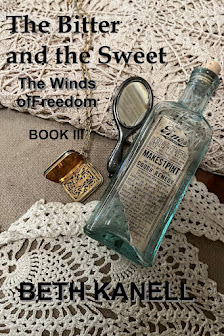


That's why book 3 in the Winds of Freedom series, THE BITTER AND THE SWEET, features would-be minister in training Almyra Alexander, whose Boston mother has passed away and whose politically active father is far too busy to raise a teenager (other than perhaps planning a marriage for her!). Readers met Almyra in book 2, when she was a pesky newcomer, dressed in city fashions and ignorant of rural ways, but already interested in the role she embraces in book 3: to become qualified to lead her own church. What about the push for abolition, a necessity for a moral person of her time -- will that get in the way of becoming a minister? And who ever heard of a woman leading a church??

I'm eager to learn what you think of Almyra's choices and adventures (including with a notorious counterfeiter) in THE BITTER AND THE SWEET. Please do let me know.

And when you've finished the book, tell me who you think the next young woman (teen!) is that I've chosen for the focus book 4. Think carefully, and remember the two-year jump involved. Can you guess the right one? I want to hear your thoughts, of course!

Monday, September 23, 2024

The Winds of Freedom: How Vermont's Northeast Kingdom Approached Abolition


In this presidential election season, I think it's been clear that the effects of the American Civil War continue to affect beliefs around the country. President Lincoln's long approach to the abolition of human enslavement in America gave us a fundamental piece of today's view of human citizenship in our nation. At the same time, the long delay in getting there, with some 250 or more years of enslavement behind that, contributes to an awareness that we are not always as "good" or principled as we ought to be. And now we have a nation divided on what goodness and principle mean.

In the 1990s, when I began writing my historic novels, I came face to face with prevailing myths in Vermont history that dismayed me. Many of them revolved around the Underground Railroad, one of the heroic efforts in America in the early to mid 1800s. What we know today, historically, is that the Underground Railroad in Vermont might as well have been called the Aboveground Railroad -- because in the theme noted now at Rokeby in North Ferrisburgh, Vermont, if you were Black and reached Vermont in the 1850s (or had lived here for many years already, like the Mero family of Coventry), you were "Free and Safe." No need for hiding places.

But many people couldn't process that idea when I talked about it. So, based on my personal connection with historic fiction, I opted to write about the 1850s here through the voices and experiences of local people, hoping that readers could internalize that experience and reshape their own vision of what happened.

That led to THE LONG SHADOW, book 1 in the Winds of Freedom series, set in North Upton (aka North Danville) in 1850, from the points of view of teenagers enmeshed in adventures there. At the moment, the printed version is out of stock, but you can get the ebook here. Also ask Kim at Green Mountain Books to watch for a gently used copy for you!

More about that story later this week ... and then about books 2 and 3.

If you'd like to hear how the abolitionists of St. Johnsbury, Vermont, and the surrounding towns saw their world in the 1850s and how they entered the movement toward abolition, here's my talk recorded at the St. Johnsbury Athenaeum. I hope you find some fascinating discoveries when you listen/watch it.


Thursday, August 8, 2024

Winds of Freedom Book 3 Is Coming This Autumn!


The Bitter and the Sweet, the third book in my Winds of Freedom series (after The Long Shadow and This Ardent Flame), should be in print by early November -- maybe sooner! -- from All Things That Matter Press. I know it's been a long wait (thanks to, you know, COVID). So I thought I'd give you a bit of a recap of what the young ladies of North Upton (in real life, North Danville) Vermont have been doing in the 1850s, as Vermont is seized by a passion for Abolition ... that is, the legal abolition of slavery in a nation that had profited in many ways from enslavement for two centuries.

But of course, for northern Vermont teenagers, that's not initially the focus of their attention!

Here's what went on in 1850 in The Long Shadow (can be ordered here or as an ebook here):

THE LONG SHADOW Synopsis


            ALICE SANBORN, age 15 in March of 1850, is the youngest member of her family and the only one not taking a stand on Abolition. In her Vermont village of North Upton, she and her best friends – JERUSHAH, whose family owns the tavern, and SARAH, a younger black girl who is waiting in Vermont for negotiations to free the rest of her family from slavery down South – are more interested in maple sugaring and the arrival of spring than in politics. Still, Alice sees enough to guess that her married brother WILLIAM is conspiring with messenger SOLOMON McBRIDE to protect fugitive slaves. 

            When a slave-hunter reaches the area, Alice’s father sends the three girls, driven by Solomon, to a nearby large town to stay briefly with the elegant MISS FARROW, herself a former slave.  But the slave-hunter spies on Solomon and follows them. The girls elude danger, as Alice starts their horse and carriage north. Solomon sends the slave-hunter on a false trail, catches up with the girls, and drives them farther, despite snow, bad roads, and a catamount.

            By the time the girls reach sanctuary with the HAYES family of Free Blacks near the Canadian border, Jerushah and Sarah are desperately ill. Solomon leaves on his own mission. Alice meets the challenges of helping Mrs. Hayes nurse her friends. CHARLES HAYES startles Alice by laying hands in prayer onto Sarah; he offers the same for Jerushah, but Alice declines on her behalf, unsure her friend would want this.

            Sarah recovers and is happy to stay with the Hayes household to await her own family. But Solomon visits and persuades Alice that Jerushah, still fretful and frail, needs to return to her own mother. Solomon, Alice, and Jerushah endure a storm, flooding, and wolves to drive home. Along the way, Alice learns about Solomon’s freedom-fighting work and considers becoming an active Abolitionist herself – a role that won’t fit her father’s view that the Union of states is more important than freeing slaves.

            The return proves disastrous: Jerushah suffers a relapse, and blame falls on Alice. Although Jerushah’s family won’t let Alice visit, there is an almost-forgotten tunnel that links Alice’s home to the tavern. With help from Jerushah’s brother MATTHEW, the two girls reconnect and begin to leave messages for each other. Alice is dismayed to realize that Jerushah’s friendship for her includes expectations of long-term affection and living together as “spinsters,” a situation Alice does not desire. At the same time, the girls’ brothers – William and Matthew – ask Alice to help in the risky transport of documents that Solomon needs for men escaping slavery and headed to Vermont.

Alice learns to navigate the tunnel even in the dark. But Jerushah’s too fragile to do that, and when she tries to, she takes a terrible fall. Is it Alice’s fault again? All this guilt burdens Alice, and being part of Solomon’s righteous efforts can’t dispel the darkness.

  * * *         

 To learn how it all works out, of course, you need to read the book! (If I told you here, that would really be a spoiler, wouldn't it?)


Watch for news about The Bitter and the Sweet, coming soon!


Monday, February 12, 2018

Lincoln's Birthday ... and Thaddeus Stevens on My Mind


"President's Day" is still a week away, but today, February 12, is the date that is Abraham Lincoln's birthday. When I was growing up, schools celebrated it -- not as a day off, but as a day to pay attention.

Today in our era marked by harsh political conflict and skyrocketing awareness of the way America's centuries of enslavement have injured our people, it's a good day for learning more about our past and choosing ways to make the present and future better, I believe.

So I paused this morning to check what Abraham Lincoln was doing in 1850, the year when my "Winds of Freedom" series opens with the book The Long Shadow (publication date April 18, 2018). In that year, Lincoln was still practicing law in Springfield, Illinois, where he took on quite a few transportation cases. He also gained a patent of his own for a boating invention. He'd already served one term as a legislator, and opposed the land grab of the Mexican-American war; that war ended two years earlier, marking his first contribution to national affairs. He wouldn't speak out again until 1854.

But in 1850, an ardent freedom fighter from Vermont, transplanted to Pennsylvania, took a powerful stance in Congress to oppose slavery. That voice came from Thaddeus Stevens, and it echoes many others, especially the voices of America's Quakers, who pointed bluntly to the evil of humans being "owned" by others. "Chattel slavery," they spoke of -- "chattel" refers to personal property, and unlike, say, indentured servants, chattel slaves could be transferred by will or by bill of sale.

Yes, you'll find actions by Thaddeus Stevens influencing Vermont village life in The Long Shadow. Importantly, the choices taking place in this book are made by women who choose to take action -- protagonist Alice Sanborn, her best friend Jerusha, and their younger and very dear friend Sarah, with her dark skin and desperate longing for her family, still enslaved but with hope of purchasing their freedom. And Miss Ruth Farrow and the Mero family -- historically "real" Black Americans who lived in my part of Vermont in 1850.

Each of us has something to contribute to making the world a more just and valued place to live. For me, it's speaking of how things really were in 1850 -- here in the Green Mountains of Vermont, where reading the words of Thaddeus Stevens gave a fierce and upright example.

"This Is the Real Thing": THRESHOLDS, an Exploration of Transitions

My new book of poems. Available in bookshops and online. My buddy B and I shared a long lunch at a community restaurant today, and wrapped i...