Showing posts with label writing. Show all posts

Wednesday, February 7, 2024

More Than One Road to Get There


I've been writing "segments" of my life, most of them taking place in northeastern Vermont, for more than three years now on the platform Medium.com. A gap in my usual copyediting labors in January gave me "bandwidth" to begin a second set of strands there, on Code Like A Girl. It probes how I've related to and worked from my STEM background -- I'm a chemist by training, as well as a writer.

What I'm discovering as I lay out this second pathway through my life is that "telling the story" from any chosen direction is very different. It's like taking the interstate from one end of Vermont to the other, or relaxing on old Route 5, or (most time-consuming of course) taking detours when they appeal. Obviously, the journey takes different amounts of time. But it also seems to glow in different colors, maybe different wavelengths. 

I'm enjoying discovering that the telling of a life is a rainbow of words. Or, on my best days, fireworks.


Friday, January 12, 2024

"Ekphrastic Challenge" and the Moon Shot

Dave and I went to Littleton in January 2016 to hear Chris Christie in person—Dave's way of listening and inquiring.

The literary journal Rattle offers a monthly "ekphrastic" challenge, where poets write from what the presented artwork suggests. The challenge was on my to-do list today. I shocked myself by writing a political campaign poem, nothing I'd ever considered doing.

But the roots of this action were clear: Earlier today, to provide support for a very ill teen, I looked up some of the memorable quotes from John F. Kennedy, whose years as US President marked my life. Well, I was young and naive! It hurt, years later, to learn some of his flaws, see the shadowy nature of his "feet of clay." 

Yet many of his words (yes, co-written by Ted Sorenson) still inspire me:


So here's a relevant (and now "vintage") postcard image, showing how JFK's moon program continued, after his assassination:


Wednesday, December 20, 2023

Combining Vermont, Love, Loss, and Literary -- It's Been a Big Poetry Month

My short haircut from Dec. 2017, when I didn't know whether breast cancer surgery and treatment might make it too hard to wash and brush my longer (and increasingly silvered) curls.


As a person with decades in recovery from alcohol abuse (it's a long time ago now, but I have no intention of picking up a "first drink" even though time has passed), I'm especially impressed with the online literary magazine Anti-Heroin Chic. It's an "anti-drug addiction safe space" where writers can express pain ... and of course, relief. So I'm touched and honored that the winter issue features two of my poems: "From Nails to Screws" reflects part of the journey I've made to set aside my Dad's well-meant but very dangerous instructions for life as a woman. And "In the Very Air" brings you first to Harvey's Lake in Barnet, Vermont, where I finished raising my sons, and then to my front porch "now" -- the place where I can see both the land's beauty and the tragedy of climate change. 

Here's the link to those two poems.

Another online magazine that's become a favorite of mine is Persimmon Tree, which offers space especially to older women writers. You can find my poem "Breast Cancer, 5 Years After," which is pretty fierce -- click here and scroll down quite a ways, browsing other intriguing work along the way.

The winter issue of Persimmon Tree also includes a "likes/dislikes" list of mine, in the fashion launched by Susan Sontag. Because there are a lot of those, they are being rotated day by day, so if you don't see my list when you first click here, take a look at some other time. Or, if you don't have time to visit twice ... here you go, without the attractive graphics of the magazine:

Things I like: hard rain on the roof, new snow, bonfires, fresh cinnamon, pillowcases, signed books, watercolors, chipmunks, Star Wars music, double rainbows, nickels, dark chocolate, globes, rowboats, comb honey, toast.
 
Things I dislike: an empty mailbox, stale mushrooms, herbicides, crumbs in bed, pigs, cheap cheesecake, splinters, garlic before breakfast, collapsed barns, diesel fumes, hammers, nylon petticoats, socks that slide down, malice.
 
**
 
This month also includes publication of "Crossing Over the Moose," as an honorable mention by Raw Earth Ink and therefore included in The 2023 Northwind Treasury, an anthology coming from Alaska. I'll post a photo when my copy arrives!
 
I've also settled into writing about one segment per week for my "story of my life" (aka memoir), on the platform Medium. You should be able to see a few of these chapters when you first visit; after a bit, Medium will ask you to subscribe to the platform. That will give you access to thousands of authors, and you'll recognize many of their names right away -- as well as getting acquainted with rising stars of the literary world.
 
Now I've got to get back to some holiday baking. May your browsing give you a break from your own stresses, and maybe some hope and pleasure as you go. 


Saturday, November 11, 2023

Digging Into Veterans Day, Poetry Included

Yesterday I spent an important hour with a "poet of war," encouraging more writing, trying to hold some doors open. I hadn't thought of this person with such a category until I got there and began to listen (in person), and then it seemed so clear that I was surprised I hadn't found the term before.

Of course there are many who've written from their war experiences. The one that brought me reality (instead of lines of warnings and mourning) was Brian Turner. Here's the cover of his first collection. He's released three new books this year, all very different from where he'd started, with a richness of music to them. I hope you'll drop in and visit his website.


A bit of one of his poems: "A murder of crows looks on in silence / from the eucalyptus trees above / as we stand over the bodies."  Or from another, where a woman at a distance is hanging laundry: "She is dressing the dead, clothing them / as they wait in silence, the pigeons circling / as fumestacks billow a noxious black smoke. / She is welcoming them back to the dry earth, / giving them dresses in tangerine and teal, / woven cotton shirts died blue."

And thinking of those two together -- one local, not-yet-very-published poet, and the nationally and even globally recognized author -- led me to writing my own poem for the moment. There is indeed very gray and cold weather in northeastern Vermont today, with winter (its trials and delights) marching toward us, unstoppable, unbearable at times unless you hold onto love.

Thoughts on Another Veterans Day


This is the same wind-tossed gray sky that held in place

at childhood Easter mornings—resurrection arrives small,

one crocus at a time, one purple pod of potential

determined to unfold in any scraps of sun.


Now I hesitate on the other side of the year

aware that every small snowfall, every frigid silent night

warns of what’s ahead: Those in shabby housing press

plastic over the windows and grieve the cost of oil.


In town, the courthouse flag flaps wildly. Solemn words,

uniforms, a prayer. At the entrance to the grocery store

an old friend sits at a modest table, resting his knees

while reaching out with red paper poppies. Take one.


Veterans I have known: An angry man whose letters to

the editor poked like porcupine quills from his raw scraped

skin. A doctor who scrubs her hands too much. Young relative,

prospering, riding between wild lands and profit.


My father, who taught us Navy knots. Mom’s father,

arranging his kitchen  for baking bread, typing out

the detailed recipes, mailing them across the ocean.

“Z,” moving up the ranks, her friends lifting a glass.


The closer they are, the more personal their survival.

But understanding? For that, I lean on words, which means

that man in the middle distance (who hid his poetry notebook

when leading into battle), pulling me beyond


the cost of winter. His reality: first a pause to smile

at children in a desert land; to admire a woman at a well;

to press the love he’d hand-nourished, into another man’s

wounds; strike with a fist his own heart, for the sake of


honesty. Which is not at all like a textbook, after all.

Because it bleeds, forms a scar, resists hard rain.


-- BK


Friday, August 11, 2023

The Writer, the Page, the Reader: A Magical Triangle


If you were a shy kid in elementary school, you will see entirely different things in a poem than your neighbor will, who arrived in first grade with friends from the neighborhood.

If the first time you made love was with the person you married, romance as a thread in the mystery you're reading may feel familiar and make you chuckle; when you've just concluded an acrimonious divorce, you might skip over those pages.

That's why I think of a piece of writing as one point on a triangle; the other two are who I am, and who you are. Good writing leaves room for the triangle to spin in different directions, expand, make a fresh angle, and rise into a second dimension. Yet the triangle, the bond between story and reader, must remain resilient and still touch all three anchors.

On August 12 at 5 pm (Eastern time), I'll bare my reviewer "chops" on Medium.com and offer a tips session for writers of haiku to short story to novel -- even applicable to nonfiction feature articles. There'll be some time for questions and answers, maybe even controversy.

Please do stop in and check it out! Scan the offerings for Medium Day and register here.

Meanwhile, a couple of sites with intriguing material on "endings":

https://www.masterclass.com/articles/how-to-write-the-perfect-ending-for-your-novel

https://www.emwelsh.com/blog/find-best-ending-story

https://scribemedia.com/write-book-conclusion/

Make A Promise In Your First Chapter: How-To Tips And Q&A For The Writing Life

Whether you’re writing a segment about your life, insight into history, a feature article, a novel, or a poem (yes, even haiku!), you’re laying out a path, an adventure, for your reader. There’s a reason for every ending: It seals the promise you make in your first line or paragraph or chapter. Then satisfaction makes your reader say, “Ah, that was good!” This seasoned author and reviewer shows how crafting your opening builds a promise to a reader. Discover the power of a beginning and ending that fit together (even when they have to fit head to toe). Gain a strategy for writing stronger and more memorable work. You’ll shape your writing with fresh insight from this chat.

Tag:Writing
Beth Kanell Writing That Braids Loss, Joy, Love

Wednesday, July 26, 2023

Summer Books, and Summer Writing -- and Sweating


Summer in Vermont is glorious, and this year it's also scary -- that steady drumbeat of climate collapse becoming part of the pulse of my body and mind. The torrential rains with floods tore apart roads, homes, businesses. And, because "this is Vermont," they also bound many of us more closely in compassion and determination. When you face Winter together (the capital W is intentional), you value the arrival of others who can tow you out of a snow-filled ditch. So when you look at what remains after flooding, with the structures already starting to grow mold and the smothered fields stinking of decomposition, you add Summer to what we need to handle together somehow.

I've been mowing and planting, "grocking" my way to gardens that will eventually thrive without much attention and bring my rehabbed land, which was scraped bare just two years ago, to something loved and lovely. Writing comes slowly for me in the heat, but I wrapped up two trios of polished work and am constructing something about bears. Yes, the ones we live with. 

In the next couple of weeks I'll post reviews of a new birding mystery from Donna Andrews, and a strange direction for Alexander McCall Smith. Yesterday my review for a new trade edition of a James Patterson thriller posted at the New York Journal of Books:


The Perfect Assassin: A Doc Savage Thriller
by James Patterson and Brian Sitts -- review by Beth Kanell


“The perfect start to a pulp-fiction series brought into the 21st century.”


Pretend you don’t know who Doc Savage is or was, and you’ve opened The Perfect Assassin for its promise of being a James Patterson thriller. You’re ready for espionage, battle, comparison of weapons, intrigue.


Instead, Pattison, with Brian Sitts, offers a double narrative: The first involves a baby kidnapped 30 years earlier in eastern Russia, confined within a brutal boarding school that removes human affection and demands total attention to mastering skills, both in the classroom and in deadly physical situations like swimming in mid winter under ice on a lake. The second begins as a perverse echo of that: A harsh and powerful woman in Chicago kidnaps a wimpy anthropology professor, Dr. Brandt Savage, and cages him in a see-through cube, forcing him daily to complete agonizing physical training, eat only the disgusting nutritional smoothies she issues to him, and be punished with a shock to his bottom whenever he doesn’t do what she tells him.


Just before the story disintegrates into some strange BDM session, the narrative abruptly widens and the connection between the kidnapped baby and the dominating trainer named Meed becomes clear. When “Doc” Savage finally dares to ask why he’s been detached from his own life and is being rapidly remade, the answer makes no sense: He’s there to save the life of—this trainer? No way.


But he’s stopped resisting her demands, and even at strategy he’s more than catching up with Meed, as an intense game of three-dimensional chess reveals:


“’Check,’ I said. … ‘Nicely done, Doctor,. she said. I could see that she was annoyed—but also impressed. Part of her liked that I beat her. I could tell. So I decided to push my luck. … I slid out the throwing knife that she had hidden there. Before she could react, I held the knife up and whipped it at the man-shaped target across the room … Kill shot. My first. I could tell that Meed liked that even better.”


When the strengths and capacities of Savage’s remade body show up as irrational and, let’s say, far above human capacity, the penny may drop (as they used to say), if you’re a fan of the original Doc Savage from the pulp magazines. Or, of course, if you’ve stopped to look him up.


Like another series Patterson is masterminding featuring “The Shadow,” a long-ago radio show hero battling the forces of darkness, this one takes a notable heroic character from American life in the 1930s and redevelops him for today’s readers. How would you change your body in order to display a six-pack of muscles? What could modern science do to remake your senses of vision and hearing? How much could you learn in your sleep, if forced to?


At its midpoint, The Perfect Assassin switches direction and mood, from this mingling of attraction and torment, into a mission focus. The thriller mode that Patterson’s developed takes over, with attacks, angles, weapons, and more. Brace for deadly peril, of course, and devotion to crimefighting, as well as chase scenes, explosions, and espionage.


But there is also an underlying mission focus to the story, as well as links in the deep past that explain why Doc Savage and his tormentor/savior “Meed” must connect, and then must align themselves with a near-impossible challenge. It’s one that seems likely to require many more books of adventure and thrills—the perfect start to a pulp-fiction series brought into the 21st century.

* *

Later today I'll remove the latest set of delights from the flower press. Here's a portrait of my mother. Mixed media, mixed feelings -- check out the chapters as they accumulate on Medium. There will be a new one later today, I'm pretty sure. If the heat doesn't flatten me first.


Friday, June 9, 2023

Book Recommendations: A New Review Feature on This Author Blog

Grieving under the wildfire smoke.


This 'n that, first: As usual, I'm working on four writing projects at once. One's a mystery novel that's gone through a couple of major revisions -- since the focal point of the crime had to change entirely, when Vermont laws changed. I'm looking for a publisher for book 3 in my Winds of Freedom series; the one who'd eagerly said "yes please" discontinued its Frontier Fiction line as the pandemic wrapped up. I've always got poems underway and am taking a course in ekphrasis, poems that respond to or interact with visual art. Wild! And in that magical moment just before sleep recently, I saw a way to entirely rewrite Queen of the Kingdom (a Northeast Kingdom contemporary novel) that I think I've got to indulge, for the fun of it.

That's the "output." I need good "input" to do all this -- some comes from daily walks, some from friendships, some from sorting the past in my ongoing memoir on Medium.

But for me, the biggest and best influences are conversations about books, and reading good ones. Here are some I'm recommending:

Tom Piazza, The Auburn Conference. A young college professor in 1883, Frederick Olstead Matthews, is desperate to make his mark and impress the college (and wider public). So he invites a handful of prestigious authors to come talk about The Future of America. Do you expect Mark Twain to get along with Frederick Douglass? Walt Whitman to treat well Harriet Beecher Stowe? What about Herman Melville's personal despair ... and what may happen when a local and equally eager journalist decides to spark things up by personally inviting a group of suffragettes, or when Twain turns mischief maker? At just under 200 pages, this short lively novel turns out to be a perfect frame for merriment, grief, and a timely look at American Dreams. University of Iowa Press (bless their heart).

Nilima Rao, Disappearance in Fiji. No sign here of being a debut novel -- Rao, a Fijian Indian Australian author, spins a deft tale of a religious Sikh whose police career has self-destructed, landing him in a racist work environment on the island of Fiji in 1914, as the world heats up for major war. Akai Singh holds human values and justice dear, which takes him digging more deeply than desired into the case of a disappearance: searching for a vanished immigrant worker, a mother from India, practically enslaved on a plantation where Akai's investigation is totally not wanted. Timely in its framing of the evils of colonialism, the book offers both a tidily told mystery and multiple cultural perspectives. From Soho Press under the ambitious and global Soho Crime imprint.

Rebecca McKanna, Don't Forget the Girl. What have true crime TV shows and books done to us? Hardened us about victims, fed a fascination with killers? McKanna's thriller poses one nasty situation after another. I hated reading it, because every chapter made me more miserable, but ... it sure gave me a lot to think about. If you're a true crime junkie, grab a copy. Sourcebook Landmarks.

I'm also re-reading A God in the House: Poets Talk About Faith, a set of interviews with poets about their religious backgrounds, discoveries, and passions. Ukrainian-American Jewish poet Ilya Kaminsky (find his poems elsewhere, online and in his books) and New Hampshire novelist Katherine Towler asked hard questions, and persuaded Carolyn Forché, Gerald Stern, Kazim Ali, Jean Hirshfield, Jean Valentine, and other heroes of modern narrative and lyric poetry to answer from personal experience and heartache -- and joy. I keep adding more bookmarks to my copy, for provocative assertions that I want to consider further. The book came out in 2012 from Tupelo Press; I should schedule another re-read for myself every couple of years. SO worth it.


Tuesday, July 12, 2022

Writing to Save the World: A Project With My Grandsons

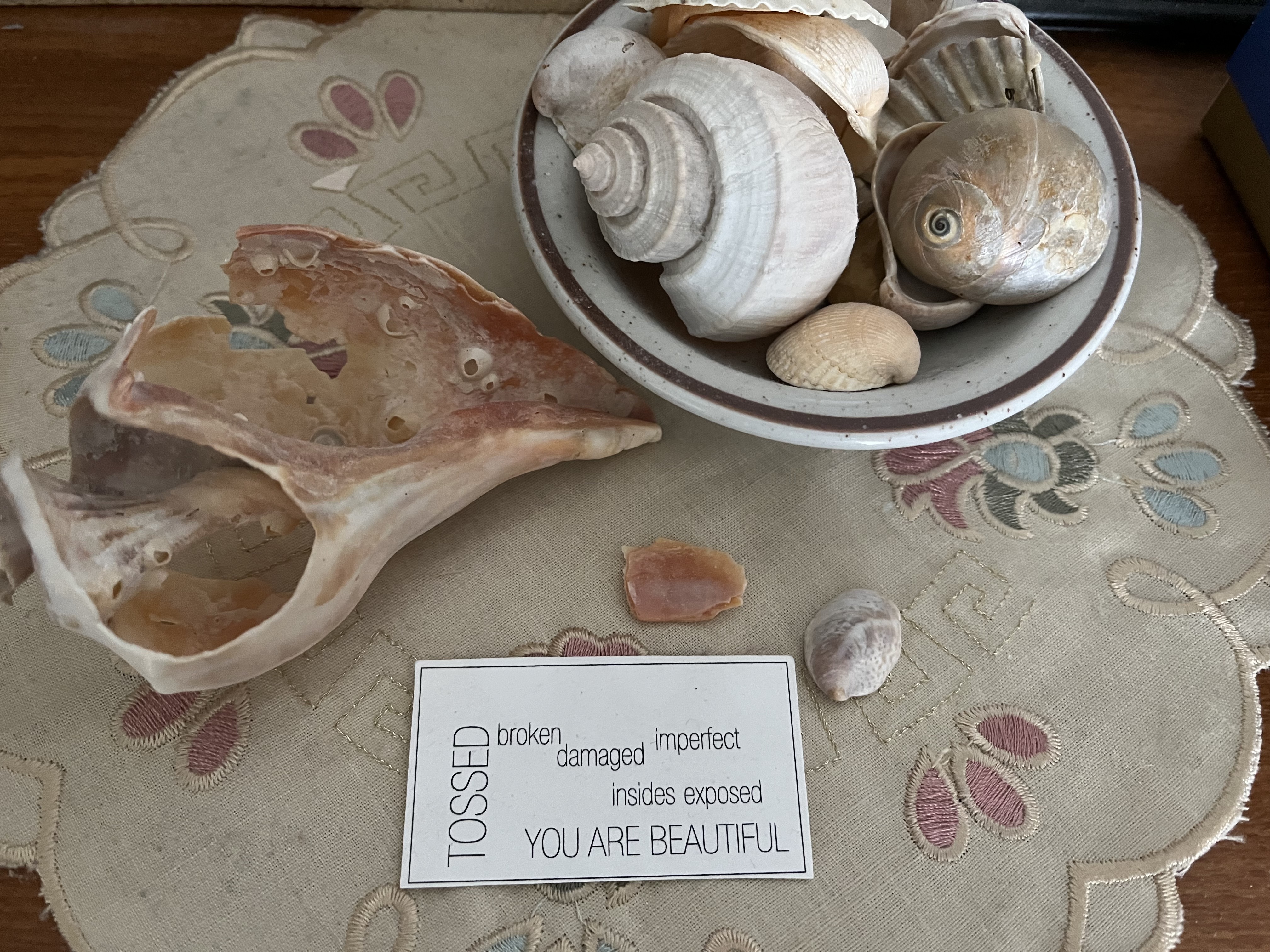
Broken shell (at left) and label from my blessedly optimistic sister-in-law Cheryl.

My grandsons' mother is doing a great job getting her sons educated, and each youngster is moving to a new school in the fall. This careful parent is already thinking about college as the long-term goal for her sons, and she's brought me into the process this summer because she wants them to write more often and with more attentiveness.

They travel in summer, which raises the challenges -- but of course, thanks to the pandemic, we have all learned to cope with that sort of distance. So the boys and I are writing something each week on a topic that I propose (although I'm open to them raising a topic; for now, they prefer that Grandma does this).

This week, I offered the website https://www.oceanoptimism.org, which I learned about through an On Being podcast. I thought it provided a good change from the doom and disaster we've all been discussing -- and the boys did, too. Each one wrote a really good piece on why we can harbor optimism about cleaning up our oceans. Each also indicated some level of personal commitment. They "get" why we are all trying to reduce our use of plastics, for instance, and they are "on it."

The same day I offered that challenge, I also received an email from Seth Godin that included promotion for his Carbon Almanac -- subtitled "It's Not Too Late." I think that's what we-who-want-to-save-the-planet need to internalize: Our choices matter, need to take place now, and are effective.

Here's the piece I wrote with the boys. I'd proudly share what the grandsons wrote, but ... that's THEIR writing, and they'll find their own way to share it. (That will have to be a topic for the end of the summer.)

Hope this gives you a boost today.

When I first heard about the #OceanOptimism tag and website, I felt skeptical. Ocean pollution seems so out of control! And every time I purchase a piece of fish to eat, the price reminds me that there is a crisis in ocean fish, as desperate as the crisis of America's western lands burning (not to mention the fires in Italy). With such a global sense of catastrophe, does optimism make any sense at all? Then I looked at the "tweets" that are tagged with #OceanOptimism, and other things came to mind. For example, one of the featured items right now quotes a scientist who is successfully bringing about change. She reminds us: "Take advantage of the unexpected. Trust your intuition. Learn to tell your story. Don't neglect the positive." None of those are spoken often by the people around me, but they reflect the best moments of my life, the times when I've felt that I enabled good results among people and organizations. They remind me also of the work of business guru Seth Godin (I learned about his work from my son Kiril), whose new Carbon Almanac is subtitled "It's Not Too Late." I learned from his writing, and from some examples around me, that people are capable of enormous amounts—if you help them to focus on their strengths and celebrate their achievements. Go positive ... go with optimism. Let's help our oceans recover.


-- With love from Grandma

Sunday, August 2, 2020

Finding Prime Resources for Historical Fiction/Mysteries

Some of the best historical resources seem to arrive here by chance: a letter postmarked nearby in the 1800s (I have three from the postmaster of West Waterford to his son, located at a postcard show), a local inventor's identity (the "improved egg case" opened up research into Edward Everett Bishop of Waterford, Vermont), or a photo album that suddenly surfaces as a gift to a local group (thank you, Jamie Ide, on behalf of the Waterford VT Historical Society!).


Last Tuesday evening, that Muse of Historical Research -- to the Greeks, that would be Clio -- tapped my shoulder during a virtual panel of mystery authors "at" the Tewksbury (Massachusetts) Public Library. Tewksbury is one town east of Lowell, the marvelous center of fabric mill invention that anchored the Northern profits from Southern enslavement. As of 1840, there were 32 mills in the city. Readers of Katherine Paterson's historical fiction may have pictured the lives that the "mill girls" led there (see Lyddie); those who've pursued history tourism in New England may have visited the remarkable National Park that now embraces some of the remaining mill structures and stewards their history. American freedoms, gender roles, Labor as a force in politics, all these and more can be embraced in the history in Lowell.

But I hadn't known about Tewksbury. One of the people attending the author panel mentioned "the old library" and the librarian moderating the panel sent me a link to some photos that reminded me of the libraries I haunted in the 1950s and 1960s.
The "old" Tewksbury Public Library.

Then, of course, I began to explore what this urban library offers in the way of historical collections, and here's what I found in the town public history collection there:

Tewksbury History Topics

  • Anne Sullivan and the Tewksbury Hospital
  • Captain John Trull (Tewksbury Minuteman)
  • King Philip's War
  • Lowell Mill Girls and Women
  • Merrimack River
  • Mico Kaufman (local sculptor)
  • Tewkesbury, England (Town namesake)
  • Town Anniversaries (including 200th Anniversary Time Capsule)
  • Tewksbury State Hospital (State Almshouse)

Link to online historical patient registers
Visit the Public Health Museum at Tewksbury Hospital

  • Town of Tewksbury Annual Reports (1878 - present)
  •  Wamesit Indians
Any one of these could slip into the books I'm writing, set in Vermont in the 1850s and 1860s, when Vermonters still saw Massachusetts as the place where the War of Independence began, rather than a traffic nightmare or a set of distant museums and restaurants. I also discovered that Tewksbury was struck by a devastating tornado in 1857 -- something that may go directly into Book 4 of my Winds of Freedom series.

Most of all, I get the sense that Clio the Muse is always ready to alert me to "something old, something new" to learn. You know, I used to feel a little guilty that I took the writing path, instead of going boldly abroad for adventures. But it occurs to me now -- every time I find another prime resource like the Tewksbury Public Library, I'm having an awesome adventure. Just wait and see what comes up in the next couple of novels I've got rolling! (Don't you love being able to share the adventure, too?)

Monday, July 27, 2020

Writing for Readers: The Big Story, the Essential Connections

On Tuesday July 28 ("tomorrow" as I write this), in the evening, I'm joining other authors for a virtual panel discussion at the Tewskbury, Massachusetts, Public Library. The title of the event is "How To Publicize Your Book."

Why?

Readers (and new writers) often think publishers take care of getting the word out about good books. After all, the words seem tied together: publisher, public, publicity.

But the "new world" of book publishing began at least a decade before the pandemic turned things upside down. Letting readers know about a book and its exciting revelations is now, for most authors, part of the writer's responsibility. True!

Let's face it. Promotion isn't usually what a writer has polished and practiced. For me, writing a great story, with details that intrigue readers about American history (especially the Vermont version) and celebrate the growth of the protagonists -- mine always tackle some injustice -- is where the effort has to be invested. Write a good story!!

So promoting that story, once it's in print, needs to be direct and effective. For me, that means starting where my heart is: at "home," whether that's geographic, or in the circles of friends on social media, or among other writers as we connect with each other.

You'll hear about my new research and writing projects here first: on the blog, and on my Facebook writing page, and even on my personal Facebook page.

And the closer we get to publication on a project (This Ardent Flame is scheduled for June 2021, even though I turned in the writing in February 2019 ... there's a pandemic affecting everyone, right?), the more I ride those circles of connection outward.

With that in mind, here are some tips for writers, and for readers who love to promote a good story (I'm hoping you'll include the first title of the Winds of Freedom series, The Long Shadow, which came out in 2018 -- have you read it yet?).
1. Keep your friends informed and engaged. Reveal surprises in research; share a bit of a struggle about how to shape a character; describe milestones in writing and publication of your work.

2. Ask friends to pass along word when they enjoy something. Your circles overlap other circles. Let them spread.

3. Celebrate and rejoice. We all need support and cheering up, whether in a pandemic or not — name the reasons for joy and satisfaction in your writing life and share them, with virtual balloons, so to speak!

4. Value your circles. Sure, time may be tight (you want to start writing the next scene), but if you're checking your own social media posts, make sure to check those of friends also, even if what you can give is five minutes of adding "likes" and smiley faces and "Wow!"

5. Remember the world is connected in ways that astonish and refresh. Introvert type happy to be at the desk solo? You can still take a couple of steps toward the "windows" and nurture the connections around you. This is how we make it a better world. And for me, it's part of how I keep "growing" my soul, so that the next book I write is even better than the one before.
Takeaway: Promoting your work in the best ways can make you a stronger, more responsive and resilient writer. Which makes it worth the effort.

Saturday, July 4, 2020

The Fourth of July in America's Past—and Today

Daniel Webster in 1835, portrait by Francis Alexander, courtesy of the National Portrait Gallery.
An 18-year-old country boy studying at Dartmouth College in 1800 was asked to give a speech at the Hanover, New Hampshire, Independence Day ceremonies. His words and his passionate delivery rocked the crowd, and the speech began his national career of service to the nation and summoning vivid language and performance, to in turn call people to action. Here is a bit of Daniel Webster's first public speech:
It becomes us, on whom the defence of our country will ere long devolve, this day, most seriously to reflect on the duties incumbent upon us. Our ancestors bravely snatched expiring liberty from the grasp of Britain, whose touch is poison... Shall we, their descendants, now basely disgrace our lineage, and pusillanimously disclaim the legacy bequeathed to us? Shall we pronounce the sad valediction to freedom, and immolate liberty on the altars our fathers have raised to her?
My second book in the Winds of Freedom series, This Ardent Flame, reveals how Vermonters took on this challenge after Webster betrayed their abolitionist goals, in forging the Compromise of 1850. It's fair to say that his legal maneuvering that year cost America dearly, in delaying the end of chattel slavery in the nation.

But the impact of giving speeches on the Fourth of July has been embraced by many another American leader. I reflect today on Abraham Lincoln's proclamation of war on behalf of the Union of American states -- which he gave on April 16, 1861, after Fort Sumter was seized by the Confederacy forces. Knowing the strands among the states were ever fragile, Lincoln deliberately called Congress to gather on July 4 to endorse his action.

In hindsight, it can feel like an intolerable delay, from April 16 to July 4. But Lincoln, portrayed by historian Doris Kearns Goodwin as a master in politics (giving, giving, and giving, until he'd call all to gather and get a task done), calculated that the patriotism of the Fourth of July would move the fragmented Congress to stand together. And he was exactly right.

The Ardent Flame was scheduled for autumn publication this year, but the COVID-19 pandemic has delayed the release until June 2021. Even so, I'm already grappling with book 3, Kindred Hearts, set in 1856 in "North Upton" (a pen name for North Danville, Vermont). In every page, in every shift of plot and character, is my own awareness that the nation was a mere five years from the war that would devastate it, far beyond any initial guesses. And I am walking with my protagonists, especially the teenagers, as they wake up to the cost of having deferred the abolition of slavery.

We, like they, are challenged to take action to address the damage done. It's a good thing to ponder on this 246th anniversary of the Declaration of Independence. May God bless our efforts to unite this land and people in liberty and justice for all.
This portrait by Joseph Alexander Ames, believed to also be of Webster, hangs a mere 6 miles from my writing desk, at the St. Johnsbury Athenaeum.

Thursday, June 25, 2020

When Is Your Writing a Calling?

“It is not light that we need, but fire; it is not the gentle shower, but thunder. We need the storm, the whirlwind, and the earthquake.” 
― Frederick Douglass

Sometimes lately, I'm just bowled over by all the things I'm being offered within this pandemic.

It's actually a bit off target to say that writers get a gift of solitude from the lockdowns, isolation, and masking. Most of us need a rhythm of writing time (usually private but not always ... I've written some good things while trying not to hear the "kids" of whatever age) and interconnecting. The surprises and frictions of human contact help move the pieces of thought and emotion around, to the point where "we have to write about something."

But wrestling with meditation, deliberate choices, and targeted insight have been my "sports" lately. I've learned how my family of origin shaped and shapes my fiction and poems, in ways I hadn't realized before. I've gone back in time way farther than the catastrophic house fire that I usually see as the trauma marker for my novels. A memoir's been slowly taking shape, one often-painful realization at a time, as I confront how I've threaded the loom of my woven life.

The isolation of the coronavirus pandemic has also taken me to lectures via Zoom that I wouldn't otherwise have attended (too far to go, too long in the car, too costly) and to discussions I might back out of in person. It's thrown me face to face with my reluctance to take political action, and challenged me to find ways I can act effectively from my desk. It's shown me how frivolous a lot of my expenditures of the past have been -- fun maybe, but now it's time for a serious stage, testing whether each concern relates to a First World Problem (many do) and laughing more often about those.

There are some things I know I'm "called" to write. Let's not try to name the Caller. Let's pay attention instead to writing as the next right action. There is a form of worship and music named call-and-response. That's what I'm hearing, and singing, and if my throat gets a bit scratchy now and then, there's always a spoonful of honey waiting. And a glass of iced tea with mint.

Because when it's a calling, my only answer is yes.

What about for your writing life? How are you uplifting the world -- and how is it cradling you today?

Friday, August 16, 2019

Discussion Questions for THE LONG SHADOW

Even as teenager Alice Sanborn begins to question the boundaries of life in her Vermont village of North Upton, her boldest actions come from taking seriously the "rules of life" she's grown up with: education, friendship, moral imperatives like correcting evil, and of course working together to make life reasonably comfortable through four seasons. Vermont winter is a force to reckon with! Consider Alice's experience as she rides up Sheffield Heights in a March blizzard:

As the sleigh tilted sideways, I found my wits and scrambled out of my side of it, struggling to pull downward and keep it from completely capsizing. Sarah and Jerushah clung to the back of it, crying out.
            So much noise and commotion—perhaps it helped to keep the invisible animal in front of us from coming closer. Its growl rose in volume, however, and the horse reared onto its hind legs. Solomon still clung to the bridle. I grabbed Sarah and pulled her free from the sleigh, and Jerushah scrambled out, just before it capsized fully into the snowbank at the left side of the road. The horse managed to come down in a half turn, dragging the capsized sleigh back the way we’d come. Solomon yelled and swore. One of his legs, caught in the leather straps of the reins and harness, jerked him so hard that he let go of the horse’s head at last and fell, yelping with pain as his shoulders struck the roadway.
            But I had eyes only for what stood revealed in front of us, a dead lamb dangling from its jaws, and the crescendo of its growl rising into a high-pitched threat: wild-eyed face suddenly visible in a gap in the snowfall, legs tensed to leap, body easily three feet long and muscular, and the long tail slashing back and forth behind it. A catamount. The fierce and powerful beast of the mountains stared at the three of us as we clung to each other, unable to think beyond the screams that erupted from all of us at once.
Here are some issues to consider after reading the book:
  1. Would you want Alice for a friend yourself? Why or why not?
  2. How different are the roles of teen boys and girls in the 1850s? In what ways does Alice fit the expectations -- and how does she push back against them?
  3. The "Underground Railroad" is an exciting part of American history -- but it doesn't fit well into Alice's experience in Vermont. Name three things that show why Vermont in the 1850s had an "aboveground railroad" for dark-skinned people traveling north.
  4. Readers often groan at the amount of work Alice does, just to get through an ordinary day. Which tasks surprised you? How has daily life changed so that you are not doing those tasks?
  5. Alice, like her neighbors in the village, sees slave-holding as a sin against man and God. A decade after THE LONG SHADOW, a "war between brothers" will split America around this issue. Problems that remain in today's America would be, for Alice, part of the "wages of sin." Do you agree? Give examples of some of these problems.
Curious about a detail or can't decide about an issue? This Vermont author makes book-group visits, in person, via email, and via Skype or FaceTime. Get in touch!

Monday, February 12, 2018

Lincoln's Birthday ... and Thaddeus Stevens on My Mind


"President's Day" is still a week away, but today, February 12, is the date that is Abraham Lincoln's birthday. When I was growing up, schools celebrated it -- not as a day off, but as a day to pay attention.

Today in our era marked by harsh political conflict and skyrocketing awareness of the way America's centuries of enslavement have injured our people, it's a good day for learning more about our past and choosing ways to make the present and future better, I believe.

So I paused this morning to check what Abraham Lincoln was doing in 1850, the year when my "Winds of Freedom" series opens with the book The Long Shadow (publication date April 18, 2018). In that year, Lincoln was still practicing law in Springfield, Illinois, where he took on quite a few transportation cases. He also gained a patent of his own for a boating invention. He'd already served one term as a legislator, and opposed the land grab of the Mexican-American war; that war ended two years earlier, marking his first contribution to national affairs. He wouldn't speak out again until 1854.

But in 1850, an ardent freedom fighter from Vermont, transplanted to Pennsylvania, took a powerful stance in Congress to oppose slavery. That voice came from Thaddeus Stevens, and it echoes many others, especially the voices of America's Quakers, who pointed bluntly to the evil of humans being "owned" by others. "Chattel slavery," they spoke of -- "chattel" refers to personal property, and unlike, say, indentured servants, chattel slaves could be transferred by will or by bill of sale.

Yes, you'll find actions by Thaddeus Stevens influencing Vermont village life in The Long Shadow. Importantly, the choices taking place in this book are made by women who choose to take action -- protagonist Alice Sanborn, her best friend Jerusha, and their younger and very dear friend Sarah, with her dark skin and desperate longing for her family, still enslaved but with hope of purchasing their freedom. And Miss Ruth Farrow and the Mero family -- historically "real" Black Americans who lived in my part of Vermont in 1850.

Each of us has something to contribute to making the world a more just and valued place to live. For me, it's speaking of how things really were in 1850 -- here in the Green Mountains of Vermont, where reading the words of Thaddeus Stevens gave a fierce and upright example.

Tuesday, January 16, 2018

The Weather Inside and Out (A Robert Frost Moment)


As I've listened to guests from around the world coming to explore "America," and especially New England, I've found Robert Frost's poems are among the ones they have most often memorized. People who live around here, in Vermont, also mention two of this California transplant's most significant poems: the one about good fences making good neighbors, and choosing which of two roads to follow (choosing the one less traveled by). In this season of frequent snowfalls and deep plunging temperatures, Frost fans also gravitate to the poem about the man who stops his horse while on errands, and wraps up by saying "I have promises to keep, and miles to go before I sleep."

I have three favorite Frost poems, and one matters a lot to me today: "Tree at My Window." You might be aware that it's a violation of copyright to post an entire poem by someone else (actually most people don't know this! I found out when I erred by posting one, blush). So I'll just give the final verse of this Frost poem here, which begins with the poet's persona talking with the tree just outside his window:
That day she put our heads together,
Fate had her imagination about her,
Your head so much concerned with outer,
Mine with inner, weather. 
Out on the mountainside today, the snow keeps taking different shades of white, oyster, light gray, even a very pale blue, as the clouds thin and thicken again in front of the well-hidden sun. A few snowflakes fall occasionally; steadier snow is expected this evening, when I'll be doing some errands of my own, so I'm paying attention to the forecast. It's a classic January day, but it's also a bit March-ish, that sense that the snow's been here a long time and isn't in any hurry to leave.

Interior weather: I've just let go of a manuscript that's lived in my heart (and on scraps of paper, in notebooks, and on the computer screen) for three years. It's both wonder-filled and terrifying to send it out into the world, where the staff of a publisher will look at it in very different ways from mine.

At these moments, I usually change the writing room, to find fresh vision and focus for the next effort. I have three books being built now: one just at the starting point, with the title "A Necessary Holiness"; another, poems of prayer and praise, perhaps half assembled; and the third, the set of stories I completed as 2017 raced to an end, where a good two days of rigorous revision should wrap up the project. But you know how life is ... setting aside those two important days will take planning.

So the room, especially the desk and walls, become part of the preparation. The photos here show what I've changed -- and where I'm going, I think.

All of this is especially necessary because I'm also stepping into the final 100 days before publication of my new adventure novel The Long Shadow and I'll be talking about that book often ... but the deep digging of the work-in-progress must continue. Wish me luck. No, on second thought, please wish me a well-crafted balance. And good weather.

Sunday, July 30, 2017

This Strange and Exquisite World

Red eft, courtesy of Vermont Fish and Wildlife.
It's good to have "city" company hanging around -- someone who is as astounded by the greenery and the explosions of blossoms as I was when I began garden-tending in Vermont. These many years later, I am still daily astounded, but in different ways: I see things with fresh eyes on the best days, honoring that joy that seems to link our eyes, breath, mind, and soul together. But I also look harder, with questions.

In the past week or two I've indulged in evening walks. They are by definition very different from morning ones: The light is fading instead of brightening, the breeze quiets to a whisper, stars begin to show up in the darker segments of the sky. This week there's the arc of a waxing (growing) moon, too; when it's full, we'll start the countdown of another month left before we have to watch for early frosts. But not yet.

Still, the evenings can be chilly here on the mountain ridge. I saw a skunk hump across the road two nights ago, fur fluffed up for warmth. It crossed where I saw the porcupine last week. With this year's questions and hypotheses, I make a guess that the marshy area that lies on both sides of this stretch of road is more than a deer path (I've seen their tracks, no need to guess that part), is also -- maybe because its vegetation is low and soft -- a path for other mammals.

The chill of the evening caused one "crossing creature" to be stranded on the cold road a few evenings ago. Its bright red skin and delicate limbs fascinated me. Definitely a red eft, the juvenile stage of the Eastern spotted newt. Without enough air or land warmth, and without the ability to make its own, the creature stood still, about a quarter of the way across the road. Car alert! Hazardous crossing!

Well, of course talking to it wasn't any use. I tenderly lifted it onto my palm -- the warmth turned the eft into a lively squirming tangle of legs and tail almost immediately, and I had to hurry across the road to release it before my fingers -- so much larger than its limbs! -- would damage it. It immediately hurried into the greenery, vanishing at once. Then I finished my walk, happy to have seen something that so rarely crossed paths with me.

This week I also read the novel BORNE by Jeff VanderMeer. It's a dystopian novel, set on a world or part of a world where an inventive "Company" has destroyed natural life and seeded the terrain with "biotechs" that can be very threatening and smart. The protagonist, Rachel, sets a new pattern in motion when she gives maternal attention to a bit of tech-made flesh that she takes home -- something that was clinging to the fur of a monster, and which becomes her pet, or her child ... she has "borne" it, and names it "Borne."

The powerful thread that ties the characters and their perils together in BORNE is a question: What is a person? If you love some creature, and it loves you in return, does it have personhood?

(I hasten to say the book does not appear to be indicating anything about the age of personhood for a human fetus or baby.)

Rachel, her friend Wick, and Borne become the testers of their world, determining whether compassionate survival is possible. I like the book; I'd recommend it to anyone curious and questioning and willing to suspend disbelief in what the future of Earth could be. Age 10 and up, I think. It will mean more to adults -- and to those who've read other dystopian novels -- but the tenderness and kindness embodied in VanderMeer's world, page after page, fit the book for skilled younger readers as well. I'm glad it was on that list of "7 Books to Read After ..." (see my earlier post).

Yes, this is how I feed the source of All Good Writing. By reading, exploring, and asking questions. Hope you have a few minutes to explore the rest of this writer's blog.

Wednesday, July 26, 2017

The "Wonder Woman" in My Heart

It's been a busy few months -- I resumed writing short stories, thanks to a crazy Saturday spent reading the stories I wrote in the 1980s that I'd forgotten all about. Still pushing daily for the "handles" of entry into the poems for a collection of "Pleas and Praise/Prays." And, of course, editing (my income-earning task). Hiking the ridgelines. And tending the gardens.

But above all, this season took me back into my newest novel, which Five Star/Cengage will release in April 2018: THE LONG SHADOW. Working with an insightful editor, I didn't just tidy up loose ends (fresh eyes help so much!). I looked into my heart to discover why I wrote this book, in which three teenage girls in 1850 confront Vermont's confusing mixture of attitudes toward abolition ... try to take care of each other ... and suffer the consequences.

As I wrapped up the responses to the editor, the film Wonder Woman arrived at the local theater. By that point, I needed to catch up on editing again, though, and with a sense of loss, I missed the chance to see the movie. (Hope I'll catch it in a few months when it's on a streaming service.) The reviews made it clear to me I'd missed a really good one -- one that asks questions about what it is to be both a woman and a hero. The questions I tackle in every book, story, and even poem that I write.

So when I saw a related list online, "7 Books to Read After Watching Wonder Woman," I figured I'd at least start tucking those books into my evening reading hours. My fabulous local librarian, Jen, tackled getting the books with enthusiasm and power, and I've just finished reading the one I chose for "first": AMERICAN WAR by Omar El Akkad (publisher's author website here; public radio interview, not so great but still interesting, here).

What a novel! Dystopian in the sense that The Hunger Games series is ... featuring a strong and relentless woman ... set in the American South, which I always realize is like another country, for this Yankee woman to visit ... and testing what people will do to each other in the name of politics and manipulation, as well as love.

Most important to me at the moment is also the detail that the woman of interest in AMERICAN WAR, Sarat Chestnut, is dark-skinned, tall, and with frizzy hair, and loved wholeheartedly by her not-identical twin sister, who is shorter, light-skinned, and has the smooth hair that I always envied in my own sister. (It's the little things, it's always the little things. My sister will read this -- her courage astounds and touches me. Meanwhile many Other Big Things sneak up on us, in fiction and in life.)

What will our nation be like after climate change forces the seas to rise above the coastal cities? How will religion-based terrorism ever resolve? Will our nation of 50+ interdependent states remain United? And what do we exchange, for the satisfaction of following through on our own longing to become Wonder Woman within the bounds of our very diverse lives?

AMERICAN WAR spoke insistently to me. I expect some of the echoes to penetrate what I write next: the sequel to THE LONG SHADOW (already underway), the prayer/praise collection, the long work on aging, the very personal novel I'm working on for an editor who trusts my ability to get there in the end. There are things worth crying about. And many, many people worth supporting, as we all struggle to make a good life, one that's honest and deep and caring.

Onward.


"This Is the Real Thing": THRESHOLDS, an Exploration of Transitions

My new book of poems. Available in bookshops and online. My buddy B and I shared a long lunch at a community restaurant today, and wrapped i...