Showing posts with label This Ardent Flame. Show all posts

Sunday, October 19, 2025

What If Aging Means Less Juggling? Novels, Poems, Feature Articles, History ...


I have never learned to juggle. I've watched a few people learn it, and it didn't seem terrible -- but as someone who can barely catch a basketball, grabbing smaller items out of the air isn't likely. Actually I don't throw very well, either. (Don't ask about the company baseball team, back in 1973 or so.)

Maybe you have read the "how" of juggling? I leaned on such book-learning for writing "Juggling Parenthood at Seventy," which is in the most recent issue of New Feathers Anthology - you can read it here (it's short). I was thrilled that New Feathers asked for a second poem, too, which again is set in my part of parenting "adult children." (Yes, it's here.)

With the onset of my seventies, I notice changes in how I move, which is no surprise. I'm losing some speed and coordination, but not, thank goodness, determination.

What scares me more than the physical changes are mental ones. I worry each time I can't pull up a word or remember why I was headed into another room. It seems that most of my similar-aged friends have the same worry ... none of us want to become dependent on others for basic life, and that's what those little glitches seem to threaten.

But I can't live under threat as a mood. It's terrible for writing. So I'm trying to be practical, the way I was when I got rid of the last throw rug (I loved it, but throw rugs are a Big Problem in terms of falling, "they" say.)

For writing, that means sometimes narrowing the range of what I'm working on. With the gracious collaboration of editor/publisher Justin Lavely, I'm taking a break from feature articles for The North Star Monthly for a few months at least, and I'm not rushing to write another novel. Instead, I'm making a lot of room for poems. There are scraps and Post-it notes and lists all over this home, with metaphors, bits of lines, ideas for structure. It's working! Maybe I should have tried this sooner.

Meanwhile, though, I'm watching how the novels are reaching readers. If you live in Vermont's Northeast Kingdom, you can buy a copy of The Bitter and the Sweet easily in St. Johnsbury or Lyndonville (thank you, Boxcar & Caboose, and Green Mountain Books). But you might not have heard: I was able to regain rights to the first two books in the series, The Long Shadow and This Ardent Flame, and Speaking Volumes has them back in print, with covers that match the ebooks. You can get the lovely softcovers at those same two bookstores -- and of course, order them in any other bookshop, in person or online.

There's some relief in not juggling as much: I don't worry about hard rubber balls landing on my head. But can I stick with just poetry? Umm, no. Watch for news about a huge historical research project in the wings. 


Thursday, July 21, 2022

When We Make It to Autumn -- Book Celebrations Ahead


It's a hot muggy July afternoon, with intermittent thunderstorms. Everyone's taking photos of butterflies lately, and I just received my first bag of "extra" zucchini squash. Double chocolate zucchini bread and a cheesey zuke casserole will follow, this evening.

But as I tend the yard and gardens, tiny crickets hop out of the way, then dive under the greenery. At night, their chirps have replaced the peepfrogs as music in the darkness. And for me, that's the first reminder: Vermont's glorious autumn is not far away.

And it's going to be an incredible October for my writing.


Last year's release of THIS ARDENT FLAME, the second in my Winds of Freedom historical novels series, dropped into the hush of the pandemic -- no book launch, no events, no readers jumping into the pages. So this fall I'm re-launching the book. I'll be at the Pope Library in Danville on Saturday October 10. Then at NVU-Lyndon for Kingdom Connect on October 4, and with bookseller Kim Crady-Smith, I'll be in North Danville for a 7 pm book talk at the Brainerd Memorial Library on Thursday October 13. (More dates to follow!)

I'm eager to share the surprises I discovered about Vermont's thriving Abolition movement in 1852 -- and about "free black" residents here at that time. Plus, of course, there's the excitement of the novel itself!


Believe it or not, I have a SECOND book launch to savor this year -- Lilith Magazine's new short story collection, Frankly Feminist: Short Stories by Jewish Women from Lilith Magazine. My story in the collection is "What Was Cut," and it uses bits from my life as a La Leche League Leader, a person in 12-Step recovery, and a rededicated Jewish family member. I think you'll appreciate the spooky edge that it carries!

Watch here for more announcements ... September 4 is already booked for my poem "Sundown Psalm" in Amethyst Review, and some time in August, As It Ought To Be Magazine is publishing another of my poems, "Do the Next Right Thing." 

Come on, crickets, keep chirping!

Thursday, June 24, 2021

How Magical!: THIS ARDENT FLAME and Harriet Beecher Stowe

This Ardent Flame is now in print, and the magic continues. 


This is the second in my Winds of Freedom series of historical mysteries, seeing the approach to the Civil War through the eyes of Vermont teenaged girls. In 1852, to be 14 was to be on the verge of womanhood—and to contemplate big questions, like Abolition, Temperance, and votes for women. Also, if you are Alice Sanborn, to confront the wickedness of a man who beats a horse and probably does the same to humans.

Writing This Ardent Flame became magical for me as Alice and her bosom buddy Caroline, deaf from childhood and newly home to Vermont after years of boarding at the School for the Deaf in Hartford, CT, were riding the train north from Boston. Their mission at that moment was to help provide a merry family distraction around two Black men traveling with Alice’s brothers. The men were freemen, but still at risk even in New England, due to the horrors of the Fugitive Slave Law.

As the girls were “conversing” in their adapted language of American Sign Language, lip reading, and already being well attuned to each other’s thoughts, a woman paused to observe and then to ask them about the exchange of Sign. Fascinated, she assured them she’d be following up on this, then leapt off the train for her connection to Maine.

I suddenly knew who it was, before the girls were aware, of course: Harriet Beecher Stowe, author of Uncle Tom’s Cabin, a woman who would later meet President Abraham Lincoln, who supposedly said to her, “So this is the little woman who started this big war.”

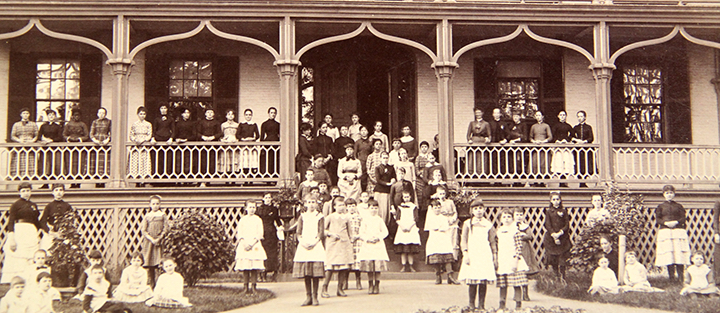
Students and teachers at the American School for the Deaf

Abashed at my own hubris in walking such an important person into the scene, I emailed one of my consultants: the historian at the American School for the Deaf. “Do you mind,” I asked with shaking typing fingers, “if Harriet Beecher Stowe walks through a scene? Could that be historic?”

The quick reply was basically: “Go for it!” Harriet Beecher Stowe and her sister Catherine, it turned out, had been close friends of Alice Cogswell, who ran the school! And in Alice’s scrap book was (gulp) an unpublished poem by the famed Hartford author of Uncle Tom’s Cabin! Here is the actual response from the school historian:

Alice Cogswell kept a scrap book, which we [were] fortunate to inherit from one of her relatives back in 1936.  The scrap book is a collection of poems, letters, and drawings from friends and family members.  She certainly did have a connection with the Beecher family because her scrap book includes a poem from Harriet Beecher Stowe and one from Catherine E. Beecher.  I have no documentation of the circumstances, but it stands to reason.  Both families were prominent in the same Hartford circles, and both women were activists in their own right.  Especially Catherine’s crusade for the education of women.  I imagine Alice’s education at ASD would have been of particular interest to Catherine.

And that, my friends, is the magic of writing historical mysteries—that every now and then, an unexpected guest walks into the scene, and turns out to uncover a real-life revelation.

Tuesday, May 25, 2021

Returning to Philip Pullman's THE BOOK OF DUST, Thinking about "Young Adult"


My newest Vermont historical adventure reaches the marketplace on June 23: THIS ARDENT FLAME. Set in a real village not far from where I research and write, in 1852, it probes the very real controversies around ending enslavement in America, from a Vermont point of view.

But for me—and I think for many other authors—a novel takes on legs and spirit of its own, and within a few pages of the start, I knew the teens in this book had complicated lives in which they felt the pain of being "other than" what's expected. They knew romance and dreams. They threw themselves into battles for justice, without full consideration of what it could cost them.

And that, for me, is the point of writing "YA." Teen protagonists aren't just unseasoned; they are passionate. When they recognize the next right thing to do, they can be more likely than careful, thoughtful adults to offer themselves and their abilities. Of course they get hurt this way. But they also grow in leaps that are exhilarating to experience, even as the writer rediscovering them. 

THIS ARDENT FLAME recaps what it meant to be deaf in Vermont before the Civil War. It exposes the pain of families already beginning to split on moral grounds. I hope that in the best of ways, it foreshadows the coming darkness of the war that tore America apart, so fiercely that the wounds have still not healed, 160 years since they began to bleed.

My kind of writing depends on constantly learning. A lot of that is from the scholarship and research of others, especially social historians. But I'm also always working at becoming a better wordsmith, scene setter, tension exposer, painter of love and loyalty. Part of my "training" comes from reading powerful stories told by others. I grew up on Madeleine L'Engle, J.R.R. Tolkein, Frances Hodson Burdett, Arthur Ransome, Robert Louis Stevenson, Louisa May Alcott, and yes, second-tier novelists who brought us important visions, like Harriet Beecher Stowe, who strolled right into THIS ARDENT FLAME and surprised me deeply.

In my non-writing life, I'm doing some hard things right now, involving selling the home where my husband and I lived and loved, and where I tended him in his final illness. I'm learning to talk with (and learn from!) contractors in preparing a new home for myself. I'm packing LOTS of books.

So I'm re-reading YA novels this month. That took me, this week, to Philip Pullman's newest series, "The Book of Dust," which has two published books so far, with the third and final yet to come. As I worked through the first one again, La Belle Sauvage (named for the canoe owned by Malcolm, one of the protagonists), I looked at how Pullman summoned power through his words, and deepened the ideas and passions behind them. 


Around halfway through the book, Malcolm's school gets taken over by a religious crusade that deliberately turns children into spies on the morals of their families and friends. Malcolm observes the effect: "Few pupils were openly naughty anymore—there were few fights in the playground, for instance—but everyone seemed guiltier."

The phrasing made me think of Orwell's Animal Farm. Political manipulation and power depend on making one group feel potent, and another feel guilty and "less than." It's a shocking book, and one that is now embedded as firmly in our culture and thinking as Orwell's other noted dystopian, 1984. 

Is Animal Farm meant for teens to read? I certainly read it first when I was a teen, for school. Recently my 12-year-old grandson read it for school, too. I tried to let him know, without being pushy about it, that I felt the book was dark, even scary. I bet he felt the same way. I hope his classroom reinforced taking a stand against the machinations exposed in the story—and supported the kids who found it painful to read. Lots of people experience the use of power against them, even before they grow up.

I'm torn about whether Pullman's books are "good for young readers." Even today, I find they hurt me, darken my views, open me to more despair. 

If you have an opinion on all this—I'd like to hear yours. Let's talk.

[Hope you'll make time to browse more of my tales here of historical research, writing, and life! Tap the link to reach the rest of the material: https://bethkanell.blogspot.com]

Sunday, February 21, 2021

Cover Release! THIS ARDENT FLAME, Publication in June 2021


 I love this cover design from Five Star/Cengage -- it certainly tells you that the protagonists in THIS ARDENT FLAME are women! In this case, they are teens, taking on their share of putting the abolition of slavery front and center for Americans, especially Vermonters, in 1852. You already met Alice Sanborn in The Long Shadow (Book 1 of Winds of Freedom). Join her as she meets Caroline, whose return to North Upton startles Alice into recognizing how limited her own world has been.

Now, of course, I'm writing book 3 of Winds of Freedom, set in 1854, and featuring Almyra Alexander. You'll want to watch for her arrival, too, in THIS ARDENT FLAME.

Looking forward to sharing the new novel with you soon!

Monday, July 27, 2020

Writing for Readers: The Big Story, the Essential Connections

On Tuesday July 28 ("tomorrow" as I write this), in the evening, I'm joining other authors for a virtual panel discussion at the Tewskbury, Massachusetts, Public Library. The title of the event is "How To Publicize Your Book."

Why?

Readers (and new writers) often think publishers take care of getting the word out about good books. After all, the words seem tied together: publisher, public, publicity.

But the "new world" of book publishing began at least a decade before the pandemic turned things upside down. Letting readers know about a book and its exciting revelations is now, for most authors, part of the writer's responsibility. True!

Let's face it. Promotion isn't usually what a writer has polished and practiced. For me, writing a great story, with details that intrigue readers about American history (especially the Vermont version) and celebrate the growth of the protagonists -- mine always tackle some injustice -- is where the effort has to be invested. Write a good story!!

So promoting that story, once it's in print, needs to be direct and effective. For me, that means starting where my heart is: at "home," whether that's geographic, or in the circles of friends on social media, or among other writers as we connect with each other.

You'll hear about my new research and writing projects here first: on the blog, and on my Facebook writing page, and even on my personal Facebook page.

And the closer we get to publication on a project (This Ardent Flame is scheduled for June 2021, even though I turned in the writing in February 2019 ... there's a pandemic affecting everyone, right?), the more I ride those circles of connection outward.

With that in mind, here are some tips for writers, and for readers who love to promote a good story (I'm hoping you'll include the first title of the Winds of Freedom series, The Long Shadow, which came out in 2018 -- have you read it yet?).
1. Keep your friends informed and engaged. Reveal surprises in research; share a bit of a struggle about how to shape a character; describe milestones in writing and publication of your work.

2. Ask friends to pass along word when they enjoy something. Your circles overlap other circles. Let them spread.

3. Celebrate and rejoice. We all need support and cheering up, whether in a pandemic or not — name the reasons for joy and satisfaction in your writing life and share them, with virtual balloons, so to speak!

4. Value your circles. Sure, time may be tight (you want to start writing the next scene), but if you're checking your own social media posts, make sure to check those of friends also, even if what you can give is five minutes of adding "likes" and smiley faces and "Wow!"

5. Remember the world is connected in ways that astonish and refresh. Introvert type happy to be at the desk solo? You can still take a couple of steps toward the "windows" and nurture the connections around you. This is how we make it a better world. And for me, it's part of how I keep "growing" my soul, so that the next book I write is even better than the one before.
Takeaway: Promoting your work in the best ways can make you a stronger, more responsive and resilient writer. Which makes it worth the effort.

Saturday, July 4, 2020

The Fourth of July in America's Past—and Today

Daniel Webster in 1835, portrait by Francis Alexander, courtesy of the National Portrait Gallery.
An 18-year-old country boy studying at Dartmouth College in 1800 was asked to give a speech at the Hanover, New Hampshire, Independence Day ceremonies. His words and his passionate delivery rocked the crowd, and the speech began his national career of service to the nation and summoning vivid language and performance, to in turn call people to action. Here is a bit of Daniel Webster's first public speech:
It becomes us, on whom the defence of our country will ere long devolve, this day, most seriously to reflect on the duties incumbent upon us. Our ancestors bravely snatched expiring liberty from the grasp of Britain, whose touch is poison... Shall we, their descendants, now basely disgrace our lineage, and pusillanimously disclaim the legacy bequeathed to us? Shall we pronounce the sad valediction to freedom, and immolate liberty on the altars our fathers have raised to her?
My second book in the Winds of Freedom series, This Ardent Flame, reveals how Vermonters took on this challenge after Webster betrayed their abolitionist goals, in forging the Compromise of 1850. It's fair to say that his legal maneuvering that year cost America dearly, in delaying the end of chattel slavery in the nation.

But the impact of giving speeches on the Fourth of July has been embraced by many another American leader. I reflect today on Abraham Lincoln's proclamation of war on behalf of the Union of American states -- which he gave on April 16, 1861, after Fort Sumter was seized by the Confederacy forces. Knowing the strands among the states were ever fragile, Lincoln deliberately called Congress to gather on July 4 to endorse his action.

In hindsight, it can feel like an intolerable delay, from April 16 to July 4. But Lincoln, portrayed by historian Doris Kearns Goodwin as a master in politics (giving, giving, and giving, until he'd call all to gather and get a task done), calculated that the patriotism of the Fourth of July would move the fragmented Congress to stand together. And he was exactly right.

The Ardent Flame was scheduled for autumn publication this year, but the COVID-19 pandemic has delayed the release until June 2021. Even so, I'm already grappling with book 3, Kindred Hearts, set in 1856 in "North Upton" (a pen name for North Danville, Vermont). In every page, in every shift of plot and character, is my own awareness that the nation was a mere five years from the war that would devastate it, far beyond any initial guesses. And I am walking with my protagonists, especially the teenagers, as they wake up to the cost of having deferred the abolition of slavery.

We, like they, are challenged to take action to address the damage done. It's a good thing to ponder on this 246th anniversary of the Declaration of Independence. May God bless our efforts to unite this land and people in liberty and justice for all.
This portrait by Joseph Alexander Ames, believed to also be of Webster, hangs a mere 6 miles from my writing desk, at the St. Johnsbury Athenaeum.

Thursday, March 5, 2020

Publication date for THIS ARDENT FLAME (Winds of Freedom Book 2)

Five Star/Cengage tells me that as of now, the publication date for THIS ARDENT FLAME is December 16, 2020.

Let's figure out how best to celebrate the book in Vermont, so everyone who wants copies for holiday gifts and holiday reading will be able to get them!

And the next big step will be the cover design, so ... watch for it!

More news on other topics, tomorrow.

PS: A taste of Chapter 1:

North Upton, Vermont, October 1852

Chapter 1
A cold wind off the ridge followed me as I trudged down the worn path, the pack basket of late apples heavy against my back. Dark clouds scudded from the west. When the first small raindrops struck my cheek, I tried to tug my woolen shawl forward, to keep my dark hair dry. But the weight of the apples and their off-balance shift in the pack meant I needed to grip the shoulder straps with both hands, so I couldn’t arrange the shawl any better.
            “Drat. Drat, again.” Had I spoken aloud? Well, nobody would hear my unladylike words. Cutting down through the field from my brother William’s home, toward the center of the village, wasn’t exactly ladylike, either. Pfui.
            Since I’d been a little girl, I’d taken this track. Of course, back then, the house beyond the mill belonged to my father’s older brother, Uncle Owen. Jerushah, my best friend, used to walk with me to visit Uncle Owen and Aunt Lina.
            Jerushah. I shivered.

Wednesday, December 26, 2018

Learning the 1800s: Sunday Mail Delivery

As I write THIS ARDENT FLAME, set in northern Vermont in 1852, I spend a lot of time in research -- but not just exploring this pre-Civil War decade of ferment. In order to understand the thinking and discussions of the time, I often backtrack to the War of Independence and the strong-minded individuals who voiced their dreams for this new nation, built from a set of very different colonies and then growing by annexation of territory (and almost always while ignoring the history and rights of Indigenous peoples).

This week I'm reading Compassionate Stranger: Asenath Nicholson and the Great Irish Famine, by Maureen O'Rourke Murphy. One reason to read the book is as background for how the characters in THIS ARDENT FLAME deal with the Irish immigrants arriving in Vermont at the time. Another is that Asenath Nicholson, an activist of the first half of the 1800s, was born and raised in Chelsea, Vermont, not far from the Northeast Kingdom. (I've spent many hours there as the mom of an actor in a Jay Craven/Howard Frank Mosher film. Where the Rivers Flow North.)

Every detail in the book takes me digging for more details elsewhere, and this morning I "dug into" Sunday mail delivery. I was surprised to learn that it was routine in our nation's first century: It was considered essential for commerce! Moreover, the 1820s/1830s movement to end Sunday mail delivery came out of a small group with religious passions and especially religious bias -- against those Irish and other Catholic immigrants, who often used their "day of rest" to feast, gather, and rejoice, rather than to endure the silent solemnity of a Puritan-style Sabbath.

The post office with its mandatory Sunday opening (required by law to be open at least one hour each Sunday) became a social location. Not only did men gather there to pick up their letters and commercial orders, but they also often sat down to socialize, drink, and play cards. This horrified those who took their Sunday worship more seriously. Interestingly, these horrified individuals were often the same ones pursuing the Abolition of slavery, out of the same Christian beliefs!

Thus, Arthur Tappan, an ardent abolitionist of both New York City and New Haven, CT, would raise as much anger by his "Sunday mail laws" campaign as by his campaign to end slavery, and his brother Lewis, campaigning the same way, had his house broken into in 1834 by an angry mob.

Only 7% of the nation claimed strong religious ties at the time, and most opposed shutting down the post office on Sundays. The invention of the telegraph in the 1840s would ease the commercial necessity of Sunday mails. But the legislation to close the post office on Sundays would not be passed until 1912, and part of the opposition to it lay in favoring one religion over another, counter to the definitive statement of the Constitution that insisted the new nation not pick and choose. (Arguments included the belief that Sunday closing of the postal service would then lead to Saturday closing on behalf of the Jewish Sabbath, to be fair!)

What eventually tipped the nation to passing the closure laws was a combination of two pressures: postal workers wanting a day off like everyone else, and trading the closure for the new service of Parcel Post: being able to handle packages routinely.

That's a lot to think about, in the context of this week's political talk about Amazon, postal rates, and Sunday deliveries that have now resumed!

Tuesday, December 4, 2018

Ruffed Grouse, or Partridge (Pa'tridge)?

One of the challenges of writing a novel set in 1852 is the details that aren't recorded, but that I still want to get "historically accurate" for the story. Today's puzzlement is how to talk about the wild bird known to American colonists, based on their British experience, as partridge -- but corrected in name to ruffed grouse. John J. Audubon painted the birds (see above). And Karen A. Bordeau of the New Hampshire Fish and Game Department also wrote this in 2015:

Regulation of grouse hunting received no attention for a long period. The first act protecting birds was passed in 1842, affording a breeding and rearing season free from molestation. They could be legally taken between September 1 and April 1, and permission of the landowner was required for hunting.
The regulation was repealed after four years, and grouse remained unprotected until 1862. The second law protecting grouse, passed in 1862, established a shorter season September 1-February 28 and four years later hunting was further curtailed by closing the season on January 31. Snaring had been a popular method of capture, and in 1885, was forbidden. By 1929, grouse were so rare all over the state that the Legislature completely closed the season in Coos County on the Canadian border, and in Cheshire County bordering Massachusetts.

And the New International Encyclopedia of 1917 says this:


So, what do my characters call these birds? That's in chapter 4 of THIS ARDENT FLAME (Book 2 of Winds of Freedom).

"This Is the Real Thing": THRESHOLDS, an Exploration of Transitions

My new book of poems. Available in bookshops and online. My buddy B and I shared a long lunch at a community restaurant today, and wrapped i...