Showing posts with label Winds of Freedom. Show all posts

Monday, October 13, 2025

History, Historiography, and Mom: A Meditation for Indigenous Peoples' Day

Real history.

My mother wasn't a historian. She remembered her own life, of course, and some of the stories told by her relatives about earlier years. Descended on her mother's side from Quakers, who kept good records, she owned one small book written by a Quaker ancestor. Otherwise, her exploration of family history took place via letters exchanged with her cousin Alice -- who, as a professor, might have been expected to be more tuned in with the standards of history. But Alice's interest was in religion, and she too mostly provided family history via stories, letters, and some photographs, as well as her personal experience. Some of those details appear in my Winds of Freedom series of historical novels set in the 1850s in Vermont.

On my grandfather's side -- Mom's father's side -- there are better records because many of the ancestors were merchants on Cape Cod. Those folks are well documented and date back quite neatly to emigration from England on the Mayflower and other notable ships. And in England, church records allow good reliability for tracking the family tree, too.

The most fragile part of Mom's stories about the family turned out to be its connections with Native Americans. I wasn't yet asking "the right questions" at the time of Mom's death -- I was only 28 then. But I have one of her excited letters, splashed with exclamation points, suggesting that my four-greats grandmother Love Perkins in Wells, Maine, might be of Native American ancestry.

Thanks to marrying historian Dave Kanell, I've become a researcher, and I question everything in the family tree, especially connections to America's pre-1600 people. It took a lot of work, but I've demonstrated that Mom was wrong about Love Perkins. But another branch of her tree, the Hopkins line, seems to have descended in part from Wampanoag members based around Nantucket and Cape Cod. I would love to be sure about that, because it would certainly be a source of great interest. But ... the historian part of me doubts that I'll ever have enough evidence.

Still, I am thinking of Margaret Diguina today, on what has been a date recently to contemplate Indigenous peoples of our continent. If she was indeed the Wampanoag person that some records suggest, she had an amazing heritage herself. I hope that her marriage to Gabriel Weldon was both willing and happy. "Historiography," the study of the writings of history, suggests I won't get answers to my related questions during my lifetime. (Also, DNA from back then is far too diluted at this point to show up in my own genetics.)

But for the sake of a bit of history today, I recommend this article on Ruth (West) Coombs of the Mashpee Wampanoag. And for the sake of my grandsons, who may read this post some day, here's a reminder: The Wampanoag did not wear those massive feather headdresses that you see in old movies. Dig into the history of your people, and your nation, and this continent. There is so much to learn!

Real postcard but fake history and garb.


Tuesday, September 16, 2025

Looks Like There Will Be an Audiobook of THE BITTER AND THE SWEET!


In surprise news today, an editor at All Things That Matter, the brave and clever publisher of THE BITTER AND THE SWEET, said there will soon be applications open to record this Vermont historical novel as an audiobook. I am thrilled! People often ask me about this, and it's the first time a publisher has offered to invest in the special version like this.

The first related author task for this process was to provide the sounds of unusual words in the book, like characters (popular names in the 1850s have sure gone out of fashion today) and places. That second part surprised me for a moment, but then I realized that St. Johnsbury might seem a strange name to a "voice actor" from, say, Georgia or Oklahoma.

So here's my list. Do you remember where in the book each one comes up? And if your answer is, you haven't yet read this third book in the Winds of Freedom -- what are you waiting for? It's available on request from local booksellers, as well as online, or you could encourage your local library to pick up a copy that more neighbors could share.

The Bitter and the Sweet -- Pronunciations


Almyra: al-MY-ruh

Antoinette: an-twuh-NET

chamomile: KAM-oh-mile

Crimean: cry-ME-uhn

Dana: DAY-nuh

Eli: EE-lie

Eliphalet: ell-IF-uh-let

Ephraim: EE-frum

GrimkeƩ: GRIM-kay

Hazen: HAY-zen

Isaiah: eye-ZAY-uh

Jerusha: juh-ROO-shuh

Jewett: JOO-it

medicament: MED-ick-uh-ment

Myles: miles

Peacham: PEECH-um

Potton: POTT-un

Rokeby: ROKE-bee

Stanstead: STAN-stead

St. Johnsbury: Saint JONS-burry

Stowe: STOH

 For extra pleasure, check out this online guide to the skills needed to become a successful audiobook narrator, or this one about what makes a GREAT one.

Tuesday, September 2, 2025

How the WINDS OF FREEDOM Series Reached Book 3


Both softcover and ebook available!


Blame it on that heirloom gold locket that my dad gave to me, after my house burned to the ground. The midwinter fire devoured all the jewelry my mother gave me over the years, all her knitting projects, a half-made crocheted bedspread for my youngest brother that I claimed after her sudden death a few years earlier, saying, “I’ll finish it for you.” Raging on a twenty-three-degrees-below December night, the fire took our clothes, my work, the children’s new Christmas toys. None of that compared to the importance of the three of us escaping, with burns on our faces and frostbite on our toes, from sock-footed hike a third of a mile to the nearest neighbor.


Dad drove north to check on us, a day later. He brought some family photos, thoughtfulness that impressed me; he brought my youngest brother the contractor, who’d never receive that bedspread after all, but who brought me boxes of his spare tools; and he brought the locket. Gold, shaped like a tiny box on a short chain, it opened to emptiness. No photo of anyone inside, but I saw an intricate gold grating that flipped outward. “It’s a hair locket,” he explained. “You put a lock of hair of your beloved into it.”


During the night of the fire, a mile from where my ex-husband lived, the only “boyfriend” in my life was playing music in New Orleans. He got a busy signal when he tried to phone me, and bitterly assumed I’d taken the phone “off the hook” to silence it during a date with someone else. Days later, he’d finally phone a neighbor and learn that a fire burns through phone and electric lines. I didn’t put a lock of his hair into the locket; he left not much later, for a dancer he’d formed a crush on.


When I turned fifty, in accordance with the answer a prayerful friend of mine had received, I met and fell joyously in love with my soulmate. By then, the kids were grown and gone, but on their rare visits home, they agreed I’d finally found the right partner. Next time my darling got his hair trimmed, I collected a curl and popped it into the locket.


Historical fiction already meant a lot to me; a lifelong history writer, and a fumbling novelist, I found the combined threads satisfying. And I wanted very much to give readers a vicarious experience of Vermont’s approach to the Abolition movement and to diverse settlers (setting aside for the moment the state’s sometimes cruel treatment of Native Americans; I’d addressed that in my first work of historical fiction, and the book is a classic, The Darkness Under the Water, but also controversial). I figured, if readers followed along with the teens in my new story, they’d discover for themselves that Black people in Vermont in the 1850s were “free and safe,” as one of the state’s great historians puts it.


If you haven’t yet written a novel, this might surprise you: Often the characters stubbornly diverge from where you thought they were going. So did the girls in The Secret Room: One morning, halfway through writing, I realized at least one of them would head into a dark collapsing tunnel, in a desperate rescue effort. As dirt fell into her eyes and mouth and she moved resolutely forward, one hand landed on an object that she reflexively tucked into a pocket. Later, in daylight, she discovered it was an antique locket.


Yes, there you have it: Dad’s little locket had crept right into my story. So it felt obvious, later, that I’d write another novel, this time set in 1850, when that locket first hung at the throat of a Vermont teen. That turned into The Long Shadow, a book I’d never imagined would be the first of a series.


Yet when I turned it in for publication, the cheerful editor said, “I hope we’ll be hearing more from these characters!” Shaken, I asked, “You mean a series? How long?” She replied, “How about until everyone is free?”


It doesn’t take a lot of American history to recognize that “when everyone is free” probably means the end of our Civil War: 1865. If I wrote a book for each year from 1850 until then, there’d be 15 books in the series. A nifty idea! However: My teenaged characters from the first book would be in their thirties. That wasn’t an age I wanted to write about – I love the voice of a teen observing her world. How could I solve this?


It took another week for the idea to arrive: If the teens had a reason for vanishing from the village at the end of each book, or maybe each second book, and the next book’s protagonist became a girl who’d been younger at the start, and I kept passing it along that way — well, you see how it would work, right? Sort of a relay race, passing along the Vermont fight for human liberty to each new girl, or set of girls. Yes! On the spot, I decided (since I’m far from young) that there would be two-year jumps between the books in the series. That meant seven or eight titles, which seemed workable, as long as I took my vitamins and avoided any repeat of the disastrous housefire.


Now we are in book 3 in what the editor and I decided to call the Winds of Freedom series. Almyra Alexander, who showed up in book 2 as a fashionable girl from Boston, longs to be a minister, a difficult if not impossible path for a woman in 1854. The Vermont village, with its changing ideas about people and their roles, may give her a way forward toward her dream.


But first she’ll have to puzzle out several newly arrived women at the local tavern, what they are carrying around the county, how to handle an aging criminal who arrives while her uncle the minister is out of town, and whether she can effectively assist the cause of Abolition.


If you’re ready to find out whether Almyra is up to those challenges, and what the risks are, and what allies she’s recruiting — get ready to read The Bitter and the Sweet.

Tuesday, August 26, 2025

Majoring in Art? Counterfeiting in the 1800s Offered You a Good Income


I've always enjoyed historical fiction. It's the classic "spoonful of sugar" for the facts of our past. As a writer of historical novels, I'm responsible for getting the underlying details—skirt fashion, maple sugaring, weather extremes, and famous persons like Harriet Beecher Stowe (real-life author of Uncle Tom's Cabin)—all correct in the stories I spin. My goal is to give readers an enjoyable ramble through Vermont's 1850s in my Winds of Freedom series, while making sure their experience in the lives of the characters is true to life.

The Long Shadow, This Ardent Flame, The Bitter and the Sweet: These are adventures of teens in the village of North Upton (based on our real North Danville), and each one explores the level of risk the teens undertake. There are scary threats around them, and as anyone who's lived in snow country knows, winter can be the most potent threat of all.

But each book also handles the dangers of 1850s life, from bounty hunters to deadly disease to unquenchable fires that take down houses, barns, and life itself.

In The Bitter and the Sweet, one of the scary aspects is counterfeiting. It took decades for the American system of coins, paper money, and banks to develop. Rampant counterfeiting took place in the 1820s and 1830s, and the effects still made problems for anyone dealing in Big Money in 1854, the year of this novel.

Historians divide written evidence of the past into two kinds: primary, written by the people alive then, and secondary, the books that the historians then write, where they line up the details and pull together the themes. For The Bitter and the Sweet, I used a "secondary" source called A Nation of Counterfeiters: Capitalists, Con Men, and the Making of the United States, by professor Stephen Mihm. (He also kindly answered some correspondence as I narrowed the details I'd be using in my story.)

I already knew about Vermont counterfeiter Christian Meadows, whose history is repeatedly rediscovered for popular articles (here's one). A skilled engraver and silversmith, he strayed from his daily work into counterfeiting, applying his skills to the design and crafting of printing plates. He was captured, convicted, and imprisoned -- but did such elegant design work that Daniel Webster spoke up for him, and Vermont governor Erastus Fairbanks in 1853 pardoned him so he could return to the legitimate side of his engraving.

Devouring the well-written pages of Mihm's comprehensive book A Nation of Counterfeiters, I discovered an even more fascinating fellow: Seneca Paige, who led a major collaborative of "money makers," including multiple artists, just across the Canada border from Vermont's Northeast Kingdom. In his later years he "reformed" and his grave in Bakersfield, Vermont, praises his life, saying, “His Loss will be felt by many; particularly by the poor. He was truly the poor man’s friend.”

I wanted my characters to meet this man (under a new name, of course, for the novel: Foster Pierce). But by 1854, the year of The Bitter and the Sweet, he was already that reformed character that won such acclaim. How could I include him in a way that would be true to the facts, but also potentially terrifying to the teens meeting him in their village?

Yes, I solved it. I won't spoil your fun by saying how! But I loved writing this book, and now that it's in print (softcover and ebook), it's a great joy to share the lives of "my" people with readers.

And I remind the artists I meet: 125 years ago, your precision skills could have been making you an excellent living ... as long as you didn't get caught. 

Tuesday, January 21, 2025

To Be a New England "Girl"


My mother, managing five children and the social commitments that went with my father's management job, rarely spent money on herself (if we don't count those cigarettes). But she indulged in two magazine subscriptions that meant the world to her: Yankee Magazine, and Down East, "The Magazine of Maine." When a copy of one of those arrived in the mail, she'd curl up in her armchair under the portrait of her four-greats grandmother, and reconnect with the New England self she'd left behind in 1950 when she married my dad and moved with him to that land of plentiful engineering jobs: New Jersey.

Each summer she'd craft lengthy lists of meal plans and clothing needed, and we'd all head to New England for family camping. Our visits to great-aunts and various sorts of cousins dwindled with time, as either they passed away or the chaos of a large family couldn't be welcomed. So my memories of "Auntie Mi" (my grandfather Palmer's sister) and her husband are very faint indeed. I recall a donkey and maybe a pony at their New Hampshire home. And one of the more distant cousins, also called Aunt out of respect for her age, made doughnuts in Vermont. I don't know which town, now.

My folks had a challenging marriage, but around 1980 Dad went to a "gestalt" psychological workshop in Florida and came home repentant, determined to start over. They put their house on the market, quickly accepted an offer, and were weeks away from moving to Mexico City, where Dad would manage a lighting factory in transition, when Mom dropped to the ground outside the nursing home where she worked, and in a shockingly short time, she died.

In between the fresh start and the devastating ending, Mom sold or gave away most of her family treasures that spoke of New England. "You kids aren't interested in the stuff," she said firmly.

I can't say for sure about my siblings, but I was already in Vermont, rebuilding the family connection to New England, parenting a toddler, and expecting a second child. By the time I knew what Mom was up to, she'd done it. 

Then three years later my home burned to the cellarhole, in one of those devastating Vermont winter fires where there's nothing left—except in this case me and my children, which of course meant the most important part survived and went forward. (Yes, this is part of why my novels often include a fire.)

Somehow, these many years later, I do have a few small items from Mom's New England life. That probably means my father held onto them and passed them to me after the house fire. Two of them, small and without family initials, remain tiny treasures to me ... and those are what I carried to the Concord Historical Society last year, when I suddenly needed cover images for my newest novel, THE BITTER AND THE SWEET (Winds of Freedom Book 3). Concord's Beth Quimby kindly opened the museum to me, so I could stage a few photographs.

This one didn't get chosen for the cover, but it includes the two small items that remind me of Mom's New England roots: a locket that now holds a bit of my late husband's hair in its specially made interior, and a tiny mirror, far smaller than the one that always rested on my mother's "dressing table" next to her rose-scented eau de toilette and her face powder.

Somehow it seems like I should look into getting my own subscriptions again to those two classic New England magazines that engaged my mother so deeply. The story keeps spiraling, though: My first published poem in a national magazine? Yes, it was in Yankee Magazine, in 1995 -- too late for Mom to see it, but confirming for me anyway that I was becoming the New England "girl" she had always been at heart.


Sunday, November 3, 2024

The Winds of Freedom, Book 3: It's the Money, Honey


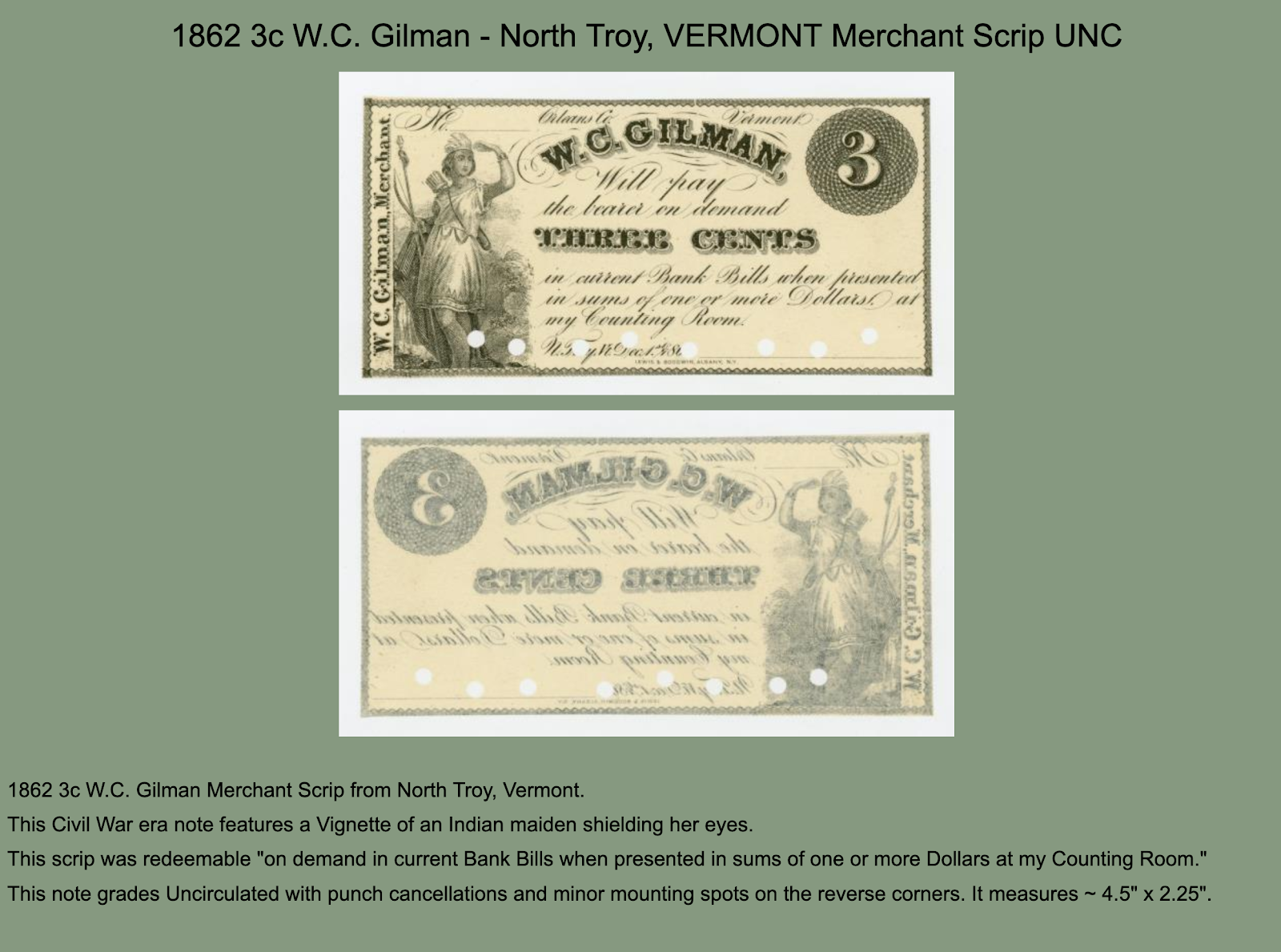
Merchant "scrip" from North Troy, Vermont.

Realizing that the teenaged girl leading the action in THE BITTER AND THE SWEET (Winds of Freedom book 3) would not be either Alice or Caroline -- the teens we follow in the preceding book, This Ardent Flame -- happened well before I started writing book 3. With a two-year jump for each novel in the series, the next protagonist would have to be Almyra Alexander.

Almyra intrigues me for several reasons: She's from Boston, a transplant to the Vermont village of North Upton (aka North Danville), so she's seen more of the sophisticated scenes than either Alice or Caroline. As a result, she brings with her some fashionable clothing and, more importantly, an assertiveness that goes with her outward confidence. That makes her a contrast to the other teens.

But her confidence is a  bit rocky, because she's almost an orphan: Her mother died young, and her father, a political operative, is way too busy to parent his lonely daughter. So when her North Upton aunt and uncle bond with her, and give her the opportunity to stay in the village instead of returning to the city, she's relieved to experience the first real sense of family support she's had in a while.

That's the underlying emotional pin for the book. Add to that her curiosity and unquestioning embrace of the social issues of the day, namely, the abolition of slavery, rights for women, and ending alcohol abuse, and I had the resonant situation that I wanted to write from.

But of course a historical novel is almost always threaded around an urgent plot of some sort, whether it's an adventure, a crisis, or a mystery. Choosing the one for THE BITTER AND THE SWEET came with the discovery of Professor Stephen Mihm's book A Nation of Counterfeiters: Capitalists, Con Men, and the Making of the United States. Not only is this book full of tales of criminal and law enforcement action in our nation's early years, but -- to my astonishment -- one of the major locations for counterfeiters in the early 1800s was our own borderlands of the Northeast Kingdom and Canada's Eastern Townships.

Professor Mihm even replied to some emailed questions, and soon I was on my way, deep into the new manuscript.

MARK YOUR CALENDAR: We'll have a party for THE BITTER AND THE SWEET at Kim Crady-Smith's Lyndonville, Vt, shop, Green Mountain Books, on Saturday Nov. 23 at 11 am. Later the same day, at 2 pm, I'll talk about the book at the North Danville Brainerd Memorial Library, and explain Danville's own connection to the counterfeiting landscape!


Wednesday, October 16, 2024

Three Teenaged Girls in 1850s Northern Vermont: My Protagonists for The Winds of Freedom


When I wrote THE LONG SHADOW, the story of Alice Sanborn's discovery of injustice and loss in her home village of North Upton, Vermont, I reached for integrity: not just for Alice and her family as they continue their commitment to the abolition of American enslavement, but also for how we see that time, that piece of our past. I wanted to give readers an experience of aromas and tastes as much as possible, along with the binding constraints of the layers of women's garments at the time, and the ways family could be both supportive and harsh. When Alice's uncle rages about the politics of the time, I want you to feel with Alice the scary and exhilarating moment of seeing someone take a stand for a difficult position.

In fact, I was so immersed in this 295-page novel that when I completed it. I was startled to hear the editor at Gale/Five Star, the publishing house, say "I hope we'll be seeing more of Alice!" "How much more are you thinking?" I asked. She responded, "Until everyone is free." That is, from 1850 to 1865.

Well, why not? Alice's interactions with her younger Black friend Sarah and the innkeepers' daughter Jerushah came to a natural end at the end of that novel. But as we all know, when one friendship ends or changes, another often comes along.


For THIS ARDENT FLAME, I chose a very different sort of new friend for Alice: Caroline Clark. Because of her inability to hear, Caroline's spent her school years in a boarding school for the deaf and hearing impaired, in another state. Returning to North Upton for Caroline could be far more traumatic if it weren't for Alice. As the two teens learn to communicate in a layered set of "languages," they learn more about the diverse people around them, and develop their own fierce commitment to abolition, as well as to the linked issue of women's roles and rights.

Readers may have been startled by the decision of these characters at the end of the book: They are headed West, to a place where their presence may be critically important to how America develops the laws and freedoms of its added territories, soon to be states. How could the Winds of Freedom series continue? Was it moving West?

Not at all. When the editor invited me to develop a series for this "young adult crossover" genre -- that is, one that features young adults (teens) as protagonists, but is read enthusiastically and with curiosity by adults, including parents and grandparents -- I saw right away that pushing the sequence by a year at a time, all the way to 1865, would mean a much longer and slower sequence than I wanted to write ... and, more urgently, it would mean that after the first few titles, the main characters would no longer be teens. Not only would that break the genre, it would take me into a kind of novel that didn't interest me. I really like writing "YA crossover."

So I came up with a plan: Each book would jump forward two years, not one; and the protagonists would shift with the timing, like a relay race, passing the action to another girl growing into the responsibility of working for a more moral nation and for the freedoms of those around her.


That's why book 3 in the Winds of Freedom series, THE BITTER AND THE SWEET, features would-be minister in training Almyra Alexander, whose Boston mother has passed away and whose politically active father is far too busy to raise a teenager (other than perhaps planning a marriage for her!). Readers met Almyra in book 2, when she was a pesky newcomer, dressed in city fashions and ignorant of rural ways, but already interested in the role she embraces in book 3: to become qualified to lead her own church. What about the push for abolition, a necessity for a moral person of her time -- will that get in the way of becoming a minister? And who ever heard of a woman leading a church??

I'm eager to learn what you think of Almyra's choices and adventures (including with a notorious counterfeiter) in THE BITTER AND THE SWEET. Please do let me know.

And when you've finished the book, tell me who you think the next young woman (teen!) is that I've chosen for the focus book 4. Think carefully, and remember the two-year jump involved. Can you guess the right one? I want to hear your thoughts, of course!

Monday, September 23, 2024

The Winds of Freedom: How Vermont's Northeast Kingdom Approached Abolition


In this presidential election season, I think it's been clear that the effects of the American Civil War continue to affect beliefs around the country. President Lincoln's long approach to the abolition of human enslavement in America gave us a fundamental piece of today's view of human citizenship in our nation. At the same time, the long delay in getting there, with some 250 or more years of enslavement behind that, contributes to an awareness that we are not always as "good" or principled as we ought to be. And now we have a nation divided on what goodness and principle mean.

In the 1990s, when I began writing my historic novels, I came face to face with prevailing myths in Vermont history that dismayed me. Many of them revolved around the Underground Railroad, one of the heroic efforts in America in the early to mid 1800s. What we know today, historically, is that the Underground Railroad in Vermont might as well have been called the Aboveground Railroad -- because in the theme noted now at Rokeby in North Ferrisburgh, Vermont, if you were Black and reached Vermont in the 1850s (or had lived here for many years already, like the Mero family of Coventry), you were "Free and Safe." No need for hiding places.

But many people couldn't process that idea when I talked about it. So, based on my personal connection with historic fiction, I opted to write about the 1850s here through the voices and experiences of local people, hoping that readers could internalize that experience and reshape their own vision of what happened.

That led to THE LONG SHADOW, book 1 in the Winds of Freedom series, set in North Upton (aka North Danville) in 1850, from the points of view of teenagers enmeshed in adventures there. At the moment, the printed version is out of stock, but you can get the ebook here. Also ask Kim at Green Mountain Books to watch for a gently used copy for you!

More about that story later this week ... and then about books 2 and 3.

If you'd like to hear how the abolitionists of St. Johnsbury, Vermont, and the surrounding towns saw their world in the 1850s and how they entered the movement toward abolition, here's my talk recorded at the St. Johnsbury Athenaeum. I hope you find some fascinating discoveries when you listen/watch it.


Thursday, August 8, 2024

Winds of Freedom Book 3 Is Coming This Autumn!


The Bitter and the Sweet, the third book in my Winds of Freedom series (after The Long Shadow and This Ardent Flame), should be in print by early November -- maybe sooner! -- from All Things That Matter Press. I know it's been a long wait (thanks to, you know, COVID). So I thought I'd give you a bit of a recap of what the young ladies of North Upton (in real life, North Danville) Vermont have been doing in the 1850s, as Vermont is seized by a passion for Abolition ... that is, the legal abolition of slavery in a nation that had profited in many ways from enslavement for two centuries.

But of course, for northern Vermont teenagers, that's not initially the focus of their attention!

Here's what went on in 1850 in The Long Shadow (can be ordered here or as an ebook here):

THE LONG SHADOW Synopsis


            ALICE SANBORN, age 15 in March of 1850, is the youngest member of her family and the only one not taking a stand on Abolition. In her Vermont village of North Upton, she and her best friends – JERUSHAH, whose family owns the tavern, and SARAH, a younger black girl who is waiting in Vermont for negotiations to free the rest of her family from slavery down South – are more interested in maple sugaring and the arrival of spring than in politics. Still, Alice sees enough to guess that her married brother WILLIAM is conspiring with messenger SOLOMON McBRIDE to protect fugitive slaves. 

            When a slave-hunter reaches the area, Alice’s father sends the three girls, driven by Solomon, to a nearby large town to stay briefly with the elegant MISS FARROW, herself a former slave.  But the slave-hunter spies on Solomon and follows them. The girls elude danger, as Alice starts their horse and carriage north. Solomon sends the slave-hunter on a false trail, catches up with the girls, and drives them farther, despite snow, bad roads, and a catamount.

            By the time the girls reach sanctuary with the HAYES family of Free Blacks near the Canadian border, Jerushah and Sarah are desperately ill. Solomon leaves on his own mission. Alice meets the challenges of helping Mrs. Hayes nurse her friends. CHARLES HAYES startles Alice by laying hands in prayer onto Sarah; he offers the same for Jerushah, but Alice declines on her behalf, unsure her friend would want this.

            Sarah recovers and is happy to stay with the Hayes household to await her own family. But Solomon visits and persuades Alice that Jerushah, still fretful and frail, needs to return to her own mother. Solomon, Alice, and Jerushah endure a storm, flooding, and wolves to drive home. Along the way, Alice learns about Solomon’s freedom-fighting work and considers becoming an active Abolitionist herself – a role that won’t fit her father’s view that the Union of states is more important than freeing slaves.

            The return proves disastrous: Jerushah suffers a relapse, and blame falls on Alice. Although Jerushah’s family won’t let Alice visit, there is an almost-forgotten tunnel that links Alice’s home to the tavern. With help from Jerushah’s brother MATTHEW, the two girls reconnect and begin to leave messages for each other. Alice is dismayed to realize that Jerushah’s friendship for her includes expectations of long-term affection and living together as “spinsters,” a situation Alice does not desire. At the same time, the girls’ brothers – William and Matthew – ask Alice to help in the risky transport of documents that Solomon needs for men escaping slavery and headed to Vermont.

Alice learns to navigate the tunnel even in the dark. But Jerushah’s too fragile to do that, and when she tries to, she takes a terrible fall. Is it Alice’s fault again? All this guilt burdens Alice, and being part of Solomon’s righteous efforts can’t dispel the darkness.

  * * *         

 To learn how it all works out, of course, you need to read the book! (If I told you here, that would really be a spoiler, wouldn't it?)


Watch for news about The Bitter and the Sweet, coming soon!


Sunday, February 21, 2021

Cover Release! THIS ARDENT FLAME, Publication in June 2021


 I love this cover design from Five Star/Cengage -- it certainly tells you that the protagonists in THIS ARDENT FLAME are women! In this case, they are teens, taking on their share of putting the abolition of slavery front and center for Americans, especially Vermonters, in 1852. You already met Alice Sanborn in The Long Shadow (Book 1 of Winds of Freedom). Join her as she meets Caroline, whose return to North Upton startles Alice into recognizing how limited her own world has been.

Now, of course, I'm writing book 3 of Winds of Freedom, set in 1854, and featuring Almyra Alexander. You'll want to watch for her arrival, too, in THIS ARDENT FLAME.

Looking forward to sharing the new novel with you soon!

Sunday, August 2, 2020

Finding Prime Resources for Historical Fiction/Mysteries

Some of the best historical resources seem to arrive here by chance: a letter postmarked nearby in the 1800s (I have three from the postmaster of West Waterford to his son, located at a postcard show), a local inventor's identity (the "improved egg case" opened up research into Edward Everett Bishop of Waterford, Vermont), or a photo album that suddenly surfaces as a gift to a local group (thank you, Jamie Ide, on behalf of the Waterford VT Historical Society!).


Last Tuesday evening, that Muse of Historical Research -- to the Greeks, that would be Clio -- tapped my shoulder during a virtual panel of mystery authors "at" the Tewksbury (Massachusetts) Public Library. Tewksbury is one town east of Lowell, the marvelous center of fabric mill invention that anchored the Northern profits from Southern enslavement. As of 1840, there were 32 mills in the city. Readers of Katherine Paterson's historical fiction may have pictured the lives that the "mill girls" led there (see Lyddie); those who've pursued history tourism in New England may have visited the remarkable National Park that now embraces some of the remaining mill structures and stewards their history. American freedoms, gender roles, Labor as a force in politics, all these and more can be embraced in the history in Lowell.

But I hadn't known about Tewksbury. One of the people attending the author panel mentioned "the old library" and the librarian moderating the panel sent me a link to some photos that reminded me of the libraries I haunted in the 1950s and 1960s.
The "old" Tewksbury Public Library.

Then, of course, I began to explore what this urban library offers in the way of historical collections, and here's what I found in the town public history collection there:

Tewksbury History Topics

  • Anne Sullivan and the Tewksbury Hospital
  • Captain John Trull (Tewksbury Minuteman)
  • King Philip's War
  • Lowell Mill Girls and Women
  • Merrimack River
  • Mico Kaufman (local sculptor)
  • Tewkesbury, England (Town namesake)
  • Town Anniversaries (including 200th Anniversary Time Capsule)
  • Tewksbury State Hospital (State Almshouse)

Link to online historical patient registers
Visit the Public Health Museum at Tewksbury Hospital

  • Town of Tewksbury Annual Reports (1878 - present)
  •  Wamesit Indians
Any one of these could slip into the books I'm writing, set in Vermont in the 1850s and 1860s, when Vermonters still saw Massachusetts as the place where the War of Independence began, rather than a traffic nightmare or a set of distant museums and restaurants. I also discovered that Tewksbury was struck by a devastating tornado in 1857 -- something that may go directly into Book 4 of my Winds of Freedom series.

Most of all, I get the sense that Clio the Muse is always ready to alert me to "something old, something new" to learn. You know, I used to feel a little guilty that I took the writing path, instead of going boldly abroad for adventures. But it occurs to me now -- every time I find another prime resource like the Tewksbury Public Library, I'm having an awesome adventure. Just wait and see what comes up in the next couple of novels I've got rolling! (Don't you love being able to share the adventure, too?)

Saturday, July 4, 2020

The Fourth of July in America's Past—and Today

Daniel Webster in 1835, portrait by Francis Alexander, courtesy of the National Portrait Gallery.
An 18-year-old country boy studying at Dartmouth College in 1800 was asked to give a speech at the Hanover, New Hampshire, Independence Day ceremonies. His words and his passionate delivery rocked the crowd, and the speech began his national career of service to the nation and summoning vivid language and performance, to in turn call people to action. Here is a bit of Daniel Webster's first public speech:
It becomes us, on whom the defence of our country will ere long devolve, this day, most seriously to reflect on the duties incumbent upon us. Our ancestors bravely snatched expiring liberty from the grasp of Britain, whose touch is poison... Shall we, their descendants, now basely disgrace our lineage, and pusillanimously disclaim the legacy bequeathed to us? Shall we pronounce the sad valediction to freedom, and immolate liberty on the altars our fathers have raised to her?
My second book in the Winds of Freedom series, This Ardent Flame, reveals how Vermonters took on this challenge after Webster betrayed their abolitionist goals, in forging the Compromise of 1850. It's fair to say that his legal maneuvering that year cost America dearly, in delaying the end of chattel slavery in the nation.

But the impact of giving speeches on the Fourth of July has been embraced by many another American leader. I reflect today on Abraham Lincoln's proclamation of war on behalf of the Union of American states -- which he gave on April 16, 1861, after Fort Sumter was seized by the Confederacy forces. Knowing the strands among the states were ever fragile, Lincoln deliberately called Congress to gather on July 4 to endorse his action.

In hindsight, it can feel like an intolerable delay, from April 16 to July 4. But Lincoln, portrayed by historian Doris Kearns Goodwin as a master in politics (giving, giving, and giving, until he'd call all to gather and get a task done), calculated that the patriotism of the Fourth of July would move the fragmented Congress to stand together. And he was exactly right.

The Ardent Flame was scheduled for autumn publication this year, but the COVID-19 pandemic has delayed the release until June 2021. Even so, I'm already grappling with book 3, Kindred Hearts, set in 1856 in "North Upton" (a pen name for North Danville, Vermont). In every page, in every shift of plot and character, is my own awareness that the nation was a mere five years from the war that would devastate it, far beyond any initial guesses. And I am walking with my protagonists, especially the teenagers, as they wake up to the cost of having deferred the abolition of slavery.

We, like they, are challenged to take action to address the damage done. It's a good thing to ponder on this 246th anniversary of the Declaration of Independence. May God bless our efforts to unite this land and people in liberty and justice for all.
This portrait by Joseph Alexander Ames, believed to also be of Webster, hangs a mere 6 miles from my writing desk, at the St. Johnsbury Athenaeum.

Thursday, March 5, 2020

Publication date for THIS ARDENT FLAME (Winds of Freedom Book 2)

Five Star/Cengage tells me that as of now, the publication date for THIS ARDENT FLAME is December 16, 2020.

Let's figure out how best to celebrate the book in Vermont, so everyone who wants copies for holiday gifts and holiday reading will be able to get them!

And the next big step will be the cover design, so ... watch for it!

More news on other topics, tomorrow.

PS: A taste of Chapter 1:

North Upton, Vermont, October 1852

Chapter 1
A cold wind off the ridge followed me as I trudged down the worn path, the pack basket of late apples heavy against my back. Dark clouds scudded from the west. When the first small raindrops struck my cheek, I tried to tug my woolen shawl forward, to keep my dark hair dry. But the weight of the apples and their off-balance shift in the pack meant I needed to grip the shoulder straps with both hands, so I couldn’t arrange the shawl any better.
            “Drat. Drat, again.” Had I spoken aloud? Well, nobody would hear my unladylike words. Cutting down through the field from my brother William’s home, toward the center of the village, wasn’t exactly ladylike, either. Pfui.
            Since I’d been a little girl, I’d taken this track. Of course, back then, the house beyond the mill belonged to my father’s older brother, Uncle Owen. Jerushah, my best friend, used to walk with me to visit Uncle Owen and Aunt Lina.
            Jerushah. I shivered.

Sunday, September 15, 2019

Investigating a Postcard of the Concord Coach


My husband Dave, who died in April, did enormous amounts of research for details I needed as I wrote my historical adventure novels set in North Upton (loosely based on North Danville), Vermont.

On September 1, 2019, I started writing the next book, tentatively titled O FIERCE AND KINDRED HEART. It will follow The Long Shadow (2018) and This Ardent Flame (accepted by the publisher, Five Star/Cengage; I am hoping for autumn 2020 publication). So this will be "Winds of Freedom" Book 3! And again it begins in North Upton, this time in 1854.

So of course, I went to Dave's stacks of postcards, and found right away this image of a Concord Coach: the kind of horse-drawn vehicle used to transport passengers and mail around New England and beyond. The card came from Franconia Notch, New Hampshire, mailed in 1961.

Notice the addressee? It's Flora Austin of Franklin, Vermont, and the sender is clearly her daughter or daughter-in-law, Susie. She starts by mentioning "Albert" and that she doesn't know when he'll be down, then says that Albert Jr. will soon be home for good.

It's easier to read this way, right?

Research, which Dave and I would have collaborated on after he'd identified the postcard publisher and probable photographer and photo year, becomes a chase for family details. And here's what I found:

Flora Bell (nƩe Garrett) Austin was born about 30 September 1881 in Franklin, Vermont. She married Willard Charles Austin (born about 1861), and they show up in the 1940 Census. He was her second husband; her fist was Peter Chagnon (1863-1913), whom she married in 1897.

Flora's marriage to Willard bore a son Albert Willard Austin (1917-2000). His son, Flora's grandson (and either Susie's nephew or son), was Reginald Albert Austin -- presumably Albert Jr.

What fascinated me among the details is, this card's presence in the Northeast Kingdom was no accident: Willard Austin died in Lyndon on 29 April 1972, and although the recorded birthplace for Albert Willard Austin is Franklin, he died in St. Johnsbury, Vermont.

Those details make me wonder whether that the Austin family connected to this postcard may also connect to Lyndon's noted Dr. Venila Lovina Shores, whose paternal grandmother was an Austen (spelled with -en, not -in); could that be? It's the kind of coincidence that often arises when working with Northeast Kingdom history!

Meanwhile, I am content to know that the Concord Coaches once drove just a few miles from where I sit writing today -- and to find that "DK" was ahead of me, leaving more for me to investigate in his collection.

Wednesday, January 23, 2019

Research: Vermont's Prohibition Laws, 1850 and 1852

An attorney with an office in St. Johnsbury, Vermont, made available to me this week the text from Vermont's early laws that prohibited alcohol sales, drunkenness, and more. They were earlier than federal Prohibition -- they were passed in 1850 and 1852, and their influence probably resulted in many of the "hidden rooms" of Vermont houses built between 1850 and 1930 or so.

The volume of laws, even though it had a lot of years of use, was in wonderful condition. Its original owner's name is stamped on it, as well as inscribed within. Of course, I wanted to know who "H. G. Edson" was. It turns out he was Henry George Edson, a St. Albans lawyer born in Swanton. I'm glad to have turned the pages of what was once his book ... and very excited to understand more about these laws, which will be in the background of the next crisis in THIS ARDENT FLAME, the 1852 adventure I'm now writing.

Onward!


Wednesday, December 26, 2018

Learning the 1800s: Sunday Mail Delivery

As I write THIS ARDENT FLAME, set in northern Vermont in 1852, I spend a lot of time in research -- but not just exploring this pre-Civil War decade of ferment. In order to understand the thinking and discussions of the time, I often backtrack to the War of Independence and the strong-minded individuals who voiced their dreams for this new nation, built from a set of very different colonies and then growing by annexation of territory (and almost always while ignoring the history and rights of Indigenous peoples).

This week I'm reading Compassionate Stranger: Asenath Nicholson and the Great Irish Famine, by Maureen O'Rourke Murphy. One reason to read the book is as background for how the characters in THIS ARDENT FLAME deal with the Irish immigrants arriving in Vermont at the time. Another is that Asenath Nicholson, an activist of the first half of the 1800s, was born and raised in Chelsea, Vermont, not far from the Northeast Kingdom. (I've spent many hours there as the mom of an actor in a Jay Craven/Howard Frank Mosher film. Where the Rivers Flow North.)

Every detail in the book takes me digging for more details elsewhere, and this morning I "dug into" Sunday mail delivery. I was surprised to learn that it was routine in our nation's first century: It was considered essential for commerce! Moreover, the 1820s/1830s movement to end Sunday mail delivery came out of a small group with religious passions and especially religious bias -- against those Irish and other Catholic immigrants, who often used their "day of rest" to feast, gather, and rejoice, rather than to endure the silent solemnity of a Puritan-style Sabbath.

The post office with its mandatory Sunday opening (required by law to be open at least one hour each Sunday) became a social location. Not only did men gather there to pick up their letters and commercial orders, but they also often sat down to socialize, drink, and play cards. This horrified those who took their Sunday worship more seriously. Interestingly, these horrified individuals were often the same ones pursuing the Abolition of slavery, out of the same Christian beliefs!

Thus, Arthur Tappan, an ardent abolitionist of both New York City and New Haven, CT, would raise as much anger by his "Sunday mail laws" campaign as by his campaign to end slavery, and his brother Lewis, campaigning the same way, had his house broken into in 1834 by an angry mob.

Only 7% of the nation claimed strong religious ties at the time, and most opposed shutting down the post office on Sundays. The invention of the telegraph in the 1840s would ease the commercial necessity of Sunday mails. But the legislation to close the post office on Sundays would not be passed until 1912, and part of the opposition to it lay in favoring one religion over another, counter to the definitive statement of the Constitution that insisted the new nation not pick and choose. (Arguments included the belief that Sunday closing of the postal service would then lead to Saturday closing on behalf of the Jewish Sabbath, to be fair!)

What eventually tipped the nation to passing the closure laws was a combination of two pressures: postal workers wanting a day off like everyone else, and trading the closure for the new service of Parcel Post: being able to handle packages routinely.

That's a lot to think about, in the context of this week's political talk about Amazon, postal rates, and Sunday deliveries that have now resumed!

Sunday, December 9, 2018

Crossing Paths with Franklin Benjamin Gage of East St Johnsbury

Although it's barely a whistlestop* now, with just a post office and a church and a "free library" on the post office porch -- plus the significant Peter and Polly Park, which I'll write about at another time -- East St Johnsbury was once a hub of manufacture and business. The significant Fairbanks family that nurtured both jobs and culture for the area erected its first mill on the Moose River in East St Johnsbury. Actually in the early days this was "St Johnsbury East" or just "East Village." And it prospered.

That prosperity and the related emphasis on education were in the background of a youth named Franklin Benjamin Gage, born in the village in 1824. He became a significant inventor in photo processes, and created both portraits and landscape images. I'm enamored of his stereo views of the region, which have become hard to find.

Shown here is a child portrait -- could it be your great-great-great-grandparent? -- probably made in Gage's studio in St. Johnsbury proper. On the reverse, he calls it an "ebonytype": a fancy name for a way of presenting the work that may have emphasized the sharp contrast of black and white in the original portrait. It's hard to tell now ... "ebonytype" doesn't have a definition that I've found, and is only mentioned in a wonderful article on Gage, from which I draw this quote:
By 1856 Gage advertised that his was the largest photographic establishment in the state of Vermont; at first offering daguerreotypes and then adding all the modern processes and styles as they became available – ambrotypes, mezzotypes, ebonytypes, cartes-de-visite, cabinet portraits, and so on, as well as displaying and selling his stereo views. 
The highly researched piece on Gage is authored by Bill Johnson and Susie Cohen -- I don't know who they were/are, and they stopped posting their writing about vintage photos five years ago. But I keep returning to the article, and now it has added meaning because the prime of F. B. Gage's life overlaps the period that's coming to life in my in-progress book, THIS ARDENT FLAME (second in the Winds of Freedom series from Five Star/Cengage). So I am thinking about what Gage may have seen in this image, and why he chose it to promote his work.

If this IS your four-greats grandparent, please do let me know. I'd love to attach a name to the face.

*Whistlestop: a railroad term. Also pertinent to the article I spent yesterday researching and drafting. You'll see it soon.

[Thanks, Dave Kanell, for the images!]

Tuesday, December 4, 2018

Ruffed Grouse, or Partridge (Pa'tridge)?

One of the challenges of writing a novel set in 1852 is the details that aren't recorded, but that I still want to get "historically accurate" for the story. Today's puzzlement is how to talk about the wild bird known to American colonists, based on their British experience, as partridge -- but corrected in name to ruffed grouse. John J. Audubon painted the birds (see above). And Karen A. Bordeau of the New Hampshire Fish and Game Department also wrote this in 2015:

Regulation of grouse hunting received no attention for a long period. The first act protecting birds was passed in 1842, affording a breeding and rearing season free from molestation. They could be legally taken between September 1 and April 1, and permission of the landowner was required for hunting.
The regulation was repealed after four years, and grouse remained unprotected until 1862. The second law protecting grouse, passed in 1862, established a shorter season September 1-February 28 and four years later hunting was further curtailed by closing the season on January 31. Snaring had been a popular method of capture, and in 1885, was forbidden. By 1929, grouse were so rare all over the state that the Legislature completely closed the season in Coos County on the Canadian border, and in Cheshire County bordering Massachusetts.

And the New International Encyclopedia of 1917 says this:


So, what do my characters call these birds? That's in chapter 4 of THIS ARDENT FLAME (Book 2 of Winds of Freedom).

"This Is the Real Thing": THRESHOLDS, an Exploration of Transitions

My new book of poems. Available in bookshops and online. My buddy B and I shared a long lunch at a community restaurant today, and wrapped i...