Showing posts with label Barnet. Show all posts

Monday, March 7, 2022

Passumpsic Photos Lasting a Century—and More (Ernest Skinner)


The other day I pulled out a cardboard folder labeled "SKINNER Postcards Passumpsic," to delve into the images DK* collected that were photographed by Ernest F. Skinner, a farmer who lived a few miles south of St. Johnsbury in the Barnet village of Passumpsic.

DK provided several notes on the most formal image—one that was clearly marketed as a postcard, with a line down the center of its reverse, and the two sides of the line labeled "This Space for Correspondence" and "This Space for Address." The photo on the front is helpfully labeled "Passumpsic, Vermont" and "Ernest F. Skinner, Barnet History, 1923." That snippet that says "Barnet History" indicates Mr. Skinner provided his photo to Frederick Palmer Wells for use in the massive volume of town history.

The covered bridge is obvious in the photo, along with the prosperity of this little village at the time. DK noted that Ernest F. Skinner (1885-1978) was a farmer in Passumpsic and had become a naturalized citizen of the United States in March 1922. His wife was Nellie M. Skinner, 1866-1965.

There are many postcard-size images today that indicate that Vermonters in the 1920s, and probably for a decade before that, enjoyed having their portraits or home portraits turned into cards that they could mail at low cost. Mr. Skinner clearly expected the photos he prepared of his village and adjacent East Barnet to be shared. It's likely that local shops sold them.

This image is labeled "Cobbler Shop Tea Room Passumpsic, Vt." and I remember when DK and I were tracking it down. He dates the card to 1920 with a mention of "4 Squares." His notes add that the house, owned in 2018 by Jeremy and Roxanne Roberts, is next to the one then owned by Craig Beck.

There are two copies of the next image, differing a bit in how dark they are. I like the evidence of local historians collaborating, since DK's first note attached says "Paul Chouinard says this in an Ernest F. Skinner Photo." It shows the wooden covered bridge in Passumpsic, built in 1898. The bridge was destroyed by the Great Flood of Nov. 3-4, 1927, and DK notes there were 1285 bridges lost in that flood. "Looking South, Passumpsic River Bridge 1898, Passumpsic, Vermont. Looking closely at the farm house on the top of Mill Hill. In 2000 the house and large barn were still present. (Info Bruce Filgate)" says DK's added note, crediting another local historian.


Among the notes connected with this Skinner photo of the East Barnet covered bridge is a printed scrap without the source: "This is a photograph of the East Barnet covered bridge over the Passumpsic river which was taken out by the flood of 1927. Note the elevation of the bridge over the river which provides a reference point regarding the height of the raging flood waters during the flood of 1927. It started raining on the evening of November 2, 1927 and by the time the rain ended on November 4th, nine inches of rain had fallen in a 36 hour period. The ground was already saturated from heavy rains during the month of October and was not capable of absorbing mo[r]e moisture. The damage from flooding was devastating to all of the towns and villages located along the Passumpsic river."


This next Skinner image is of those flood waters. The photographer's caption reads "Passumpsic Vt. Nov. 4, 1927" and DK notes that the image is included in the book "Lights and Shadows" on page 56, labeled "The Uncontrolled Flood Waters at Passumpsic."


The flood did more than tear out the bridge—it also wrecked the train station and rail lines. Mr. Skinner's photo postcard is marked "Flood Nov. 4, 1927, Passumpsic, Vt." I wonder how the milk was moved, while both the river and the rail were impasssible.


For another perspective on the damage, here is the depot itself; look closely to see the footings washed away. Mr. Skinner's label is "C.P.R. [Canadian Pacific Railway] Depot, Passumpsic Vt. Flood Nov. 4, 1927."


This very full image is marked "Passumpsic, Vt. #2" by the photographer. DK's note reminds us that it shows the village corner on Route 5. He describes the card as a Velox (an image created by adding a screen to a photo), dating it to 1907-1914. Paul Chouinard has written about the store at this corner and the nearby residents, from his experience growing up in the village in the 1950s.


Inspect "The Ferry Passumpsic Vt. Apr. 25, 1928 (card number) 41" and see the 10-gallon milk cans crossing the river; the ferry operator is using a cable to pull the flat-bottom vessel along. DK points out the engine and railroad freight cars in the card also, and commented that the ferry is "listing or tilting." The milk cans prompted him to add notes on the Passumpsic Creamery, operated by the Passumpsic Creamery Association, M. K. Bruce, Mgr; operations were 1879-1964. A second note mentions Mountain View Creamery in the area's 1930 directory, with J. J.  Richie Mgr.; O. [Ollie] B. Exley was the foreman in West Barnet [his daughter was teacher Miss Karlene Exley—BK].

I'm glad to have taken time to type up DK's notes and present these cards. I anticipate more Passumpsic Village history from Paul Chouinard in the future.

*DK is my late husband David Kanell -- as he would ink in, 1952-2019.


Thursday, April 16, 2015

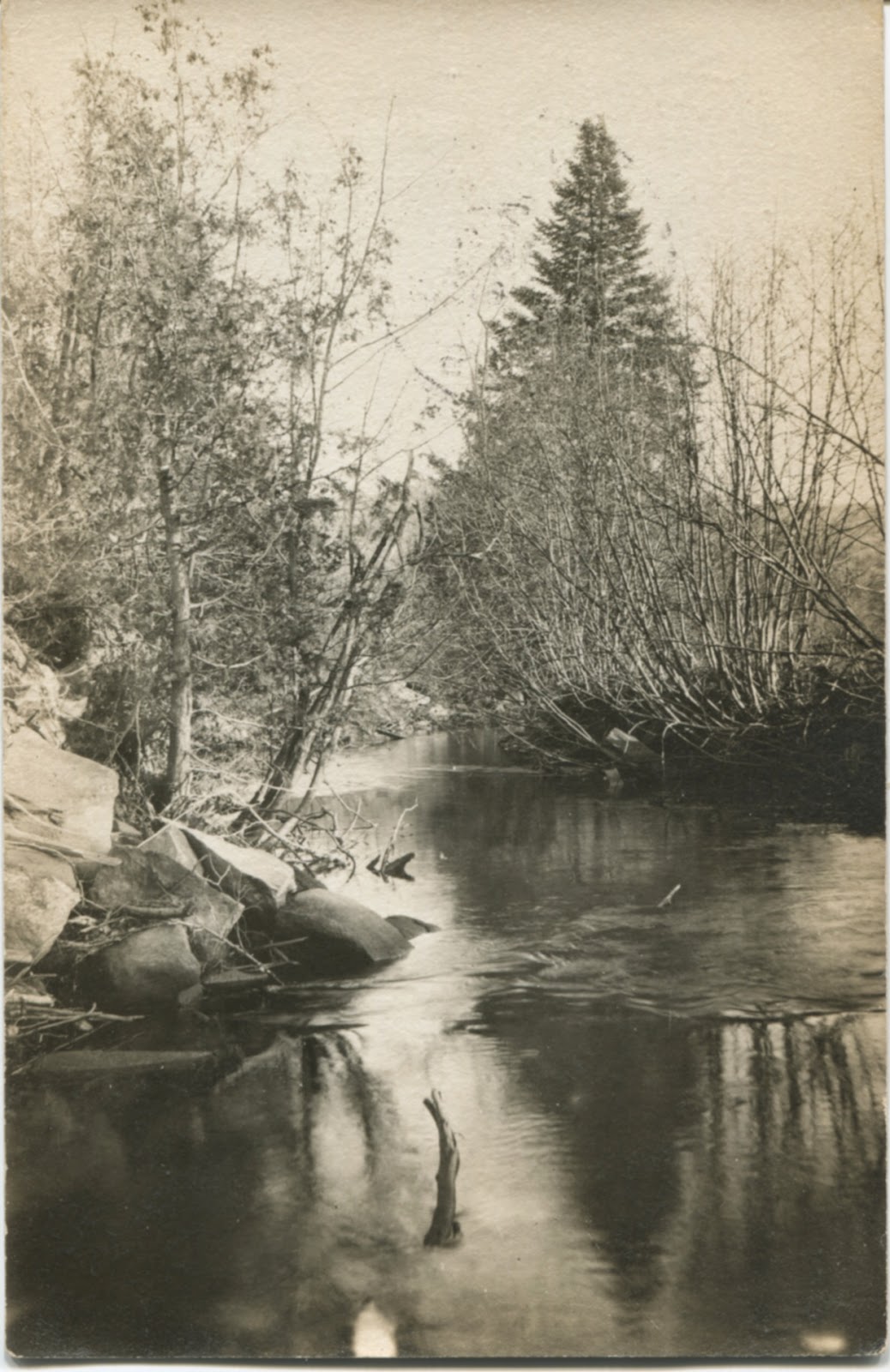
Every Postcard Tells a Story -- This One, in Vermont in 1907

(front)

(rear)
One of the mysteries I'm now writing is set in 1899 -- which makes this 1907 postcard "close enough" in terms of noticing how people write to each other. I find it particularly intriguing because of the sender's signature. But that's getting ahead of the story.

Charles Augustus Choate Jr., known to his friends as "Chubb," lived and farmed in Barnet, Vermont. He was born in 1871, and on August 19, 1903, he married a "girl" 10 years younger than himself, Pearl May Field (born May 9, 1881, in Brookline, Vermont). In the records that refer to his wife, she's always called "Pearl M. Choate" -- very reasonably.

But on this postcard -- showing a photo of the stream near her farm home --which she sent to her somewhat older friend Mrs. Jessie M. Titus (b. 1862) in Springfield, Vermont, with Christmas greetings in December 1907, she signs herself "Pearl Field Choate." Why?

The suggestion is that her friend Jesse may know the Field family in a meaningful way. Some confirmation comes in looking up where Brookline, Vermont -- Pearl's birthplace -- is. It turns out it's a small town south of Springfield. Good backing for this guess!

Finally, one more curious note about this card: It's easy to find Pearl M. Choate's marriage, and the years that belong with her husband Charles (1871-1930) -- but the Choate family trees online don't show Pearl's date of death, and neither do the Vermont records. It took some searching to figure out what happened: In 1949, the long-widowed Pearl May (Field) Choate married Joseph Devins of  nearby Ryegate. Her Vermont death certificate is under the name Pearl Devins, October 17, 1962, in St. Johnsbury, Vermont.

I hope some of the keepers of the Choate family trees will ink in this detail; I think it's sweet that Pearl had another marital chapter, and hope it was a very happy one.

Wednesday, April 30, 2014

Learning from Common Core Standards While Revising CHARLIE'S PLACE

This Vermont home is like the one I picture for Charlie's new friend John.
Yesterday and today have been revision days for one of my books in progress, Charlie's Place -- the third-grader story set at Ben Thresher's Mill in Barnet, Vermont, underway with co-author and teacher Sue Haven Tester. In addition to tightening the story and making the action as clear as possible, I've been following Sue's suggestion to wrestle with making the book's vocabulary more varied and rich. Along with this is the skill of embedding more challenging words in multiple ways in the text, so readers become familiar with their usage in varied context.

Today's adults looking back fondly at Grade 3 may be surprised at the actions that third graders are expected to take as they read new material in school. This is part of what I see as the improvements we're invited to make in teaching, and therefore also in the books we write for the kids to enjoy: The Common Core State Standards (CCSS) are a teacher-led and state-by-state adopted set of goals to work toward, one after another, so that our graduating high school seniors can tackle life at an adult level. So, here's what third graders need to be doing with the story they're reading (in addition to enjoying it!):
Assess.
Critique.
Formulate.
Hypothesize.
Cite evidence.
Develop logical arguments.
Today I took great pleasure in reshaping this paragraph to develop text with more depth, including several ideas that Sue contributed:

Charlie looked way up at that boy’s face and worried. The boy made clown-like faces. He pushed close to John and said more things. John covered his ears. John said No! Charlie got angry. The mean boy was scaring John. Charlie hit the massive boy. Stop! No!
But I also paid attention to this passage, weaving back into the text some special terms I'd introduced earlier:
There was water everywhere, with pieces of wood floating in it. It was too dark to see the turbine or the penstock, but the little bit of light flickered on the moving water. Was Old Ben shining a flashlight while he repaired the turbine? No, nobody could fix things in the cellar with this much water, not even Old Ben. The stairs kept shaking. Now Charlie felt scared. 
And it was also a good day to outline the nonfiction material for the end of the book, where (me being me) I suggested a timeline to organize the information and investigations that readers might add to their experience of the story. 

Have you guessed yet from the way the text paragraphs here are written? Charlie is deaf ... at age eight, in about 1956 in Vermont. Things were very different then. I'm enjoying painting in the details, along with things that haven't changed at all, like the chest-quivering sensation of thunder, the comfort of morning pancakes with Grandma, and the satisfaction that comes from being as brave as possible, in a scary situation. Know what I mean? 

Friday, February 21, 2014

Learning to Write Better, Because My Co-Author Teaches Third Grade

East Barnet Schoolhouse, courtesy Janice Boyko
--> I'm working on the second draft of CHARLIE'S PLACE, a book for third and fourth graders -- and my co-author, Sue Tester, is behind many of the details in this revision. (I wrote the first draft, based on our plotting and character sessions together.)
Sue teaches grade 3 now and has taught others, and she taught me some Common Core Standards vocabulary to go with what we're now doing to the text: working on rich vocabulary that takes readers into the text. On my own, I then poked into Bloom's Taxonomy of Learning, Webb's Depth of Knowledge, technology in classroom learning ... 

I also took a course this January on the "arc of the story," and it helped me zoom through my plot twists and focus on character in fresh ways. But Sue and I are writing the kind of book where every word matters. Partly that's because it's for younger readers. Partly it's because I care about words as a poet does. And now it's also because Sue is showing me how to carry this into her classroom effectively.

Some of this is new names and frames for what good writers/storytellers do, and all of it is pushing me to dig deeper, think harder, write better. Here's a small example of the changes happening, as we take 8-year-old Charlie into school for his first time, around 1956:
First draft: Charlie looked around. Big windows made the schoolhouse very bright inside. Two windows had small screens at the bottom of them. Air from outside came to Charlie through the window screens.

Second draft: Charlie looked around. Big windows made the schoolhouse very bright inside. Two windows had small screens at the bottom of them. Charlie noticed the late summer breeze slipping into the room. Some of the outdoors came inside this way. 
Good.  It's exciting for me to see my own writing and revision process as part of what's happening in US classrooms where teachers are using the new Common Core standards. I like this chart from teaching coach Tracy Watanabe (http://wwwatanabe.blogspot.com), showing the deliberate changes that teachers are aiming for.


PS to Barnet, Vermont, and Ben's Mill readers and fans: The East Barnet schoolhouse photo is a good one, a bit earlier than the time when this story takes place.  I'm actually picturing for the story the West Barnet schoolhouse, which, when I moved to town in 1986, was the home of K&M Sales and I believe had been a Grange hall as well. If you have photos, I'd love to see them! 

Sunday, March 3, 2013

The Underground Railroad in Vermont: Call It the "Aboveground Railroad" Instead!

Jane Williamson, director of Rokeby, Vermont's premier authenticated Underground Railroad site, often points out how literal the thinking is of third graders, who arrive at her historic center, eager to see the "trains that run under the ground." She has many other things to show and teach them, but sometimes they are still baffled that they haven't yet found the train.

With adults, both director Williamson and I find widespread attachment to the romance of the Underground Railroad myth in Vermont. As she says, it would be better to call the movement of African-American fugitives here in the 1800s "the Aboveground Railroad." Most Vermonters believed slaveholding was immoral, and that all humans should own their own lives. Dark-skinned fugitives arriving in the state weren't just assisted in their travels -- at places like Rokeby, they also could polish their skills for independent living and move toward owning their own land and businesses, from earned wages that they saved. Moreover, Vermont was so far from the slaveholding states of the American South that the vision of the fugitive cowering in a hidden room while the slavehunter passed by was a fiction; African Americans worked on farms, established homes, and nurtured their families here.

Many otherwise well-informed adults still leap to the conclusion that a "hidden room" in Vermont had a connection to the heroic labors of the Underground Railroad. Usually there are other reasons for such rooms: for hiding alcoholic beverages, or money, or, much later, Chinese migrants barred from entering America from 1882 to the First World War. Sadly, some rooms may have been the final resource of family members who weren't "fit to be out in public." Increasingly, rooms found near chimneys or in much-rearranged homes are remnants of homeowner layout changes -- say, changing from a wide old fireplace to a narrower chimney for a furnace.


At the Goodwillie House in Barnet, Vermont, a site that plays a role in my book The Secret Room when Shawna and Thea visit to test some of their ideas about the Underground Railroad, there is a double-walled section of the cellar that long had a rumored description as an underground railroad hiding place. I'd rather see it as a place the Rev. David Goodwillie -- who served Barnet as pastor, postmaster, and more -- might have put a few things he didn't want all his relatives to see. Or perhaps his wife stored the best potatoes and carrots there, to still have a few by the time the winter dining reached Easter Sunday!

Here's a newly acquired portrait of the Rev. Goodwillie, as well as a photo of the brickwork inside the house. There's a lot to explore here, and a lot to discover. Historical research backs up the best of the stories of the Goodwillie House, and one of my favorite bits is knowing that the family here had the first sheet-iron stove in town, and even added pipes to bring water inside the house, quite an innovation at the time.

The Barnet Historical Society opens the Goodwillie House several times each year, and often the town's eighth graders welcome visitors. Inquire for details or make an appointment: http://www.barnetvt.org/historical.php

Friday, March 23, 2012

Interlude: Slowly Planning a Later Novel


One part of my own "writing process" is that there's always another novel coming together in the background. Driving in today's lovely springy weather took me through East Barnet, Vermont -- where the depot in the days of the passenger trains was named "Inwood." Here are three postcard views from the wonderful Northeast Kingdom postcards site provided by Janice Boyko -- one showing a railroad washout, and the other two, views of East Barnet village. Thanks to Marvin Roy, I also have a copy of a scrapbook from a family connected with the huge mill structure you can see in the postcards, home to the Roy Brothers croquet factory.

Weather and wooden structure conspired to destroy the factory three times, and the railroad only runs a freight train now (twice a day). The village is more of a whisper, a bend in the road with a cluster of homes closer together. But there's a story lurking there, and each time I drive through, a little more of it will come clearly. In a few years, I'll know the characters and the plot.

But for today, I know the title: Inwood.

School Days, School Days -- in Poetry School

Although I've lived in the Green Mountain State for almost half a century (!), I didn't grow up in Vermont.  My father, an industria...