Showing posts with label counterfeiting. Show all posts

Tuesday, September 2, 2025

How the WINDS OF FREEDOM Series Reached Book 3


Both softcover and ebook available!


Blame it on that heirloom gold locket that my dad gave to me, after my house burned to the ground. The midwinter fire devoured all the jewelry my mother gave me over the years, all her knitting projects, a half-made crocheted bedspread for my youngest brother that I claimed after her sudden death a few years earlier, saying, “I’ll finish it for you.” Raging on a twenty-three-degrees-below December night, the fire took our clothes, my work, the children’s new Christmas toys. None of that compared to the importance of the three of us escaping, with burns on our faces and frostbite on our toes, from sock-footed hike a third of a mile to the nearest neighbor.


Dad drove north to check on us, a day later. He brought some family photos, thoughtfulness that impressed me; he brought my youngest brother the contractor, who’d never receive that bedspread after all, but who brought me boxes of his spare tools; and he brought the locket. Gold, shaped like a tiny box on a short chain, it opened to emptiness. No photo of anyone inside, but I saw an intricate gold grating that flipped outward. “It’s a hair locket,” he explained. “You put a lock of hair of your beloved into it.”


During the night of the fire, a mile from where my ex-husband lived, the only “boyfriend” in my life was playing music in New Orleans. He got a busy signal when he tried to phone me, and bitterly assumed I’d taken the phone “off the hook” to silence it during a date with someone else. Days later, he’d finally phone a neighbor and learn that a fire burns through phone and electric lines. I didn’t put a lock of his hair into the locket; he left not much later, for a dancer he’d formed a crush on.


When I turned fifty, in accordance with the answer a prayerful friend of mine had received, I met and fell joyously in love with my soulmate. By then, the kids were grown and gone, but on their rare visits home, they agreed I’d finally found the right partner. Next time my darling got his hair trimmed, I collected a curl and popped it into the locket.


Historical fiction already meant a lot to me; a lifelong history writer, and a fumbling novelist, I found the combined threads satisfying. And I wanted very much to give readers a vicarious experience of Vermont’s approach to the Abolition movement and to diverse settlers (setting aside for the moment the state’s sometimes cruel treatment of Native Americans; I’d addressed that in my first work of historical fiction, and the book is a classic, The Darkness Under the Water, but also controversial). I figured, if readers followed along with the teens in my new story, they’d discover for themselves that Black people in Vermont in the 1850s were “free and safe,” as one of the state’s great historians puts it.


If you haven’t yet written a novel, this might surprise you: Often the characters stubbornly diverge from where you thought they were going. So did the girls in The Secret Room: One morning, halfway through writing, I realized at least one of them would head into a dark collapsing tunnel, in a desperate rescue effort. As dirt fell into her eyes and mouth and she moved resolutely forward, one hand landed on an object that she reflexively tucked into a pocket. Later, in daylight, she discovered it was an antique locket.


Yes, there you have it: Dad’s little locket had crept right into my story. So it felt obvious, later, that I’d write another novel, this time set in 1850, when that locket first hung at the throat of a Vermont teen. That turned into The Long Shadow, a book I’d never imagined would be the first of a series.


Yet when I turned it in for publication, the cheerful editor said, “I hope we’ll be hearing more from these characters!” Shaken, I asked, “You mean a series? How long?” She replied, “How about until everyone is free?”


It doesn’t take a lot of American history to recognize that “when everyone is free” probably means the end of our Civil War: 1865. If I wrote a book for each year from 1850 until then, there’d be 15 books in the series. A nifty idea! However: My teenaged characters from the first book would be in their thirties. That wasn’t an age I wanted to write about – I love the voice of a teen observing her world. How could I solve this?


It took another week for the idea to arrive: If the teens had a reason for vanishing from the village at the end of each book, or maybe each second book, and the next book’s protagonist became a girl who’d been younger at the start, and I kept passing it along that way — well, you see how it would work, right? Sort of a relay race, passing along the Vermont fight for human liberty to each new girl, or set of girls. Yes! On the spot, I decided (since I’m far from young) that there would be two-year jumps between the books in the series. That meant seven or eight titles, which seemed workable, as long as I took my vitamins and avoided any repeat of the disastrous housefire.


Now we are in book 3 in what the editor and I decided to call the Winds of Freedom series. Almyra Alexander, who showed up in book 2 as a fashionable girl from Boston, longs to be a minister, a difficult if not impossible path for a woman in 1854. The Vermont village, with its changing ideas about people and their roles, may give her a way forward toward her dream.


But first she’ll have to puzzle out several newly arrived women at the local tavern, what they are carrying around the county, how to handle an aging criminal who arrives while her uncle the minister is out of town, and whether she can effectively assist the cause of Abolition.


If you’re ready to find out whether Almyra is up to those challenges, and what the risks are, and what allies she’s recruiting — get ready to read The Bitter and the Sweet.

Tuesday, August 26, 2025

Majoring in Art? Counterfeiting in the 1800s Offered You a Good Income


I've always enjoyed historical fiction. It's the classic "spoonful of sugar" for the facts of our past. As a writer of historical novels, I'm responsible for getting the underlying details—skirt fashion, maple sugaring, weather extremes, and famous persons like Harriet Beecher Stowe (real-life author of Uncle Tom's Cabin)—all correct in the stories I spin. My goal is to give readers an enjoyable ramble through Vermont's 1850s in my Winds of Freedom series, while making sure their experience in the lives of the characters is true to life.

The Long Shadow, This Ardent Flame, The Bitter and the Sweet: These are adventures of teens in the village of North Upton (based on our real North Danville), and each one explores the level of risk the teens undertake. There are scary threats around them, and as anyone who's lived in snow country knows, winter can be the most potent threat of all.

But each book also handles the dangers of 1850s life, from bounty hunters to deadly disease to unquenchable fires that take down houses, barns, and life itself.

In The Bitter and the Sweet, one of the scary aspects is counterfeiting. It took decades for the American system of coins, paper money, and banks to develop. Rampant counterfeiting took place in the 1820s and 1830s, and the effects still made problems for anyone dealing in Big Money in 1854, the year of this novel.

Historians divide written evidence of the past into two kinds: primary, written by the people alive then, and secondary, the books that the historians then write, where they line up the details and pull together the themes. For The Bitter and the Sweet, I used a "secondary" source called A Nation of Counterfeiters: Capitalists, Con Men, and the Making of the United States, by professor Stephen Mihm. (He also kindly answered some correspondence as I narrowed the details I'd be using in my story.)

I already knew about Vermont counterfeiter Christian Meadows, whose history is repeatedly rediscovered for popular articles (here's one). A skilled engraver and silversmith, he strayed from his daily work into counterfeiting, applying his skills to the design and crafting of printing plates. He was captured, convicted, and imprisoned -- but did such elegant design work that Daniel Webster spoke up for him, and Vermont governor Erastus Fairbanks in 1853 pardoned him so he could return to the legitimate side of his engraving.

Devouring the well-written pages of Mihm's comprehensive book A Nation of Counterfeiters, I discovered an even more fascinating fellow: Seneca Paige, who led a major collaborative of "money makers," including multiple artists, just across the Canada border from Vermont's Northeast Kingdom. In his later years he "reformed" and his grave in Bakersfield, Vermont, praises his life, saying, “His Loss will be felt by many; particularly by the poor. He was truly the poor man’s friend.”

I wanted my characters to meet this man (under a new name, of course, for the novel: Foster Pierce). But by 1854, the year of The Bitter and the Sweet, he was already that reformed character that won such acclaim. How could I include him in a way that would be true to the facts, but also potentially terrifying to the teens meeting him in their village?

Yes, I solved it. I won't spoil your fun by saying how! But I loved writing this book, and now that it's in print (softcover and ebook), it's a great joy to share the lives of "my" people with readers.

And I remind the artists I meet: 125 years ago, your precision skills could have been making you an excellent living ... as long as you didn't get caught. 

Sunday, November 3, 2024

The Winds of Freedom, Book 3: It's the Money, Honey


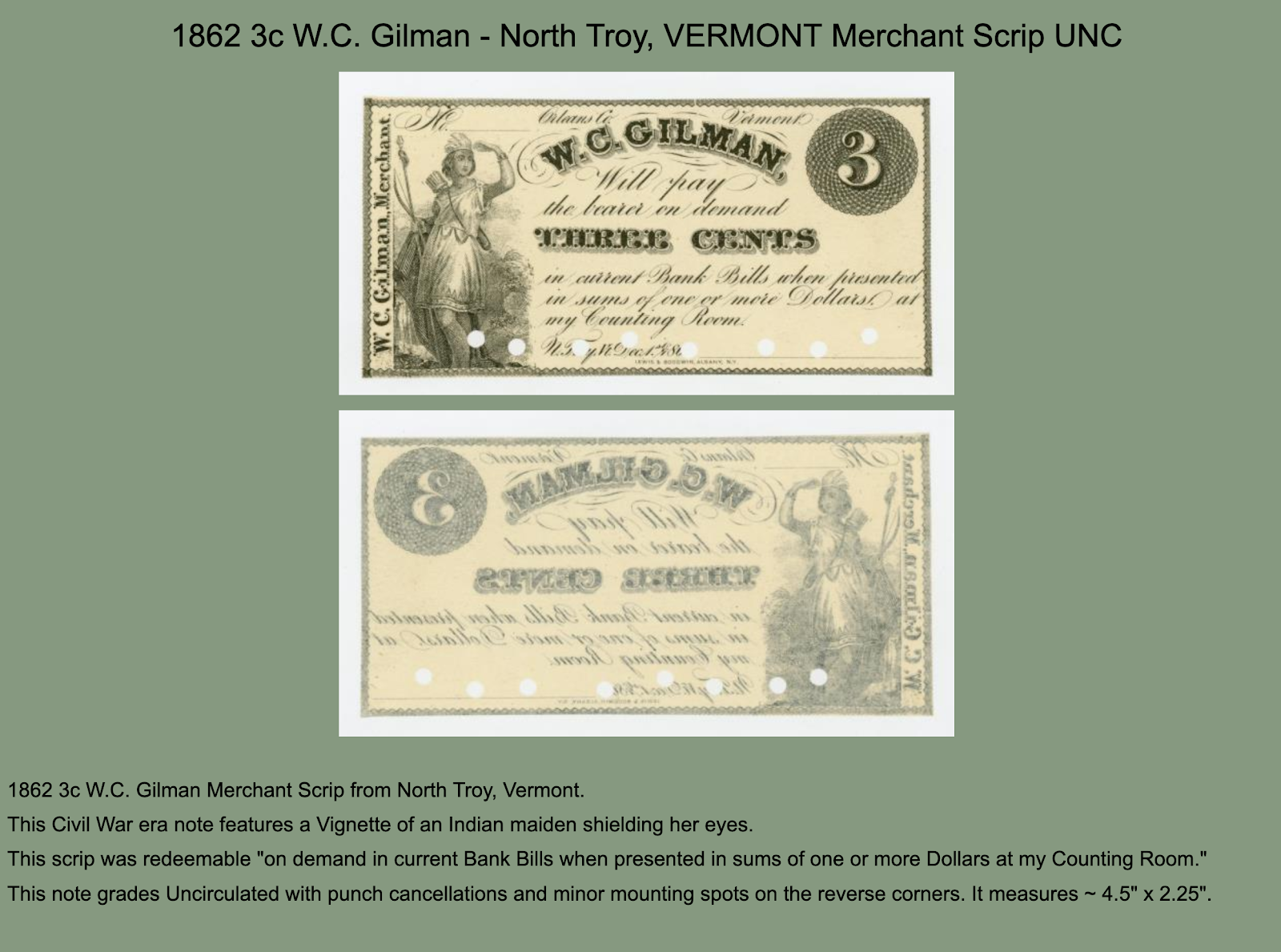
Merchant "scrip" from North Troy, Vermont.

Realizing that the teenaged girl leading the action in THE BITTER AND THE SWEET (Winds of Freedom book 3) would not be either Alice or Caroline -- the teens we follow in the preceding book, This Ardent Flame -- happened well before I started writing book 3. With a two-year jump for each novel in the series, the next protagonist would have to be Almyra Alexander.

Almyra intrigues me for several reasons: She's from Boston, a transplant to the Vermont village of North Upton (aka North Danville), so she's seen more of the sophisticated scenes than either Alice or Caroline. As a result, she brings with her some fashionable clothing and, more importantly, an assertiveness that goes with her outward confidence. That makes her a contrast to the other teens.

But her confidence is a  bit rocky, because she's almost an orphan: Her mother died young, and her father, a political operative, is way too busy to parent his lonely daughter. So when her North Upton aunt and uncle bond with her, and give her the opportunity to stay in the village instead of returning to the city, she's relieved to experience the first real sense of family support she's had in a while.

That's the underlying emotional pin for the book. Add to that her curiosity and unquestioning embrace of the social issues of the day, namely, the abolition of slavery, rights for women, and ending alcohol abuse, and I had the resonant situation that I wanted to write from.

But of course a historical novel is almost always threaded around an urgent plot of some sort, whether it's an adventure, a crisis, or a mystery. Choosing the one for THE BITTER AND THE SWEET came with the discovery of Professor Stephen Mihm's book A Nation of Counterfeiters: Capitalists, Con Men, and the Making of the United States. Not only is this book full of tales of criminal and law enforcement action in our nation's early years, but -- to my astonishment -- one of the major locations for counterfeiters in the early 1800s was our own borderlands of the Northeast Kingdom and Canada's Eastern Townships.

Professor Mihm even replied to some emailed questions, and soon I was on my way, deep into the new manuscript.

MARK YOUR CALENDAR: We'll have a party for THE BITTER AND THE SWEET at Kim Crady-Smith's Lyndonville, Vt, shop, Green Mountain Books, on Saturday Nov. 23 at 11 am. Later the same day, at 2 pm, I'll talk about the book at the North Danville Brainerd Memorial Library, and explain Danville's own connection to the counterfeiting landscape!


The Poetry of Transitions: What Is Poetic Language?

On Thursday July 16 at 6:30 pm in the Davies Memorial Library in Lower Waterford, Vt., I'll be chatting about my new book THRESHOLDS (fr...