Showing posts with label Beth Kanell. Show all posts

Tuesday, September 2, 2025

How the WINDS OF FREEDOM Series Reached Book 3


Both softcover and ebook available!


Blame it on that heirloom gold locket that my dad gave to me, after my house burned to the ground. The midwinter fire devoured all the jewelry my mother gave me over the years, all her knitting projects, a half-made crocheted bedspread for my youngest brother that I claimed after her sudden death a few years earlier, saying, “I’ll finish it for you.” Raging on a twenty-three-degrees-below December night, the fire took our clothes, my work, the children’s new Christmas toys. None of that compared to the importance of the three of us escaping, with burns on our faces and frostbite on our toes, from sock-footed hike a third of a mile to the nearest neighbor.


Dad drove north to check on us, a day later. He brought some family photos, thoughtfulness that impressed me; he brought my youngest brother the contractor, who’d never receive that bedspread after all, but who brought me boxes of his spare tools; and he brought the locket. Gold, shaped like a tiny box on a short chain, it opened to emptiness. No photo of anyone inside, but I saw an intricate gold grating that flipped outward. “It’s a hair locket,” he explained. “You put a lock of hair of your beloved into it.”


During the night of the fire, a mile from where my ex-husband lived, the only “boyfriend” in my life was playing music in New Orleans. He got a busy signal when he tried to phone me, and bitterly assumed I’d taken the phone “off the hook” to silence it during a date with someone else. Days later, he’d finally phone a neighbor and learn that a fire burns through phone and electric lines. I didn’t put a lock of his hair into the locket; he left not much later, for a dancer he’d formed a crush on.


When I turned fifty, in accordance with the answer a prayerful friend of mine had received, I met and fell joyously in love with my soulmate. By then, the kids were grown and gone, but on their rare visits home, they agreed I’d finally found the right partner. Next time my darling got his hair trimmed, I collected a curl and popped it into the locket.


Historical fiction already meant a lot to me; a lifelong history writer, and a fumbling novelist, I found the combined threads satisfying. And I wanted very much to give readers a vicarious experience of Vermont’s approach to the Abolition movement and to diverse settlers (setting aside for the moment the state’s sometimes cruel treatment of Native Americans; I’d addressed that in my first work of historical fiction, and the book is a classic, The Darkness Under the Water, but also controversial). I figured, if readers followed along with the teens in my new story, they’d discover for themselves that Black people in Vermont in the 1850s were “free and safe,” as one of the state’s great historians puts it.


If you haven’t yet written a novel, this might surprise you: Often the characters stubbornly diverge from where you thought they were going. So did the girls in The Secret Room: One morning, halfway through writing, I realized at least one of them would head into a dark collapsing tunnel, in a desperate rescue effort. As dirt fell into her eyes and mouth and she moved resolutely forward, one hand landed on an object that she reflexively tucked into a pocket. Later, in daylight, she discovered it was an antique locket.


Yes, there you have it: Dad’s little locket had crept right into my story. So it felt obvious, later, that I’d write another novel, this time set in 1850, when that locket first hung at the throat of a Vermont teen. That turned into The Long Shadow, a book I’d never imagined would be the first of a series.


Yet when I turned it in for publication, the cheerful editor said, “I hope we’ll be hearing more from these characters!” Shaken, I asked, “You mean a series? How long?” She replied, “How about until everyone is free?”


It doesn’t take a lot of American history to recognize that “when everyone is free” probably means the end of our Civil War: 1865. If I wrote a book for each year from 1850 until then, there’d be 15 books in the series. A nifty idea! However: My teenaged characters from the first book would be in their thirties. That wasn’t an age I wanted to write about – I love the voice of a teen observing her world. How could I solve this?


It took another week for the idea to arrive: If the teens had a reason for vanishing from the village at the end of each book, or maybe each second book, and the next book’s protagonist became a girl who’d been younger at the start, and I kept passing it along that way — well, you see how it would work, right? Sort of a relay race, passing along the Vermont fight for human liberty to each new girl, or set of girls. Yes! On the spot, I decided (since I’m far from young) that there would be two-year jumps between the books in the series. That meant seven or eight titles, which seemed workable, as long as I took my vitamins and avoided any repeat of the disastrous housefire.


Now we are in book 3 in what the editor and I decided to call the Winds of Freedom series. Almyra Alexander, who showed up in book 2 as a fashionable girl from Boston, longs to be a minister, a difficult if not impossible path for a woman in 1854. The Vermont village, with its changing ideas about people and their roles, may give her a way forward toward her dream.


But first she’ll have to puzzle out several newly arrived women at the local tavern, what they are carrying around the county, how to handle an aging criminal who arrives while her uncle the minister is out of town, and whether she can effectively assist the cause of Abolition.


If you’re ready to find out whether Almyra is up to those challenges, and what the risks are, and what allies she’s recruiting — get ready to read The Bitter and the Sweet.

Sunday, December 1, 2024

Poems Published in 2024: "Body in a Box"


What joy it was to enter the pages of Cathexis Northwest Press with this poem, reflecting on how Dave seems often very present, even though his "remains" are buried at the beautiful Mt. Pleasant Cemetery in St. Johnsbury, Vermont. See the poem and the rest of the issue here. (The poem is on page 43.)


Wednesday, September 27, 2023

Recently Published Poems, Stories, More


Rise Up Review, winter 2022 issue, "Psalm for Gaza."

Medium Day tutorial video on writing novels (and more): Make a Promise In Your First Chapter. 

Persimmon Tree, poem, "Forget-Me-Nots."

Written Tales Magazine, poem, "Storm Surge."

RitualWell, poem, "Ten Plagues Sestina." 

Gyroscope Review, winter 2023, poem, "Letter from This Morning's Burdock Plant."

Lilith Magazine, Feb. 2022, "Knit. Purl. Repeat."

Journal of Radical Wonder, "Rescuing the Abandoned Property in Vermont."

Lilith Magazine, "Mythic Under the Radiation's Red Eye."

Mystery and thriller reviews being added steadily at New York Journal of Books.

Sunday, February 21, 2021

Vermont History Comes Alive -- on the Pages, and in Short Videos

Photo by Darcie McCann

A huge joy in my writing life is researching and writing articles for the North Star Monthly that focus on remarkable people of this region of Vermont, whose lives and adventures have become part of our history.

Many people ask me, "How did you get the idea to look into that one?"

So I've started a series of short videos on "where this story came from." If you're curious, you can check them out at my YouTube page, or go directly to one of these:

The Fur Farms of Vermont

Pioneering Aeronauts of the NEK (Northeast Kingdom of Vermont)

I'll add another each month. Hope you enjoy these!

Sunday, August 2, 2020

Finding Prime Resources for Historical Fiction/Mysteries

Some of the best historical resources seem to arrive here by chance: a letter postmarked nearby in the 1800s (I have three from the postmaster of West Waterford to his son, located at a postcard show), a local inventor's identity (the "improved egg case" opened up research into Edward Everett Bishop of Waterford, Vermont), or a photo album that suddenly surfaces as a gift to a local group (thank you, Jamie Ide, on behalf of the Waterford VT Historical Society!).


Last Tuesday evening, that Muse of Historical Research -- to the Greeks, that would be Clio -- tapped my shoulder during a virtual panel of mystery authors "at" the Tewksbury (Massachusetts) Public Library. Tewksbury is one town east of Lowell, the marvelous center of fabric mill invention that anchored the Northern profits from Southern enslavement. As of 1840, there were 32 mills in the city. Readers of Katherine Paterson's historical fiction may have pictured the lives that the "mill girls" led there (see Lyddie); those who've pursued history tourism in New England may have visited the remarkable National Park that now embraces some of the remaining mill structures and stewards their history. American freedoms, gender roles, Labor as a force in politics, all these and more can be embraced in the history in Lowell.

But I hadn't known about Tewksbury. One of the people attending the author panel mentioned "the old library" and the librarian moderating the panel sent me a link to some photos that reminded me of the libraries I haunted in the 1950s and 1960s.
The "old" Tewksbury Public Library.

Then, of course, I began to explore what this urban library offers in the way of historical collections, and here's what I found in the town public history collection there:

Tewksbury History Topics

  • Anne Sullivan and the Tewksbury Hospital
  • Captain John Trull (Tewksbury Minuteman)
  • King Philip's War
  • Lowell Mill Girls and Women
  • Merrimack River
  • Mico Kaufman (local sculptor)
  • Tewkesbury, England (Town namesake)
  • Town Anniversaries (including 200th Anniversary Time Capsule)
  • Tewksbury State Hospital (State Almshouse)

Link to online historical patient registers
Visit the Public Health Museum at Tewksbury Hospital

  • Town of Tewksbury Annual Reports (1878 - present)
  •  Wamesit Indians
Any one of these could slip into the books I'm writing, set in Vermont in the 1850s and 1860s, when Vermonters still saw Massachusetts as the place where the War of Independence began, rather than a traffic nightmare or a set of distant museums and restaurants. I also discovered that Tewksbury was struck by a devastating tornado in 1857 -- something that may go directly into Book 4 of my Winds of Freedom series.

Most of all, I get the sense that Clio the Muse is always ready to alert me to "something old, something new" to learn. You know, I used to feel a little guilty that I took the writing path, instead of going boldly abroad for adventures. But it occurs to me now -- every time I find another prime resource like the Tewksbury Public Library, I'm having an awesome adventure. Just wait and see what comes up in the next couple of novels I've got rolling! (Don't you love being able to share the adventure, too?)

Monday, July 27, 2020

Writing for Readers: The Big Story, the Essential Connections

On Tuesday July 28 ("tomorrow" as I write this), in the evening, I'm joining other authors for a virtual panel discussion at the Tewskbury, Massachusetts, Public Library. The title of the event is "How To Publicize Your Book."

Why?

Readers (and new writers) often think publishers take care of getting the word out about good books. After all, the words seem tied together: publisher, public, publicity.

But the "new world" of book publishing began at least a decade before the pandemic turned things upside down. Letting readers know about a book and its exciting revelations is now, for most authors, part of the writer's responsibility. True!

Let's face it. Promotion isn't usually what a writer has polished and practiced. For me, writing a great story, with details that intrigue readers about American history (especially the Vermont version) and celebrate the growth of the protagonists -- mine always tackle some injustice -- is where the effort has to be invested. Write a good story!!

So promoting that story, once it's in print, needs to be direct and effective. For me, that means starting where my heart is: at "home," whether that's geographic, or in the circles of friends on social media, or among other writers as we connect with each other.

You'll hear about my new research and writing projects here first: on the blog, and on my Facebook writing page, and even on my personal Facebook page.

And the closer we get to publication on a project (This Ardent Flame is scheduled for June 2021, even though I turned in the writing in February 2019 ... there's a pandemic affecting everyone, right?), the more I ride those circles of connection outward.

With that in mind, here are some tips for writers, and for readers who love to promote a good story (I'm hoping you'll include the first title of the Winds of Freedom series, The Long Shadow, which came out in 2018 -- have you read it yet?).
1. Keep your friends informed and engaged. Reveal surprises in research; share a bit of a struggle about how to shape a character; describe milestones in writing and publication of your work.

2. Ask friends to pass along word when they enjoy something. Your circles overlap other circles. Let them spread.

3. Celebrate and rejoice. We all need support and cheering up, whether in a pandemic or not — name the reasons for joy and satisfaction in your writing life and share them, with virtual balloons, so to speak!

4. Value your circles. Sure, time may be tight (you want to start writing the next scene), but if you're checking your own social media posts, make sure to check those of friends also, even if what you can give is five minutes of adding "likes" and smiley faces and "Wow!"

5. Remember the world is connected in ways that astonish and refresh. Introvert type happy to be at the desk solo? You can still take a couple of steps toward the "windows" and nurture the connections around you. This is how we make it a better world. And for me, it's part of how I keep "growing" my soul, so that the next book I write is even better than the one before.
Takeaway: Promoting your work in the best ways can make you a stronger, more responsive and resilient writer. Which makes it worth the effort.

Friday, August 16, 2019

Discussion Questions for THE LONG SHADOW

Even as teenager Alice Sanborn begins to question the boundaries of life in her Vermont village of North Upton, her boldest actions come from taking seriously the "rules of life" she's grown up with: education, friendship, moral imperatives like correcting evil, and of course working together to make life reasonably comfortable through four seasons. Vermont winter is a force to reckon with! Consider Alice's experience as she rides up Sheffield Heights in a March blizzard:

As the sleigh tilted sideways, I found my wits and scrambled out of my side of it, struggling to pull downward and keep it from completely capsizing. Sarah and Jerushah clung to the back of it, crying out.
            So much noise and commotion—perhaps it helped to keep the invisible animal in front of us from coming closer. Its growl rose in volume, however, and the horse reared onto its hind legs. Solomon still clung to the bridle. I grabbed Sarah and pulled her free from the sleigh, and Jerushah scrambled out, just before it capsized fully into the snowbank at the left side of the road. The horse managed to come down in a half turn, dragging the capsized sleigh back the way we’d come. Solomon yelled and swore. One of his legs, caught in the leather straps of the reins and harness, jerked him so hard that he let go of the horse’s head at last and fell, yelping with pain as his shoulders struck the roadway.
            But I had eyes only for what stood revealed in front of us, a dead lamb dangling from its jaws, and the crescendo of its growl rising into a high-pitched threat: wild-eyed face suddenly visible in a gap in the snowfall, legs tensed to leap, body easily three feet long and muscular, and the long tail slashing back and forth behind it. A catamount. The fierce and powerful beast of the mountains stared at the three of us as we clung to each other, unable to think beyond the screams that erupted from all of us at once.
Here are some issues to consider after reading the book:
  1. Would you want Alice for a friend yourself? Why or why not?
  2. How different are the roles of teen boys and girls in the 1850s? In what ways does Alice fit the expectations -- and how does she push back against them?
  3. The "Underground Railroad" is an exciting part of American history -- but it doesn't fit well into Alice's experience in Vermont. Name three things that show why Vermont in the 1850s had an "aboveground railroad" for dark-skinned people traveling north.
  4. Readers often groan at the amount of work Alice does, just to get through an ordinary day. Which tasks surprised you? How has daily life changed so that you are not doing those tasks?
  5. Alice, like her neighbors in the village, sees slave-holding as a sin against man and God. A decade after THE LONG SHADOW, a "war between brothers" will split America around this issue. Problems that remain in today's America would be, for Alice, part of the "wages of sin." Do you agree? Give examples of some of these problems.
Curious about a detail or can't decide about an issue? This Vermont author makes book-group visits, in person, via email, and via Skype or FaceTime. Get in touch!

Friday, July 19, 2019

Vermont Digging: Waterford's "Business Community" in the 1800s

The trouble with research -- and also the delight -- is that it takes on its own compulsions. The further I get on exploring a piece of Vermont history, the more I want to know.

Yesterday I followed threads on Waterford's merchants and manufacturers. To the publishers of "Walton's Register," a business directory combined with weather almanac and political "who's who," these were the prime categories of the people who kept Vermont growing. Manufacturers created goods. Merchants sold them.

The earliest "Walton's" that I have is from 1840, and cost me a pretty penny, as the expression goes. Sometime after after 1870, for a while, and then after 1931, these little guidebooks took on a new name, the Vermont Year Book. I'm sure it felt more modern at the time!

I was looking for details on these businesses in my town, a Connecticut River settlement at the southern edge of the Northeast Kingdom. Along with looking for trends and growth areas, I especially wanted to find out something about Edward R. Goss, whose name is on the general store pictured above.

The hunt took me through a volume of family history, dozens of Ancestry documents, and volume after volume of Walton's. A Vermont Village:
To my enormous relief, I finally found Edward in the 1910 Walton's -- then realized I could have saved a lot of searching if I'd gone first to the (not always fully reliable) town's volume of history written by Dr. C. E. Harris:

I finally lurched toward sleep, rather later than I'd planned. Proving once again the adage, "You find something in the last place you look for it."

Today I added one more top note to this stack: the origin of the Goss surname, which turns out to center in the West Country of England in the 15th century. Now to the next stage: adding this to my other research on local businesses in the 1800s, and figuring out how to present it all as an engaging story for people who don't suffer from "find out more" compulsion!

If you live in northern Vermont, I hope you may be able to join me on Wed. July 24 at the Davies Memorial Library in Lower Waterford, to look at all this, together, for the Waterford Historical Society meeting. And if you don't live nearby -- relax, you'll get the best of the results packaged into the series of historical novels I'm writing, Winds of Freedom. I've just started Book 3: O Fierce and Kindred Heart. What do you want to be the title gets shortened to Kindred Hearts along the way?

Wednesday, March 13, 2019

Thinking Pink, A Happy Year from My Last Radiation Treatment

Last weekend the Boston Globe ran an opinion piece that said people shouldn't have to crowdfund to pay for their health care. The piece described a man with critical diabetes who fell $50 short of his fundraising goal -- and as a result, the piece implied, he died.

I'm not sure the article made complete sense. But I get the point: Health care should be better than this. Sick people shouldn't have to go out and ask their friends and total strangers to donate, to save them. It's terrible.

Equally shocking, a quick Google search shows that crowdfunding is now supporting cancer research (both breast and prostate, say the articles, showing gender equity).

Wait, does that mean if the lab falls $50 short on donations, it doesn't get the testing equipment or microscopes? Sheesh.

I'm happy to celebrate a year this month since my last radiation treatment for very ordinary, very treatable, and still very scary breast cancer. Great treatment doctors and teams, top-notch support. And thanks to waiting until I was over 65 for the diagnosis, my health care insurance (part Medicare, part gap coverage) took me through this, brilliantly. Without added health care debts. Thank you, thank you, thank you!!! (I try not to remember that if I'd dared to get the diagnosis a year before 65, which might have been wiser in terms of cancer's action, I'd be hundreds of thousands of dollars in debt. Truth.)

There is one other small downer, though: Since I'm self-employed, even though I worked really hard and completed every assignment last year, I didn't have the extra energy for a while to go chasing extra work—and these days, the routine assignments don't cover all the living expenses. Fact of life. For 2019, I'll do better. But gosh darn it, I've still got to make up for that slowdown in 2018.

So I've taken a tip from the Big Research Labs and the little uninsured and everyone in between who's running behind these days financially, and done it my way:

Crowdfunding publication of my awesome (and already award-winning!) Vermont mystery, ALL THAT GLITTERS.

It's simple: Pre-order a copy of the book (click here to see it and browse). You get your money's worth as the book goes to print (we need 750 pre-orders for that), and I'll get a share after that happens, which ought to make up a chunk of the difference in what I needed last year, versus what I earned.

Oh, and if you pre-order three copies -- you get your name into the book as a sponsor. (So, like, you could sign the book next to your own name, really!) One thing I especially like about this route is, you can read the book for free on the website and make sure you're going to like it. (Sure, click here.)

This crazy notion comes via Inkshares, which is printing some really lovely books, on nice paper, well bound, well made ... and without a fuss. I love it!

So if you're in the mood to "Think Pink" may I suggest buying this mystery? You'll have a lot of fun, and you won't have to walk five miles or make people sign your pledge page or call the radio station or any of that. Just click here, and sign up for a book.

Then tell a couple of friends about it. That's how the real "crowdfunding" works. Because getting through modern life takes a lot of help. And trust me—I'll be signing up for YOUR crowdfunder next year.

Hugs and hope to you all!


Monday, February 4, 2019

New Teen Sleuth Mystery ALL THAT GLITTERS Gets First Award!

Zowie! ALL THAT GLITTERS just won its first award -- and it's not even in print yet!!

The Break the Bechdel With Strong Female Characters Syndicate just named "All That Glitters" as its February 2019 pick. Here's why: "All that Glitters" hooks you in the first paragraph and doesn't let go! Beth Kanell has crafted a main character who feels real from the first page, and has already introduced a mother whose voice is all her own-- and certainly someone to reckon with! We can't wait to follow Lucky as she tracks down the person who shot her father, with the help of her two friends who also already show great potential for fully developed roles!

Hope you are following along, on this adventure in off-the-usual-route publishing. After all -- this is OUR Vermont Nancy Drew book (and, just a whisper to you ... like the original, this is a series, with seven more books plotted out already). I always loved Nancy Drew, and was ready for an update. Now, here it is.

Here's that link for the book, and you'll see the Break the Bechdel* "badge" on the page now. Then click the pre-order button (and note the 3-copy version that puts YOUR name in the printed book, too):


* Many readers don't yet know about the Bechdel test -- a relatively new way to look for books with strong, independent female characters. To learn more of its history, check out this link. It's named for a graphic novelist based in Vermont, so I'm especially happy to have it applied to ALL THAT GLITTERS. We're in this together, right?

Hugs and hope for today -- Beth

Tuesday, July 17, 2018

Cold Midnight, Chapter 1 -- By Special Request!


I still have copies available of Cold Midnight, a "YA crossover" mystery set in 1921 in St. Johnsbury, Vermont, and based on a real "cold case" that the town never closed. By special request, here's chapter 1; you can get the softcover book from me, or the ebook online.


Cold Midnight

by Beth Kanell


Autumn 1921

Chapter 1
            The new rope worked much better than the knotted strips of sheets. And it was more than twice as long.
            In the darkness behind the tenement house, untying the knot required her fingers to dig and tug. Claire wished she’d brought a spike or even a nail. A nail – there should be some scattered around on the ground. Easing quietly toward the pool of light spilling from the downstairs parlor, Claire scuffed her shoes until she felt something roll under them, and coaxed it along to where she could see it and pick it up. She moved back against the wall and poked at the knot with the iron point. Done!
            Claire was used to creeping down the back porches and only using her twisted line of sheeting to drop down the last ten feet to the ground. It could hang there until she returned. But the rope was different: she needed to take it with her so she could get where she needed to go.
            The smell of tar hung thick in the warm night air. Main Street, just around the corner from the tenement house, gleamed under its new coat of paving. No sense stepping in the soft black ooze – Claire took the back route around the little green-sided Christian Science church to the alley next to Willis’s hardware. Carefully, she coiled the twenty feet of rope over her left shoulder. On tiptoes, she ran up the three flights of fire stairs, avoiding the windows. Now one long stretch, twenty feet high, separated her from the rooftop. She set her fingers and toes into the brickwork and edged upward.
            After so many times crawling in darkness up the wall, with its fancy brick courses and false window frames extending out as perfect footholds, the climb came easily, up to the last bit where the roof hung over. Until now, the overhang had defeated her. But this time, with her rope, she formed a sling and looped it over a massive iron hook at the roof’s edge, built to grasp the snowload and prevent it from falling on unsuspecting pedestrians in winter. The hook and the rope sling would provide a way to let go of the wall and swing out.
            She tugged at the sling to make sure the knot would hold. It ought to: a square knot, the way her father had shown her ages ago. Blue funk gripped her stomach for a moment. She twisted her left hand around the rope sling, then snatched at it with her right, flying loose from the wall. Four stories above the ground, she dangled from her rope loop. Keep moving, she told herself, and heaved with both arms, until she figured out how to launch her legs up. The scrape of her boots against the roof startled her.
            Don’t stop now. It’s just like on the bars of the swing. Go!
            Seconds later, Claire stood on the roof of the Willis Block for the first time. The size of it had always impressed her, as it stretched across five street-level businesses. Her left arm burned from the rope’s friction, and she rubbed it while she crouched and surveyed this new view of town. She peered down to be sure nobody had seen or heard her – but the coast was clear.
            First she looked west, up the ridge, and oriented herself by the dark bulk of the ancient pines above the town. She could see the distant cliffs block the starry sky. The grand Bateman mansion spread solidly against the nearer slope, gas lamps twinkling in the upper windows. There were no lights in the long glassed greenhouse beside the mansion, but she saw small reflections of the bright stars of early September.
            Slowly, Claire turned north, gazing past the short steeple of the Christian Science church to see the massive stone structure of the North Church, then the brick steeple of the Irish Catholic one. Beyond the handful of large homes at the north end of town, the land rose to Mt. Pleasant Cemetery. She bent to rub one knee, realizing she’d scraped that, too. Most likely her stockings would cover it tomorrow, but she would need to be careful that no signs of her adventures showed around her skirt and blouse, or her mother would grow suspicious.
            Claire swiveled south, toward the dark courthouse with its clock tower, then the imposing halls of the Academy campus – the school halls that she already hated after a single week of classes. Claire frowned fiercely, wishing they’d disappear. For a moment she pondered what it would feel like to set them aflame, the crisp, snapping fire engulfing them in seconds. But she knew it was insane, a wild fantasy she’d never actually try. Her father had warned her about fire-setters and their madness, back before the war, when he still talked to her about real things.
            Claire closed her eyes and made the final quarter turn to face east, down the slope to the downtown, the railroad, the river beyond. For a moment longer, she stood blind, eyelids clamped together. She stretched her arms and hands wide, feeling the cool night air between her fingers. She sniffed the breeze for river scent, but she couldn’t find it. At last, she lowered her arms and opened her eyes.
            Ah! Cramped knuckles and scraped knees faded into insignificance. The town lay out before her as if Claire were its only audience. Golden lamplight and silver starlight splashed through and against windows. Halfway down the hill the French Catholic church interrupted with its dark stone steeple. Closer to her, someone pulled a curtain closed at an upper level. A late truck growled as it pulled up Eastern Avenue toward Main Street. A dog began to bark angrily, a second one yelped in conversation, and she caught a hint of a distant shouting voice.
            They can’t hear me, she thought. They can’t see me. But they are mine, all mine.
            The bells of North Church tolled the hour: ten o’clock. She resolved to explore her rooftops until midnight struck. Seven buildings linked together meant she could walk all the way from here to the edge of the last roof above Eastern Avenue itself. She twitched her rope to lay it flat on the first section of roof, then started walking.
            A surprising number of objects rolled under her booted feet as she scuffed slowly along. Although a rounded wedge of moon showed itself above the eastern horizon, it didn’t light the roof. Claire could feel nails, and the snap of twigs, and something soft that might be the remains of a bird. She tried to avoid crushing whatever it was – the poor thing was most likely mangled enough. Plus, she didn’t want to step in anything that would reek of decay. Continuing to escape the house at night depended on not leaving traces that her mother would notice. Her father, of course, wouldn’t notice if she put her muddiest boots directly onto his lap.
            Placing a hand on a chimney top, she realized someone in the building had lit a fire. Silly thing to do on such a warm night! But on second thought, perhaps it was still warm from cooking supper. At home, supper could take place any time between five and nine o’clock, depending on whether her mother felt exalted that evening. Sometimes Claire’s mother set a row of candles along the table and decorated it to resemble a feast, even when supper was only a reheated slice of Sunday’s pork pie. She’d tear the bread apart with her long slender fingers, instead of slicing it: “This was how his disciples recognized the Lord,” she’d explain. “The way He broke the bread. After He rose again, of course. Drink some wine, Claire. It’s not a sacrament like at church.”
            “You’ve watered it down,” her father would complain if he happened to be there. And he’d take a draw from his flask instead, then forget to finish eating as he shuffled out of the kitchen to the parlor and its darkness. Her mother’s shoulders would slump, half from plain irritation, half from some deeper wound.
            “Pray for your father tonight,” she’d instruct Claire. “Forty ‘Hail Marys’ and then the Our Father. He needs to go to confession.” Her voice louder, she’d repeat, “Robert, you need to go to confession. You can’t take Holy Communion until you’ve confessed to the priest.”
            “Go there yourself, eh,” her father would mumble back, and mutter a curse in French just to annoy her, and drop heavily into his armchair without turning on a lamp.
            The warm chimney also reminded Claire that she was walking above tenements where people lived, over the shops. She hoped their ceilings muffled her footfalls. Who lived in the rooms just beneath her? Mr. Willis, who owned the hardware? No, he lived lower down, right above his store. This place must be his brother’s, the one with all the small children.
            The urge seized her to peer through their windows and catch a glimpse of their life. Could she reach the fire stairs behind this section of the store block? She edged eastward, to the back end of the roof, and squinted into the darkness below. She knew there was another set of stairs, but she had left her rope back by the first set. Besides, she didn’t know how far this set went. She’d have to inspect it by daylight before risking the drop.
            Back to the center again, then south, across the roof of the ladies’ clothing store. Then the two sections joined together below into the grocery and what must be the little bakery. At last she knew she stood above the photographer’s studio. The rising moon lit a low wall in front of her, where the roofline rose to go across the bank at the corner, with a false row of windows along the front.
            The wide, open space of Eastern Avenue yawned in the darkness below. Across the way was the park, and beyond that, the courthouse. A movement among the bushes caught her eye: a dog, scruffy and slow. She could barely hear its faint snuffling.
            When the whistling started, she jerked in place, grabbing the chimney nearest to her to stop a wave of vertigo. Her head spun. The sweet pure whistle rose in a tune she knew: “Listen to the mockingbird,” it trilled. The strangeness of it in her hard-luck town, her town viewed from its high Main Street roofs, nearly blinded her. Then the whistle began to dance around the tune, ornamenting it, pouring it into the darkness as if night were shaped with a space that belonged to music and to joy.
            Just before the tune ended, she realized a boy in dark clothing, with the bulk of a jacket slung over his shoulder, had emerged from the shadows of the park and was walking into the long alley behind the store buildings. By the time she thought to cross the roof and look directly down the side of the building, he had vanished into the darkness, along with his melody.
            In the boy’s absence, the town laid itself out again, nearly silent. Claire walked the roof in the other direction, back to where her rope lay folded, getting the feel of it into her feet. The false windows rising above the front of the photographer’s building offered a good place to perch, so she circled back there. Where her hand rested on the brick wall, she felt lumps like chewing gum. Bird droppings. She scrubbed her hand against her sweater and stuffed it into a pocket, where her handkerchief sat in a ball.
Why would someone build a row of false window arches at the front of a building? Just to make it look taller? There was no glass, nothing behind them except the roof itself. Claire fingered the brick surface carefully before climbing inside an arch, to sit curled within the chilly but strong framework. Looking up the hillside to the west, with the Bateman mansion in the center of her view, she watched the upstairs lamps begin to go out, one after another in a line. The last one lingered a few minutes longer. Someone setting aside his or her clothes, no doubt. Would it be Mr. Bateman himself? No, that upper room must belong to a maid or the cook.
            Below her, footsteps pattered along Main Street. Somebody was running there, keeping close to the block of buildings. She turned to hook an arm more firmly, then leaned cautiously from her position inside the arch, not wanting to make a sound.
            The person in the darkness reached the corner of Eastern Avenue and Claire could see enough to be sure it was a man or a very tall, older boy. His arms were pumping and she could hear his breath, ragged and rapid. From above, the cap on his head looked like one of her father’s uniform caps. He stopped, reached out, and pulled the hammer of the fire alarm box. Then he ran.
            Bells rang loudly in the firehouse down the road and in the Methodist church steeple. Lamps flared higher. Men shouted, and a truck engine roared to life. Claire pressed her back against the wall. Crouching behind the brick edging, she watched: one truck, the pumper; then the second one, its ladders hanging off the end; four men clutching the rails. A fifth man stood by the open doorway, staring down the road, then bolted back inside, shouting again.
            A harsh charcoal smell filled the night, much stronger than chimney smoke. Not far from her, metal on metal screeched and more shouts echoed as the new fire trucks halted just beyond the courthouse. Hunched low, keeping her balance, she ran to the south end of the line of buildings and saw a red flicker of flame at the side of the boarding house beyond the courthouse park.
            Her father would be there soon! The fire bells surely had summoned him by now. Any moment, he might wake her mother, too. Claire needed to return to her bed and be under the covers in case they looked into her room.
            She fled back north along the roofs, fumbled for the loops of her rope, and swung wildly for the steps below. 

Thursday, March 29, 2018

Updated: Talking about THE LONG SHADOW: Events


“One can practically smell the stench of the town drunk and feel the cold in the root cellars . . . the characters are well-drawn. Both adults and teens should enjoy the story and look forward to Kanell’s next book.”
-- Booklist, The American Library Association


One of the pleasures of bringing out a new book is bringing it TO people! I'm looking forward to sharing some of the stories that led to THE LONG SHADOW as I meet with groups over the next few months. Here's the schedule for the near future:

Saturday September 1: Barnet Historical Society -- more details soon! 

And I'll be speaking at the New England Crime Bake in November. Lots to think about before then, though.

Watch for news about the Shadow Photo Collection ...

Saturday, November 7, 2015

New Poems: BACK TO THE GARDEN


The series is piling up nicely. These are first drafts; I won't go to revisions for a while yet. I love the way first drafts pile up, like raked leaves, that same dry scent ...


The scent of the autumn woods, a leaf
caught in my hair – did we choose the place,
or did it pull us relentlessly (it was always
meant to be: this hunger you wake in me,
this place in the chest where October lives).
Once upon a time I thought each question
had to be asked. Now, I only want your mouth
against mine, your pulse, this answer,
real as the twig caught against my shoulder.
Say “maple.” Say “birch.” Say “yes.”

-- BK, 10/30/15
 
A Visit to the Old Place

Every year around this time
with the harvest in, oats, carrots, apples
dry leaves crunching underfoot
we pull the truck out of the barn.
There is room behind the seats for the big thermos
and sandwiches, whose fragrance
fills the space between us: garlic, onion, salt
(oh yes, salt asserts its own fragrance)
and behind us the house diminishes until
the road bends – we enter that wilderness
of need and complaint. Why would God invent
traffic jams, road construction, yellow diggers
surrounded by supervisors in orange vets –
things we have not missed during our autumn.
But we missed the home place, the well of grace.
He drives. I comment. “Things have grown up so much.”
There’s no answer to change, except to grow apples
somewhere else. Shopping mall, parking strip,
cluster of seedy brick shops. Declare MacIntosh. Cortland.
Golden Delicious. Are we there yet? He watches
the odometer, brakes, says “Here. It was here.”
One iron gate hangs loose from a stone pillar,
broken pavement beyond it. A red plastic cup and
crumpled paper on shattered tarmac. Leafless branches
bare and thin as arms escaping a white gown. Some sad smell.
“The angel stood: there.”

-- BK 11/7/2015

Hungry During Deer Season

Going “back to the land” meant hunting: the awkward feel
of cold steel, balancing the rifle, checking the calendar.
That first season of daily hunts, though, the man in my life
did everything the hard way. No snow to track with.
No high-tech clothing for warmth. Each day, perched in a tree
with a bow and arrows, tested at the suburban archery range.
And on the last day of the season, mid afternoon,
he ran breathless out of the forest, arms waving, stumbling:
“Come with,” he gasped, “need you. Carry.”
I wrapped my coat around my swollen belly and followed.

It was a small deer, as deer go. But male, and with antlers,
and the paper tag already fastened to the corpse
as if it needed a toe tag but the hoof couldn’t cooperate:
body, cooling, heavy with the day’s grazing. Close up,
it wasn’t Bambi at all, but coarse-haired, wild, muscled.
“Take the front legs,” my hunter directed me. “Don’t bump
the head into any trees. Lift.”

Even dead, the round eyes shone, ready to capture
the last sunlight. The sun sank into cold twilight
and we lifted, tugged, staggered. How heavy it was,
that awkward, stiffening body. When I stumbled,
he cried out, “Careful! Don’t hurt him!” But my hands
needed to release the hairy skin, the bony leg,
needed to rub in habit and comfort against
the baby bump. Oh child to come, oh little one,
already it’s you, most important in my life.
Not yet for him, bearing his first deer, his heart
wild in triumph and joy – yet the little fists in my belly
struck outward, toward that man becoming a father.

“I need,” I said. “I need to breathe. I need to stop
for a moment to rest my hands.”  And my heart.
Supper to make, but first the kill to report,
and the body to raise high into a tree,
its belly slit, its liver sliced and sizzling in a cast-iron pan.

From here onward, it’s all the other wants
that I’m hearing. I cook. I feed. When the baby comes,
it will be strong, healthy. Hungry.

-- BK 11/6/15

Sunday, May 17, 2015

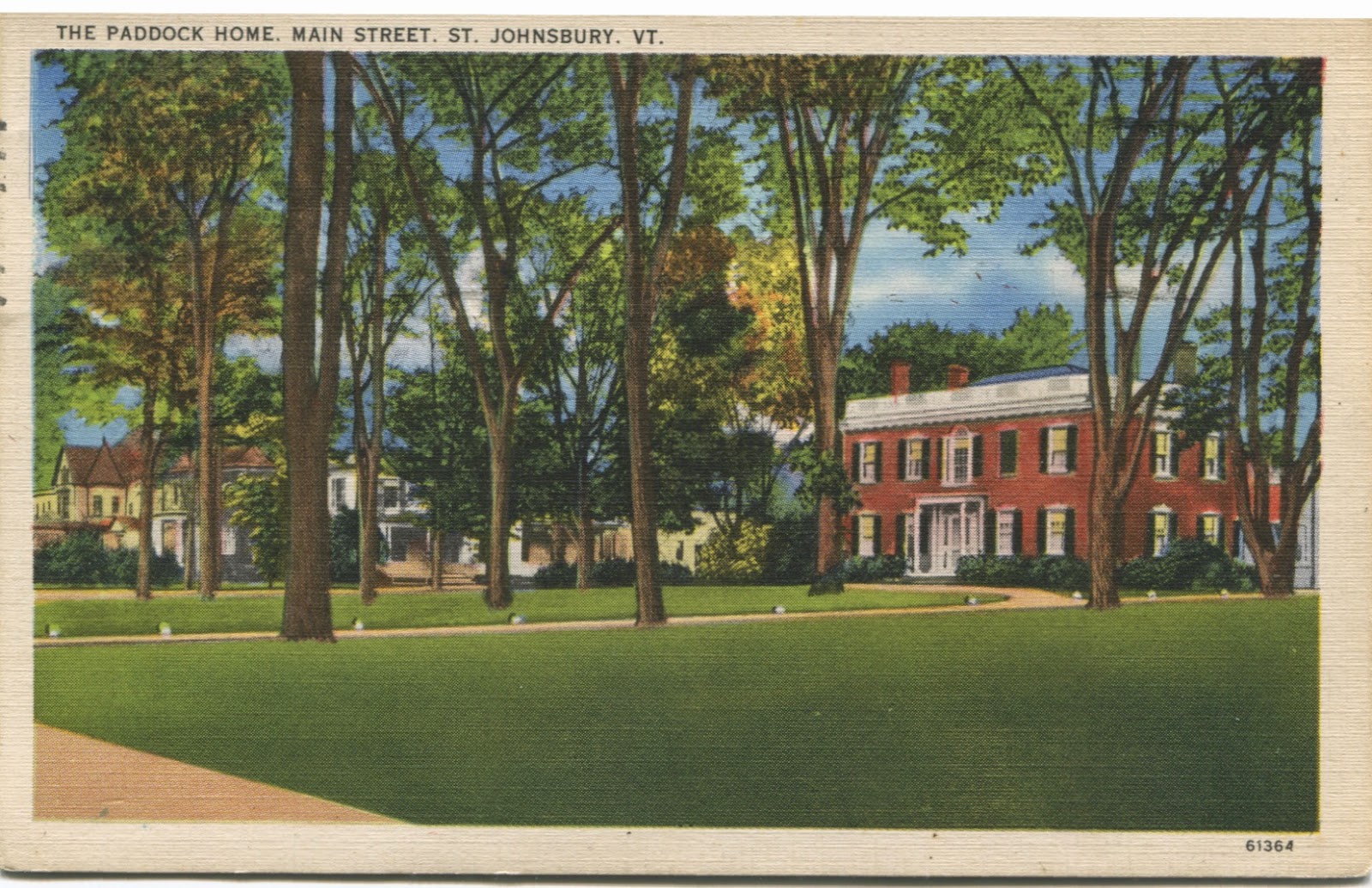
The Real Houses, for the Stories: The Paddock House


My husband Dave recently gave me a postcard image that shows one of the important locations in my 1850 Vermont adventure, THE LONG SHADOW (2018 update: now published by Five Star/Cengage). This is the house where Alice Sanborn and her friends decide they have no other choice -- they race for the horse and carriage and ... but I'm getting ahead of myself. Here, instead, is how the book begins:


THE LONG SHADOW

-->
North Upton, Vermont, March 1850
             
           
            Uncle Martin wiped his plate with a thick slab of graham bread and pressed the gravy-soaked slice all into one mouthful, brushed his hands off on his jacket, and pulled a rustling handful of newsprint out from under his chair with a flourish.
            “Your man’s gone soft of thinking,” he told my father as he shoved the pages toward him. “Webster the golden orator has turned coat on us. What use is the Union to us all, if we let the stinking reek of slave-holding move into the Territories after all?”
            My mother made a small sound of protest. Thump, came my uncle’s fist on the table, and the dishes rattled. At the same moment, I heard a light tap at the kitchen door. At my mother’s nod, I rose to see who had arrived.
            Standing in the dooryard, faces flushed with cold, were my two sweetest friends, both speaking at once. “Alice, school’s finished for the week, the doctor said it’s too close a space, and the Hopkins twins are fevered,” Jerushah announced in a burst, overcoming Sarah’s softer voice. “So will you come across after supper to sew with us? We’ve only one guest at the house, you know, and there’s no stage arriving until Monday, and my mother said to ask your mother.”
            Jerushah was the most beautiful girl in North Upton, Vermont. Her hair shone like black silk, and her clothes were always the latest styles. I loved the way her eyes crinkled with merriment, and her mouth smiled naturally, even when she was at her books. And Sarah, well, she was our adopted sister, we say: a sister dark as tanned deerskin, with deep brown eyes that hold the hurt and horror of all the Africans pressed into Southern slavery. The moment we first saw her, bundled off the stagecoach into the inn as a frail armful, Jerushah and I had pledged ourselves to her. Sarah’s parents still lingered under the wicked South’s cruel lash. But transported north, Sarah stayed safe with us. Though as best anyone can tell she was only some twelve years of age, she had brightened and sharpened in our care so that she studied with Jerushah and me at the schoolhouse. We were both more than fifteen years of age ourselves, nearly out of the schoolroom and into an age of preparing our womanly selves for the years ahead of us.
            I held up a hand to my friends for their patience and slipped back into the steam-fragrant house to ask my mother’s permission. Distracted by a loud interchange between my father and his brother, she gave a short nod and told me to send the others on their way, for my own dinner lay cooling on the table. This I did, dashing back out the kitchen door to brush a quick kiss onto Jerushah’s cheek and then Sarah’s, promising I’d be at the inn across the road as soon as the day gave way to dark evening.
            A roar and more table thumping came from within the house, and I told my startled friends, “It’s news of the Senate and Daniel Webster himself. I’ll tell you everything, later.” They laughed with me, knowing how men love to argue politics, and I watched them pass back to the road before I took a final thirsty breath of the clear March air and returned to the family dinner.

Monday, December 15, 2014

Things Change: In Small Towns in Vermont, Often via Disaster

When my husband Dave and I began investigating the people and events indicated by an 1880 postcard mailed from one small town near us, to another, I opened up a resource that I'd purchased a few years ago, knowing it would be significant -- but at the time, I'd finished one project related to it, and didn't need the details. It was a doctoral dissertation by Northeast Kingdom historian Allan Yale, and gave details of operations at E. and T. Fairbanks, or, as it was locally called more often, the Mill -- or today, "Fairbanks Scale."

Thanks to Scott Wheeler, editor/publisher of Vermont's Northland Journal, I pulled together all the research around the postcard into a story of discovery, with some suprises in it. And that will be an article in the February issue of Scott's magazine.

I gave to Scott images of the front and back of the postcard. I really wanted to also send along images of a building that has an important role in the story, the company store that the Fairbanks factory operated. But I got frustrated, trying to find a good image. This shows the structure at that location, more or less "today," in brick with the name FAIRBANKS inset up high on the building. But I wasn't sure it fit with the 1880s, and didn't know how to find the right version of the building.
Left to right: St Johnsbury Athenaeum, St. J. Fire Dept., "Fairbanks" building, dental office. Circa 2005.


Well, you know how "collecting" can be -- my puzzle inspired Dave to keep searching in his own "ephemera" (the fancy name for items that have a very short lifetime, especially old paper). He found a lovely old stapled booklet of photos of the town, and called me to his work space in triumph: there it was, the Fairbanks company store, probably photographed around 1880 to 1900.

But what a difference from today's lineup of structures! In fact, it's clearly made of wood, not brick, and even the "St. Johnsbury House" next door is not the same building we see today.

Fairbanks company store, left; St. Johnsbury House, right. 1880-1890?


More or less today's St. Johnsbury House. Photo postcard about 1950.
What happened?

Sadly, we know the answer is likely to have been: Fire.

Next task -- find the record of the local disaster that wiped out those earlier structures, and put a date to the change. Even in the past 15 years, St. Johnsbury has seen more than its share of fires in the wooden or wood-framed downtown structures. Someday, the idea of towns that are forced to change via fire, or even via flood (more on that at another time), will seem quaint to us. But today it's still very real. We wish our extended neighborhood a safe winter, and hope this will be a year when fire does not escape its proper place.

"This Is the Real Thing": THRESHOLDS, an Exploration of Transitions

My new book of poems. Available in bookshops and online. My buddy B and I shared a long lunch at a community restaurant today, and wrapped i...