Showing posts with label The Long Shadow. Show all posts

Sunday, October 19, 2025

What If Aging Means Less Juggling? Novels, Poems, Feature Articles, History ...


I have never learned to juggle. I've watched a few people learn it, and it didn't seem terrible -- but as someone who can barely catch a basketball, grabbing smaller items out of the air isn't likely. Actually I don't throw very well, either. (Don't ask about the company baseball team, back in 1973 or so.)

Maybe you have read the "how" of juggling? I leaned on such book-learning for writing "Juggling Parenthood at Seventy," which is in the most recent issue of New Feathers Anthology - you can read it here (it's short). I was thrilled that New Feathers asked for a second poem, too, which again is set in my part of parenting "adult children." (Yes, it's here.)

With the onset of my seventies, I notice changes in how I move, which is no surprise. I'm losing some speed and coordination, but not, thank goodness, determination.

What scares me more than the physical changes are mental ones. I worry each time I can't pull up a word or remember why I was headed into another room. It seems that most of my similar-aged friends have the same worry ... none of us want to become dependent on others for basic life, and that's what those little glitches seem to threaten.

But I can't live under threat as a mood. It's terrible for writing. So I'm trying to be practical, the way I was when I got rid of the last throw rug (I loved it, but throw rugs are a Big Problem in terms of falling, "they" say.)

For writing, that means sometimes narrowing the range of what I'm working on. With the gracious collaboration of editor/publisher Justin Lavely, I'm taking a break from feature articles for The North Star Monthly for a few months at least, and I'm not rushing to write another novel. Instead, I'm making a lot of room for poems. There are scraps and Post-it notes and lists all over this home, with metaphors, bits of lines, ideas for structure. It's working! Maybe I should have tried this sooner.

Meanwhile, though, I'm watching how the novels are reaching readers. If you live in Vermont's Northeast Kingdom, you can buy a copy of The Bitter and the Sweet easily in St. Johnsbury or Lyndonville (thank you, Boxcar & Caboose, and Green Mountain Books). But you might not have heard: I was able to regain rights to the first two books in the series, The Long Shadow and This Ardent Flame, and Speaking Volumes has them back in print, with covers that match the ebooks. You can get the lovely softcovers at those same two bookstores -- and of course, order them in any other bookshop, in person or online.

There's some relief in not juggling as much: I don't worry about hard rubber balls landing on my head. But can I stick with just poetry? Umm, no. Watch for news about a huge historical research project in the wings. 


Monday, September 23, 2024

The Winds of Freedom: How Vermont's Northeast Kingdom Approached Abolition


In this presidential election season, I think it's been clear that the effects of the American Civil War continue to affect beliefs around the country. President Lincoln's long approach to the abolition of human enslavement in America gave us a fundamental piece of today's view of human citizenship in our nation. At the same time, the long delay in getting there, with some 250 or more years of enslavement behind that, contributes to an awareness that we are not always as "good" or principled as we ought to be. And now we have a nation divided on what goodness and principle mean.

In the 1990s, when I began writing my historic novels, I came face to face with prevailing myths in Vermont history that dismayed me. Many of them revolved around the Underground Railroad, one of the heroic efforts in America in the early to mid 1800s. What we know today, historically, is that the Underground Railroad in Vermont might as well have been called the Aboveground Railroad -- because in the theme noted now at Rokeby in North Ferrisburgh, Vermont, if you were Black and reached Vermont in the 1850s (or had lived here for many years already, like the Mero family of Coventry), you were "Free and Safe." No need for hiding places.

But many people couldn't process that idea when I talked about it. So, based on my personal connection with historic fiction, I opted to write about the 1850s here through the voices and experiences of local people, hoping that readers could internalize that experience and reshape their own vision of what happened.

That led to THE LONG SHADOW, book 1 in the Winds of Freedom series, set in North Upton (aka North Danville) in 1850, from the points of view of teenagers enmeshed in adventures there. At the moment, the printed version is out of stock, but you can get the ebook here. Also ask Kim at Green Mountain Books to watch for a gently used copy for you!

More about that story later this week ... and then about books 2 and 3.

If you'd like to hear how the abolitionists of St. Johnsbury, Vermont, and the surrounding towns saw their world in the 1850s and how they entered the movement toward abolition, here's my talk recorded at the St. Johnsbury Athenaeum. I hope you find some fascinating discoveries when you listen/watch it.


Thursday, August 8, 2024

Winds of Freedom Book 3 Is Coming This Autumn!


The Bitter and the Sweet, the third book in my Winds of Freedom series (after The Long Shadow and This Ardent Flame), should be in print by early November -- maybe sooner! -- from All Things That Matter Press. I know it's been a long wait (thanks to, you know, COVID). So I thought I'd give you a bit of a recap of what the young ladies of North Upton (in real life, North Danville) Vermont have been doing in the 1850s, as Vermont is seized by a passion for Abolition ... that is, the legal abolition of slavery in a nation that had profited in many ways from enslavement for two centuries.

But of course, for northern Vermont teenagers, that's not initially the focus of their attention!

Here's what went on in 1850 in The Long Shadow (can be ordered here or as an ebook here):

THE LONG SHADOW Synopsis


            ALICE SANBORN, age 15 in March of 1850, is the youngest member of her family and the only one not taking a stand on Abolition. In her Vermont village of North Upton, she and her best friends – JERUSHAH, whose family owns the tavern, and SARAH, a younger black girl who is waiting in Vermont for negotiations to free the rest of her family from slavery down South – are more interested in maple sugaring and the arrival of spring than in politics. Still, Alice sees enough to guess that her married brother WILLIAM is conspiring with messenger SOLOMON McBRIDE to protect fugitive slaves. 

            When a slave-hunter reaches the area, Alice’s father sends the three girls, driven by Solomon, to a nearby large town to stay briefly with the elegant MISS FARROW, herself a former slave.  But the slave-hunter spies on Solomon and follows them. The girls elude danger, as Alice starts their horse and carriage north. Solomon sends the slave-hunter on a false trail, catches up with the girls, and drives them farther, despite snow, bad roads, and a catamount.

            By the time the girls reach sanctuary with the HAYES family of Free Blacks near the Canadian border, Jerushah and Sarah are desperately ill. Solomon leaves on his own mission. Alice meets the challenges of helping Mrs. Hayes nurse her friends. CHARLES HAYES startles Alice by laying hands in prayer onto Sarah; he offers the same for Jerushah, but Alice declines on her behalf, unsure her friend would want this.

            Sarah recovers and is happy to stay with the Hayes household to await her own family. But Solomon visits and persuades Alice that Jerushah, still fretful and frail, needs to return to her own mother. Solomon, Alice, and Jerushah endure a storm, flooding, and wolves to drive home. Along the way, Alice learns about Solomon’s freedom-fighting work and considers becoming an active Abolitionist herself – a role that won’t fit her father’s view that the Union of states is more important than freeing slaves.

            The return proves disastrous: Jerushah suffers a relapse, and blame falls on Alice. Although Jerushah’s family won’t let Alice visit, there is an almost-forgotten tunnel that links Alice’s home to the tavern. With help from Jerushah’s brother MATTHEW, the two girls reconnect and begin to leave messages for each other. Alice is dismayed to realize that Jerushah’s friendship for her includes expectations of long-term affection and living together as “spinsters,” a situation Alice does not desire. At the same time, the girls’ brothers – William and Matthew – ask Alice to help in the risky transport of documents that Solomon needs for men escaping slavery and headed to Vermont.

Alice learns to navigate the tunnel even in the dark. But Jerushah’s too fragile to do that, and when she tries to, she takes a terrible fall. Is it Alice’s fault again? All this guilt burdens Alice, and being part of Solomon’s righteous efforts can’t dispel the darkness.

  * * *         

 To learn how it all works out, of course, you need to read the book! (If I told you here, that would really be a spoiler, wouldn't it?)


Watch for news about The Bitter and the Sweet, coming soon!


Saturday, November 28, 2020

Lemonade from Pandemic Lemons: Here Come the Ebooks!


Although hardcover publishing for my next book is delayed until June 2021, Speaking Volumes has created an ebook of The Long Shadow, my 1850 Vermont adventure novel. A new cover accompanies the publication, and I love it! 

It's wonderful to be able to share more of my work via ebook versons now. And there will be other novels soon to come.

Saturday, September 12, 2020

Miss Exley began, "Patience is a virtue ..."

One of the delights of being a historical fiction author is, I can confess what a large percentage of my life is spent mining the past!

Photo from the North Star Monthly, June 2006

For 16 years I lived in Barnet, Vermont (I've now lived in Waterford, Vermont, for almost 15), and my best friends there included a retired teacher named Miss Karlene Exley. One day I noticed that when she'd tell stories of her own mother, she referred to herself as "Kay." I asked her whether she'd like me to use that name with her, and she said yes. I felt so honored to be included that way!

Every historical novel I write has a bit of Miss Exley in it. (She is long gone, in person.) Today I'm thinking of her chant, clearly from her own childhood: "Patience is a virtue, Virtue is a grace, Grace is a little girl with dirt upon her face."

And I am so glad to say that the need for PATIENCE around getting ebook access to The Darkness Under the Water and The Long Shadow is almost over ... Speaking Volumes expects to make these available in October. (Yes, October of this year!)

I'll let you know just as soon as it's really real.


Monday, July 27, 2020

Writing for Readers: The Big Story, the Essential Connections

On Tuesday July 28 ("tomorrow" as I write this), in the evening, I'm joining other authors for a virtual panel discussion at the Tewskbury, Massachusetts, Public Library. The title of the event is "How To Publicize Your Book."

Why?

Readers (and new writers) often think publishers take care of getting the word out about good books. After all, the words seem tied together: publisher, public, publicity.

But the "new world" of book publishing began at least a decade before the pandemic turned things upside down. Letting readers know about a book and its exciting revelations is now, for most authors, part of the writer's responsibility. True!

Let's face it. Promotion isn't usually what a writer has polished and practiced. For me, writing a great story, with details that intrigue readers about American history (especially the Vermont version) and celebrate the growth of the protagonists -- mine always tackle some injustice -- is where the effort has to be invested. Write a good story!!

So promoting that story, once it's in print, needs to be direct and effective. For me, that means starting where my heart is: at "home," whether that's geographic, or in the circles of friends on social media, or among other writers as we connect with each other.

You'll hear about my new research and writing projects here first: on the blog, and on my Facebook writing page, and even on my personal Facebook page.

And the closer we get to publication on a project (This Ardent Flame is scheduled for June 2021, even though I turned in the writing in February 2019 ... there's a pandemic affecting everyone, right?), the more I ride those circles of connection outward.

With that in mind, here are some tips for writers, and for readers who love to promote a good story (I'm hoping you'll include the first title of the Winds of Freedom series, The Long Shadow, which came out in 2018 -- have you read it yet?).
1. Keep your friends informed and engaged. Reveal surprises in research; share a bit of a struggle about how to shape a character; describe milestones in writing and publication of your work.

2. Ask friends to pass along word when they enjoy something. Your circles overlap other circles. Let them spread.

3. Celebrate and rejoice. We all need support and cheering up, whether in a pandemic or not — name the reasons for joy and satisfaction in your writing life and share them, with virtual balloons, so to speak!

4. Value your circles. Sure, time may be tight (you want to start writing the next scene), but if you're checking your own social media posts, make sure to check those of friends also, even if what you can give is five minutes of adding "likes" and smiley faces and "Wow!"

5. Remember the world is connected in ways that astonish and refresh. Introvert type happy to be at the desk solo? You can still take a couple of steps toward the "windows" and nurture the connections around you. This is how we make it a better world. And for me, it's part of how I keep "growing" my soul, so that the next book I write is even better than the one before.
Takeaway: Promoting your work in the best ways can make you a stronger, more responsive and resilient writer. Which makes it worth the effort.

Friday, August 16, 2019

Discussion Questions for THE LONG SHADOW

Even as teenager Alice Sanborn begins to question the boundaries of life in her Vermont village of North Upton, her boldest actions come from taking seriously the "rules of life" she's grown up with: education, friendship, moral imperatives like correcting evil, and of course working together to make life reasonably comfortable through four seasons. Vermont winter is a force to reckon with! Consider Alice's experience as she rides up Sheffield Heights in a March blizzard:

As the sleigh tilted sideways, I found my wits and scrambled out of my side of it, struggling to pull downward and keep it from completely capsizing. Sarah and Jerushah clung to the back of it, crying out.
            So much noise and commotion—perhaps it helped to keep the invisible animal in front of us from coming closer. Its growl rose in volume, however, and the horse reared onto its hind legs. Solomon still clung to the bridle. I grabbed Sarah and pulled her free from the sleigh, and Jerushah scrambled out, just before it capsized fully into the snowbank at the left side of the road. The horse managed to come down in a half turn, dragging the capsized sleigh back the way we’d come. Solomon yelled and swore. One of his legs, caught in the leather straps of the reins and harness, jerked him so hard that he let go of the horse’s head at last and fell, yelping with pain as his shoulders struck the roadway.
            But I had eyes only for what stood revealed in front of us, a dead lamb dangling from its jaws, and the crescendo of its growl rising into a high-pitched threat: wild-eyed face suddenly visible in a gap in the snowfall, legs tensed to leap, body easily three feet long and muscular, and the long tail slashing back and forth behind it. A catamount. The fierce and powerful beast of the mountains stared at the three of us as we clung to each other, unable to think beyond the screams that erupted from all of us at once.
Here are some issues to consider after reading the book:
  1. Would you want Alice for a friend yourself? Why or why not?
  2. How different are the roles of teen boys and girls in the 1850s? In what ways does Alice fit the expectations -- and how does she push back against them?
  3. The "Underground Railroad" is an exciting part of American history -- but it doesn't fit well into Alice's experience in Vermont. Name three things that show why Vermont in the 1850s had an "aboveground railroad" for dark-skinned people traveling north.
  4. Readers often groan at the amount of work Alice does, just to get through an ordinary day. Which tasks surprised you? How has daily life changed so that you are not doing those tasks?
  5. Alice, like her neighbors in the village, sees slave-holding as a sin against man and God. A decade after THE LONG SHADOW, a "war between brothers" will split America around this issue. Problems that remain in today's America would be, for Alice, part of the "wages of sin." Do you agree? Give examples of some of these problems.
Curious about a detail or can't decide about an issue? This Vermont author makes book-group visits, in person, via email, and via Skype or FaceTime. Get in touch!

Sunday, December 2, 2018

Review of THE LONG SHADOW in Vermont History, Summer/Fall 2018, Social Studies Focus

One of the best tests of a historical Vermont novel with teen protagonists takes place when a social studies teacher -- a professional in the field -- sits down to read it. So I am hugely grateful and honored that Christine Smith, a teacher-librarian at Spaulding High School in Barre, Vermont, and president of the Vermont Alliance of the Social Studies (VASS), chose to read and review THE LONG SHADOW for the summer/fall 2018 issue of Vermont History, the journal of the Vermont Historical Society. I'm posting the review here -- seeing this in print is one of the great benefits of being a member of the Vermont Historical Society. Other articles in this issue focus on Burlington's ethnic communities, a Vermont steamboat pioneer, and Revolution-era hero Seth Warner. All worth reading!


Tuesday, July 3, 2018

Independence Day for Book Lovers

Independence Day is such a great holiday in Vermont -- community events, meals shared, LOTS of pies and ice cream, and fireworks in all directions.

Many Vermont people will take part in the annual readings from Frederick Douglass's poignant and powerful speech, "What to the Negro Is the Fourth of July?" (Find some of those events here.) A few years ago, I discovered Frederick Douglass had actually spoken in nearby St. Johnsbury, Vermont -- so glad to know this!

I'll also be burrowing into writers' investigations of "independence" in many books, and I appreciated finding this in my e-mail today from New York Times editor Rumaan Alam:

Many great books for children are grounded in American history. When I was younger, two of my favorites were Robert Lawson’s “Mr. Revere and I” and “Ben and Me,” which imagine the horse that Paul Revere rode into history and a mouse who inspired Ben Franklin’s greatest innovations. I’ve got two young readers of my own, now, and one of the books I most enjoy sharing with them is “I, Too, Am America,” which marries illustrations by Bryan Collier with the enduring text by Langston Hughes. My boys are also huge fans of everything Maira Kalman does; she’s written and illustrated two children’s biographies of great presidents: Thomas Jefferson: Life, Liberty and the Pursuit of Everything and Looking at Lincoln. (Kalman has also published a wonderful illustrated book for adults that includes her thoughts on those presidents and much more, “And the Pursuit of Everything,” which I recommend highly.)
So of course, I wrote back to Mr. Alam:
I like your Independence Day suggestions! Here are a couple more, since straightening out US history is so important: Never Caught: The Washingtons' Relentless Pursuit of Their Runaway Slave, Ona Judge (by Erica Armstrong Dunbar); New England Bound: Slavery and Colonization in Early America (by Wendy Warren); The Half Has Never Been Told: Slavery and the Making of American Capitalism (by Edward E. Baptist).

These interest me because I'm trying to straighten out the picture of Vermont in the years before the Civil War, in The Long Shadow (by Beth Kanell, naturally), which is Book One of the Winds of Freedom (Five Star / Cengage).
What new insight into American history have you found this year? Was a well-written, well-researched book involved?

Happy Fourth of July!
--> -->

Thursday, March 29, 2018

Updated: Talking about THE LONG SHADOW: Events


“One can practically smell the stench of the town drunk and feel the cold in the root cellars . . . the characters are well-drawn. Both adults and teens should enjoy the story and look forward to Kanell’s next book.”
-- Booklist, The American Library Association


One of the pleasures of bringing out a new book is bringing it TO people! I'm looking forward to sharing some of the stories that led to THE LONG SHADOW as I meet with groups over the next few months. Here's the schedule for the near future:

Saturday September 1: Barnet Historical Society -- more details soon! 

And I'll be speaking at the New England Crime Bake in November. Lots to think about before then, though.

Watch for news about the Shadow Photo Collection ...

Monday, February 12, 2018

Lincoln's Birthday ... and Thaddeus Stevens on My Mind


"President's Day" is still a week away, but today, February 12, is the date that is Abraham Lincoln's birthday. When I was growing up, schools celebrated it -- not as a day off, but as a day to pay attention.

Today in our era marked by harsh political conflict and skyrocketing awareness of the way America's centuries of enslavement have injured our people, it's a good day for learning more about our past and choosing ways to make the present and future better, I believe.

So I paused this morning to check what Abraham Lincoln was doing in 1850, the year when my "Winds of Freedom" series opens with the book The Long Shadow (publication date April 18, 2018). In that year, Lincoln was still practicing law in Springfield, Illinois, where he took on quite a few transportation cases. He also gained a patent of his own for a boating invention. He'd already served one term as a legislator, and opposed the land grab of the Mexican-American war; that war ended two years earlier, marking his first contribution to national affairs. He wouldn't speak out again until 1854.

But in 1850, an ardent freedom fighter from Vermont, transplanted to Pennsylvania, took a powerful stance in Congress to oppose slavery. That voice came from Thaddeus Stevens, and it echoes many others, especially the voices of America's Quakers, who pointed bluntly to the evil of humans being "owned" by others. "Chattel slavery," they spoke of -- "chattel" refers to personal property, and unlike, say, indentured servants, chattel slaves could be transferred by will or by bill of sale.

Yes, you'll find actions by Thaddeus Stevens influencing Vermont village life in The Long Shadow. Importantly, the choices taking place in this book are made by women who choose to take action -- protagonist Alice Sanborn, her best friend Jerusha, and their younger and very dear friend Sarah, with her dark skin and desperate longing for her family, still enslaved but with hope of purchasing their freedom. And Miss Ruth Farrow and the Mero family -- historically "real" Black Americans who lived in my part of Vermont in 1850.

Each of us has something to contribute to making the world a more just and valued place to live. For me, it's speaking of how things really were in 1850 -- here in the Green Mountains of Vermont, where reading the words of Thaddeus Stevens gave a fierce and upright example.

Sunday, May 17, 2015

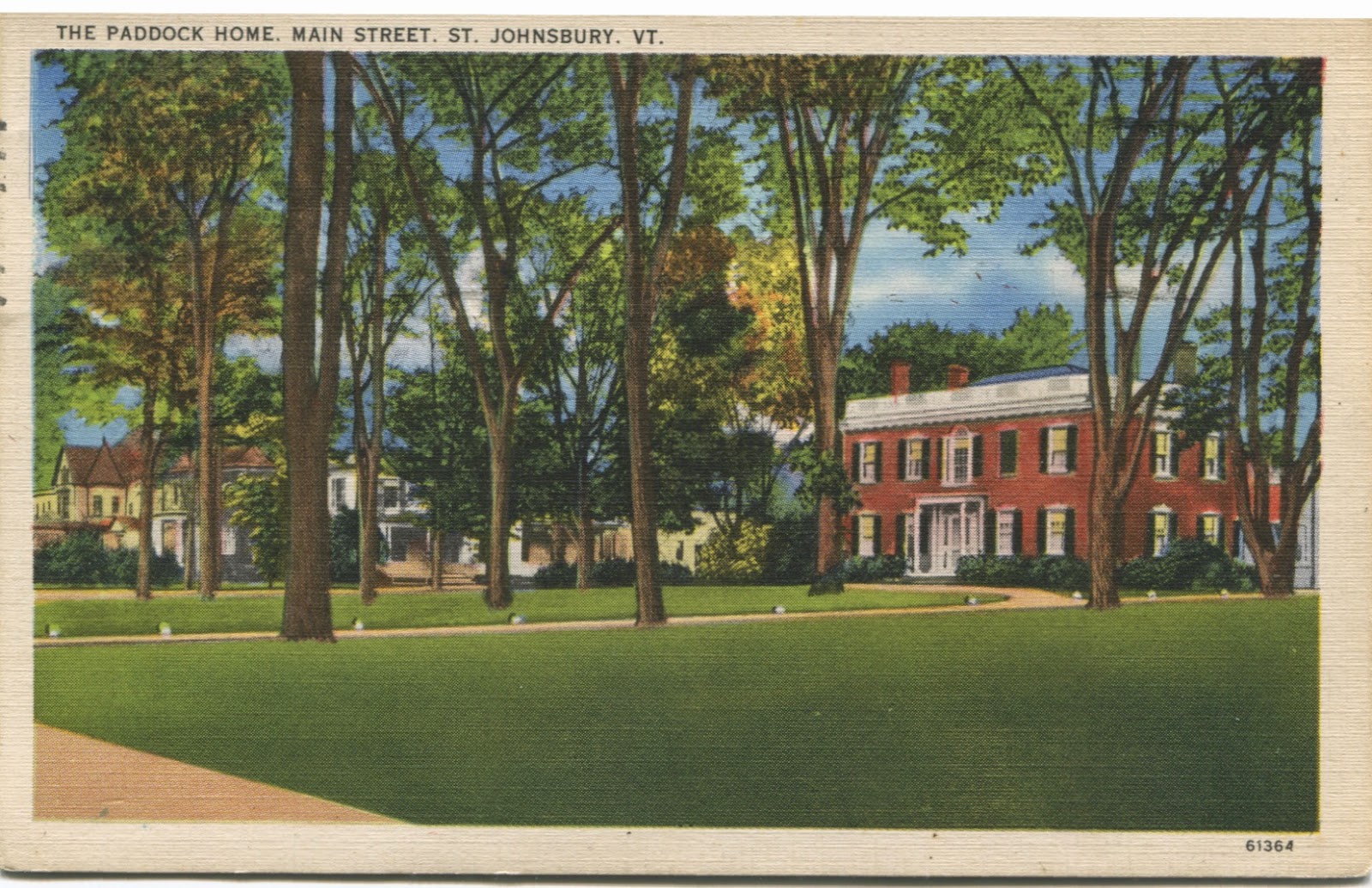
The Real Houses, for the Stories: The Paddock House


My husband Dave recently gave me a postcard image that shows one of the important locations in my 1850 Vermont adventure, THE LONG SHADOW (2018 update: now published by Five Star/Cengage). This is the house where Alice Sanborn and her friends decide they have no other choice -- they race for the horse and carriage and ... but I'm getting ahead of myself. Here, instead, is how the book begins:


THE LONG SHADOW

-->
North Upton, Vermont, March 1850
             
           
            Uncle Martin wiped his plate with a thick slab of graham bread and pressed the gravy-soaked slice all into one mouthful, brushed his hands off on his jacket, and pulled a rustling handful of newsprint out from under his chair with a flourish.
            “Your man’s gone soft of thinking,” he told my father as he shoved the pages toward him. “Webster the golden orator has turned coat on us. What use is the Union to us all, if we let the stinking reek of slave-holding move into the Territories after all?”
            My mother made a small sound of protest. Thump, came my uncle’s fist on the table, and the dishes rattled. At the same moment, I heard a light tap at the kitchen door. At my mother’s nod, I rose to see who had arrived.
            Standing in the dooryard, faces flushed with cold, were my two sweetest friends, both speaking at once. “Alice, school’s finished for the week, the doctor said it’s too close a space, and the Hopkins twins are fevered,” Jerushah announced in a burst, overcoming Sarah’s softer voice. “So will you come across after supper to sew with us? We’ve only one guest at the house, you know, and there’s no stage arriving until Monday, and my mother said to ask your mother.”
            Jerushah was the most beautiful girl in North Upton, Vermont. Her hair shone like black silk, and her clothes were always the latest styles. I loved the way her eyes crinkled with merriment, and her mouth smiled naturally, even when she was at her books. And Sarah, well, she was our adopted sister, we say: a sister dark as tanned deerskin, with deep brown eyes that hold the hurt and horror of all the Africans pressed into Southern slavery. The moment we first saw her, bundled off the stagecoach into the inn as a frail armful, Jerushah and I had pledged ourselves to her. Sarah’s parents still lingered under the wicked South’s cruel lash. But transported north, Sarah stayed safe with us. Though as best anyone can tell she was only some twelve years of age, she had brightened and sharpened in our care so that she studied with Jerushah and me at the schoolhouse. We were both more than fifteen years of age ourselves, nearly out of the schoolroom and into an age of preparing our womanly selves for the years ahead of us.
            I held up a hand to my friends for their patience and slipped back into the steam-fragrant house to ask my mother’s permission. Distracted by a loud interchange between my father and his brother, she gave a short nod and told me to send the others on their way, for my own dinner lay cooling on the table. This I did, dashing back out the kitchen door to brush a quick kiss onto Jerushah’s cheek and then Sarah’s, promising I’d be at the inn across the road as soon as the day gave way to dark evening.
            A roar and more table thumping came from within the house, and I told my startled friends, “It’s news of the Senate and Daniel Webster himself. I’ll tell you everything, later.” They laughed with me, knowing how men love to argue politics, and I watched them pass back to the road before I took a final thirsty breath of the clear March air and returned to the family dinner.

"This Is the Real Thing": THRESHOLDS, an Exploration of Transitions

My new book of poems. Available in bookshops and online. My buddy B and I shared a long lunch at a community restaurant today, and wrapped i...