Showing posts with label St. Johnsbury. Show all posts

Wednesday, April 8, 2026

April Is National Poetry Month -- and I'm All In on This One!


Today you can read "Hometown" in RockPaperPoem literary magazine -- I wrote it when translator Tony Hao, a resident artist here with Catamount Arts, suggested ways to write about our home towns, and I realized I didn't have one. Where I grew up is so different from where I live now, and my roots are confused. See what you think: https://rockpaperpoem.com/current-issue/

I'll be at the St. Johnsbury PoemTown reading at the St. Johnsbury Athenaeum on Saturday April 11, at 4 pm -- my two poems displayed downtown for this year's Poem Town are "Voices in the Night" (at Momentum Business Solutions at the intersection of Eastern Avenue and Railroad Street), and "Revolution" at Caledonia Plant Shop (nearby at 18 Eastern Ave). I'll post photos of them soon, but you can stroll the town and read these, along with many other wonderful insights.


I'll be at Bear Pond Books in Montpelier on Sunday April 26, 4:30 pm, along with other Northeast Kingdom writers including Judith Janoo and S.J. (Steve) Cahill, as well as my old friend Garret Keizer and long-ago Kingdom Books ally Chard deNiord, and others. 

Last but not least, on April 27 there will be four of us reading online with the Vermont Jewish Poets -- if that's meaningful to you, do look into it.

Watch for a BIG announcement about my poetry collection THRESHOLDS later this week. 

So ... am I working hard enough? 

After all that, you've earned a bit of a poem, right? This is from "Voices in the Night":


                            Here, the language of trauma (reddened, sore)

and the language of regret (tender apology for a path not seen) mingle,

soft balm to burned fingers. We always wanted to hear each other,

didn’t we? But accent and origin, animal nature, our canine, feline,

equine coughs of distress fell like rough echoes. What you say at night

your voice uncovering, discovering, slicing, even scarring: I hear you

with an organ centered just below my beating heart. 

BK 

Monday, September 23, 2024

The Winds of Freedom: How Vermont's Northeast Kingdom Approached Abolition


In this presidential election season, I think it's been clear that the effects of the American Civil War continue to affect beliefs around the country. President Lincoln's long approach to the abolition of human enslavement in America gave us a fundamental piece of today's view of human citizenship in our nation. At the same time, the long delay in getting there, with some 250 or more years of enslavement behind that, contributes to an awareness that we are not always as "good" or principled as we ought to be. And now we have a nation divided on what goodness and principle mean.

In the 1990s, when I began writing my historic novels, I came face to face with prevailing myths in Vermont history that dismayed me. Many of them revolved around the Underground Railroad, one of the heroic efforts in America in the early to mid 1800s. What we know today, historically, is that the Underground Railroad in Vermont might as well have been called the Aboveground Railroad -- because in the theme noted now at Rokeby in North Ferrisburgh, Vermont, if you were Black and reached Vermont in the 1850s (or had lived here for many years already, like the Mero family of Coventry), you were "Free and Safe." No need for hiding places.

But many people couldn't process that idea when I talked about it. So, based on my personal connection with historic fiction, I opted to write about the 1850s here through the voices and experiences of local people, hoping that readers could internalize that experience and reshape their own vision of what happened.

That led to THE LONG SHADOW, book 1 in the Winds of Freedom series, set in North Upton (aka North Danville) in 1850, from the points of view of teenagers enmeshed in adventures there. At the moment, the printed version is out of stock, but you can get the ebook here. Also ask Kim at Green Mountain Books to watch for a gently used copy for you!

More about that story later this week ... and then about books 2 and 3.

If you'd like to hear how the abolitionists of St. Johnsbury, Vermont, and the surrounding towns saw their world in the 1850s and how they entered the movement toward abolition, here's my talk recorded at the St. Johnsbury Athenaeum. I hope you find some fascinating discoveries when you listen/watch it.


Saturday, October 2, 2021

From the Earth Itself: Pottery Made in St. Johnsbury Center


Every time I pass a brick house in the Northeast Kingdom of Vermont, I'm reminded that these long-lasting house components came directly from the soil here. My understanding is that brickyards were once common in the region, especially along the streams and rivers, where clay beds could be found.

But it wasn't only bricks that came from such clay. Pottery, a classic of early American life, is formed from this specially elastic material, which can be shaped and then baked at high temperature in a kiln, to form waterproof containers. According to St. Johnsbury historian Edward Fairbanks, the products of the St. Johnsbury Stone Ware Pottery "were in constant demand until the introduction of tinware."

Studying the history of the Center Village, known today as St. Johnsbury Center, took me seeking the history of this pottery. "Early New England Potters and Their Wares" by Lura Woodside Watkins fills in the details that Fairbanks mentions in his history.

General (probably a militia title, perhaps from our Revolution) Richard Webber Fenton founded his stoneware manufactory about half a mile south of the village, on the west side of the river. His son Leander W. Fenton seems to have taken on the business and partnered with someone named Hancock; the "domestic ware" ("from jugs, jars, bottles and milk pans, at a dollar a dozen, to fancy flower pots at sixty cents each," wrote Fairbanks) were marked either "L. W. Fenton" or "Fenton & Hancock," along with the town's name. Power for the pottery, with its spinning potters' wheels, came from a brook spilling down the slope.

Watkins wrote that a great-granddaughter of Leander's, Mrs. W. W. Husband, lived in St. Johnsbury and had a list of the articles available in the late 1850s:

Both Fairbanks and Watkins mention the end of the pottery firm in November 1859, when a fire destroyed it. While working on my recent article on St. Johnsbury Center history for the October 2021 North Star Monthly, I found mention of the fire in the Caledonian, reprinted in the November 17, 1859, edition of the Green-Mountain Freeman:


 I don't know of any items from this potterymaker locally, although Watkins enthuses about a distinctive one of the water coolers, with cobalt blue decorations that she guesses might have been done by either Eleazar Orcutt or Edward Alonzo Crafts, both known to have been employed in St. Johnsbury.

Jugs with the Fenton & Hancock mark come up at antique auctions fairly often, and I have borrowed an image from one of these to show above. Look closely and you can see part of the name of the pottery across the top of the blue decoration.

Do you know more about the pottery? Have a fragment or whole item in your own collection? Have connections to the Fentons or Mrs. Husband, or more detail for who Hancock was? Please do comment!


Thursday, March 18, 2021

Unpacking a Vintage Postcard: The Little Revelations of Research


My husband Dave was the main collector of vintage postcards here. With a dozen want lists, ranging among his passions of Vermont history, AT&T founder and Lyndonville experimental farmer and philanthropist Theodore Newton Vail, the village of Gilman, and Jewish themes, he spent hours roaming the online listings, and something intriguing arrived in the mail most mornings.

It's taken me time to absorb his tasks in with mine, since his death two years ago. But I am now hunting postcards when I have time. I picked up this one for its charming "Bird's Eye View of West Derby, Vt." (which is now part of Newport, Vermont), thinking we might not have the image itself among his Newport and Derby postcards.

And then, of course, the back of the card drew me in.

It's hard to read, scrawled in pencil and overlaid with a Newport (Vt.) postmark. Even the postmark year is difficult to parse, though we can see it comes from the years when a postcard traveled for the cost of a penny stamp. Even the stamp is a challenge for my aging eyes! But with the aid of a lighted magnifier, I read "Balboa 1513" and marveled that this U.S. stamp commemorated the Spanish explorer's claiming of the Pacific Ocean on behalf of his nation.

The message, once you turn it upright, reads as follows:

July 17 - '15

Dear friend You card rec'd this a.m. Was so glad to know you'd not forgotten me. I'm getting stronger every day and hope you are also. It was so nice of Leola to see me off. I was about sick for three days after coming home. Very sincerely, Mrs. Kimball

I puzzled over the address for a while, and came up with Mrs. B. W. McCosco, 54 Concord Ave., St. Johnsbury Vt.  However, I thought I probably had the name wrong, since I'd never heard that name before. So I started pulling up town listings from the early 1900s. It didn't take long to realize that McCosco was indeed a local surname, and here's what I found:

Mrs. Maude C. McCosco was a teacher who boarded at 159 Railroad Street in St. J. She was the second wife of Basil Winfred McCosco (born in West Danville in 1872, died in St. J in 1920). Her marriage took place in 1912, and her name before the marriage was Winifred Maude Blair Clifford (she lived from 1879 to 1967).

Note that her postcard was addressed using her husband's initials, B. W.; also note that she was listed in the town as a "boarder" just a few years after her marriage. I wonder now ... had Basil left her alone for some reason? What caused him to die at the relatively young age of 48? Which years did Maude teach school, and where?

Which just goes to show: The more you pull out the clues from a postcard, the more mysteries you open up in response.


Tuesday, March 17, 2020

Irish Soda Bread, and Some Vermont Irish History

The best of St. Patrick's Day to you! And may your luck be cheerful and in all the right directions on this fine March day.

It's a day that I like to celebrate by making Irish soda bread, and this year, just for the fun of it, I tried out the whole-grain boxed mix provided by King Arthur Flour, one of our Vermont-focused businesses. Very tasty, and it didn't cut much into my work time this way!

It's a good moment to remember that being Irish once meant a great deal in St. Johnsbury, Vermont. Just a few decades ago, the town's residents in response to the Census notched up 30% with Irish heritage. Significant in the area was the presence for decades of two Catholic churches: one "French" (mostly French Canadian, with Mass provided in both Latin and French), and "Irish" (Mass in Latin and English). The "Irish" church was St. Aloysius, pictured here; after the "French" church, Notre Dame des Victories, burned (yes, arson), the congregations merged and renamed the new church group St. John the Evangelist. Here's the building, from one of my late husband Dave Kanell's postcards.

The most recent available Census data, from the 2017 American Community Survey (the newer name for this batch of Census detail), showed 10.1% of Americans mentioning Irish heritage; 17.3% of Vermont residents; and 14.4% of those responding in Caledonia County (where another 14.4 percent mentioned French, 11.1% French Canadian -- should we add those together? -- and 18.2% English heritage; yes, Scottish comes in at 5.9%, and Italian at 5.5%). That's about one-seventh of the county with Irish heritage!

When I visit my New York City grandsons, I like to step across to their neighborhood's amazing Irish Hunger Memorial. Here are two photos of the structure, taken by Wally Gobetz and shared on flickr (thank you!); there's a description of the memorial added below, and if you don't have time to read it all, just keep this in mind: It's built from an actual stone cottage from Ireland, like the ones people lived in at the time of the potato famine there. I imagine the mud and stone and starvation made these homes feel terribly, frighteningly cold.


In fact, we have some great descriptions of exactly that, from Asenath Hatch Nicholson, a woman originally from Chelsea, Vermont, who left what comfort she'd found in New York City to go and see the starvation conditions for herself back in 1844. See my earlier discussion of her work here.

Now, before I go spread some good Vermont-branded butter on my next chunk of Irish soda bread, one more important history item: The first to use "baking soda" in bread recipes were not the Irish, but Native Americans, says noted food writer Gillie Houston -- see her explanation here -- and the recipe drifted to Ireland, as that region adopted agriculture and recipes for locally grown "soft" wheat.

You just never know what you'll come across, when you start digging into history. Or baking!

***
[memorial explanation originally published at https://www.atlasobscura.com/places/irish-hunger-memorial]

A winding path is lined with blackthorn, foxglove, and ling heather, marked with 32 rocks each engraved with the name of an Irish county. The quarter-acre of Ireland on the edge of Manhattan is a memorial to the over one million Irish who died during the Great Famine of the 1840s, as well as those who continue to suffer from hunger.

Designed by artist Brian Tolle, the Irish Hunger Memorial in Battery Park incorporates a Famine-era stone cottage brought over from County Mayo, Ireland, and reconstructed as the heart of the monument. Visitors can enter directly from the street up a path through the suspended field, or through a tunnel lined with granite and words behind glass remembering worldwide hunger crises, while a ghostly recording plays voices recounting famine.
Room has been left for more words to mark new hunger crises. From the top of the field at 25 feet in the air, there is a view of the Statue of Liberty and Ellis Island, the first stop for many of the over two million Irish immigrants to the United States.

Tuesday, July 17, 2018

Cold Midnight, Chapter 1 -- By Special Request!


I still have copies available of Cold Midnight, a "YA crossover" mystery set in 1921 in St. Johnsbury, Vermont, and based on a real "cold case" that the town never closed. By special request, here's chapter 1; you can get the softcover book from me, or the ebook online.


Cold Midnight

by Beth Kanell


Autumn 1921

Chapter 1
            The new rope worked much better than the knotted strips of sheets. And it was more than twice as long.
            In the darkness behind the tenement house, untying the knot required her fingers to dig and tug. Claire wished she’d brought a spike or even a nail. A nail – there should be some scattered around on the ground. Easing quietly toward the pool of light spilling from the downstairs parlor, Claire scuffed her shoes until she felt something roll under them, and coaxed it along to where she could see it and pick it up. She moved back against the wall and poked at the knot with the iron point. Done!
            Claire was used to creeping down the back porches and only using her twisted line of sheeting to drop down the last ten feet to the ground. It could hang there until she returned. But the rope was different: she needed to take it with her so she could get where she needed to go.
            The smell of tar hung thick in the warm night air. Main Street, just around the corner from the tenement house, gleamed under its new coat of paving. No sense stepping in the soft black ooze – Claire took the back route around the little green-sided Christian Science church to the alley next to Willis’s hardware. Carefully, she coiled the twenty feet of rope over her left shoulder. On tiptoes, she ran up the three flights of fire stairs, avoiding the windows. Now one long stretch, twenty feet high, separated her from the rooftop. She set her fingers and toes into the brickwork and edged upward.
            After so many times crawling in darkness up the wall, with its fancy brick courses and false window frames extending out as perfect footholds, the climb came easily, up to the last bit where the roof hung over. Until now, the overhang had defeated her. But this time, with her rope, she formed a sling and looped it over a massive iron hook at the roof’s edge, built to grasp the snowload and prevent it from falling on unsuspecting pedestrians in winter. The hook and the rope sling would provide a way to let go of the wall and swing out.
            She tugged at the sling to make sure the knot would hold. It ought to: a square knot, the way her father had shown her ages ago. Blue funk gripped her stomach for a moment. She twisted her left hand around the rope sling, then snatched at it with her right, flying loose from the wall. Four stories above the ground, she dangled from her rope loop. Keep moving, she told herself, and heaved with both arms, until she figured out how to launch her legs up. The scrape of her boots against the roof startled her.
            Don’t stop now. It’s just like on the bars of the swing. Go!
            Seconds later, Claire stood on the roof of the Willis Block for the first time. The size of it had always impressed her, as it stretched across five street-level businesses. Her left arm burned from the rope’s friction, and she rubbed it while she crouched and surveyed this new view of town. She peered down to be sure nobody had seen or heard her – but the coast was clear.
            First she looked west, up the ridge, and oriented herself by the dark bulk of the ancient pines above the town. She could see the distant cliffs block the starry sky. The grand Bateman mansion spread solidly against the nearer slope, gas lamps twinkling in the upper windows. There were no lights in the long glassed greenhouse beside the mansion, but she saw small reflections of the bright stars of early September.
            Slowly, Claire turned north, gazing past the short steeple of the Christian Science church to see the massive stone structure of the North Church, then the brick steeple of the Irish Catholic one. Beyond the handful of large homes at the north end of town, the land rose to Mt. Pleasant Cemetery. She bent to rub one knee, realizing she’d scraped that, too. Most likely her stockings would cover it tomorrow, but she would need to be careful that no signs of her adventures showed around her skirt and blouse, or her mother would grow suspicious.
            Claire swiveled south, toward the dark courthouse with its clock tower, then the imposing halls of the Academy campus – the school halls that she already hated after a single week of classes. Claire frowned fiercely, wishing they’d disappear. For a moment she pondered what it would feel like to set them aflame, the crisp, snapping fire engulfing them in seconds. But she knew it was insane, a wild fantasy she’d never actually try. Her father had warned her about fire-setters and their madness, back before the war, when he still talked to her about real things.
            Claire closed her eyes and made the final quarter turn to face east, down the slope to the downtown, the railroad, the river beyond. For a moment longer, she stood blind, eyelids clamped together. She stretched her arms and hands wide, feeling the cool night air between her fingers. She sniffed the breeze for river scent, but she couldn’t find it. At last, she lowered her arms and opened her eyes.
            Ah! Cramped knuckles and scraped knees faded into insignificance. The town lay out before her as if Claire were its only audience. Golden lamplight and silver starlight splashed through and against windows. Halfway down the hill the French Catholic church interrupted with its dark stone steeple. Closer to her, someone pulled a curtain closed at an upper level. A late truck growled as it pulled up Eastern Avenue toward Main Street. A dog began to bark angrily, a second one yelped in conversation, and she caught a hint of a distant shouting voice.
            They can’t hear me, she thought. They can’t see me. But they are mine, all mine.
            The bells of North Church tolled the hour: ten o’clock. She resolved to explore her rooftops until midnight struck. Seven buildings linked together meant she could walk all the way from here to the edge of the last roof above Eastern Avenue itself. She twitched her rope to lay it flat on the first section of roof, then started walking.
            A surprising number of objects rolled under her booted feet as she scuffed slowly along. Although a rounded wedge of moon showed itself above the eastern horizon, it didn’t light the roof. Claire could feel nails, and the snap of twigs, and something soft that might be the remains of a bird. She tried to avoid crushing whatever it was – the poor thing was most likely mangled enough. Plus, she didn’t want to step in anything that would reek of decay. Continuing to escape the house at night depended on not leaving traces that her mother would notice. Her father, of course, wouldn’t notice if she put her muddiest boots directly onto his lap.
            Placing a hand on a chimney top, she realized someone in the building had lit a fire. Silly thing to do on such a warm night! But on second thought, perhaps it was still warm from cooking supper. At home, supper could take place any time between five and nine o’clock, depending on whether her mother felt exalted that evening. Sometimes Claire’s mother set a row of candles along the table and decorated it to resemble a feast, even when supper was only a reheated slice of Sunday’s pork pie. She’d tear the bread apart with her long slender fingers, instead of slicing it: “This was how his disciples recognized the Lord,” she’d explain. “The way He broke the bread. After He rose again, of course. Drink some wine, Claire. It’s not a sacrament like at church.”
            “You’ve watered it down,” her father would complain if he happened to be there. And he’d take a draw from his flask instead, then forget to finish eating as he shuffled out of the kitchen to the parlor and its darkness. Her mother’s shoulders would slump, half from plain irritation, half from some deeper wound.
            “Pray for your father tonight,” she’d instruct Claire. “Forty ‘Hail Marys’ and then the Our Father. He needs to go to confession.” Her voice louder, she’d repeat, “Robert, you need to go to confession. You can’t take Holy Communion until you’ve confessed to the priest.”
            “Go there yourself, eh,” her father would mumble back, and mutter a curse in French just to annoy her, and drop heavily into his armchair without turning on a lamp.
            The warm chimney also reminded Claire that she was walking above tenements where people lived, over the shops. She hoped their ceilings muffled her footfalls. Who lived in the rooms just beneath her? Mr. Willis, who owned the hardware? No, he lived lower down, right above his store. This place must be his brother’s, the one with all the small children.
            The urge seized her to peer through their windows and catch a glimpse of their life. Could she reach the fire stairs behind this section of the store block? She edged eastward, to the back end of the roof, and squinted into the darkness below. She knew there was another set of stairs, but she had left her rope back by the first set. Besides, she didn’t know how far this set went. She’d have to inspect it by daylight before risking the drop.
            Back to the center again, then south, across the roof of the ladies’ clothing store. Then the two sections joined together below into the grocery and what must be the little bakery. At last she knew she stood above the photographer’s studio. The rising moon lit a low wall in front of her, where the roofline rose to go across the bank at the corner, with a false row of windows along the front.
            The wide, open space of Eastern Avenue yawned in the darkness below. Across the way was the park, and beyond that, the courthouse. A movement among the bushes caught her eye: a dog, scruffy and slow. She could barely hear its faint snuffling.
            When the whistling started, she jerked in place, grabbing the chimney nearest to her to stop a wave of vertigo. Her head spun. The sweet pure whistle rose in a tune she knew: “Listen to the mockingbird,” it trilled. The strangeness of it in her hard-luck town, her town viewed from its high Main Street roofs, nearly blinded her. Then the whistle began to dance around the tune, ornamenting it, pouring it into the darkness as if night were shaped with a space that belonged to music and to joy.
            Just before the tune ended, she realized a boy in dark clothing, with the bulk of a jacket slung over his shoulder, had emerged from the shadows of the park and was walking into the long alley behind the store buildings. By the time she thought to cross the roof and look directly down the side of the building, he had vanished into the darkness, along with his melody.
            In the boy’s absence, the town laid itself out again, nearly silent. Claire walked the roof in the other direction, back to where her rope lay folded, getting the feel of it into her feet. The false windows rising above the front of the photographer’s building offered a good place to perch, so she circled back there. Where her hand rested on the brick wall, she felt lumps like chewing gum. Bird droppings. She scrubbed her hand against her sweater and stuffed it into a pocket, where her handkerchief sat in a ball.
Why would someone build a row of false window arches at the front of a building? Just to make it look taller? There was no glass, nothing behind them except the roof itself. Claire fingered the brick surface carefully before climbing inside an arch, to sit curled within the chilly but strong framework. Looking up the hillside to the west, with the Bateman mansion in the center of her view, she watched the upstairs lamps begin to go out, one after another in a line. The last one lingered a few minutes longer. Someone setting aside his or her clothes, no doubt. Would it be Mr. Bateman himself? No, that upper room must belong to a maid or the cook.
            Below her, footsteps pattered along Main Street. Somebody was running there, keeping close to the block of buildings. She turned to hook an arm more firmly, then leaned cautiously from her position inside the arch, not wanting to make a sound.
            The person in the darkness reached the corner of Eastern Avenue and Claire could see enough to be sure it was a man or a very tall, older boy. His arms were pumping and she could hear his breath, ragged and rapid. From above, the cap on his head looked like one of her father’s uniform caps. He stopped, reached out, and pulled the hammer of the fire alarm box. Then he ran.
            Bells rang loudly in the firehouse down the road and in the Methodist church steeple. Lamps flared higher. Men shouted, and a truck engine roared to life. Claire pressed her back against the wall. Crouching behind the brick edging, she watched: one truck, the pumper; then the second one, its ladders hanging off the end; four men clutching the rails. A fifth man stood by the open doorway, staring down the road, then bolted back inside, shouting again.
            A harsh charcoal smell filled the night, much stronger than chimney smoke. Not far from her, metal on metal screeched and more shouts echoed as the new fire trucks halted just beyond the courthouse. Hunched low, keeping her balance, she ran to the south end of the line of buildings and saw a red flicker of flame at the side of the boarding house beyond the courthouse park.
            Her father would be there soon! The fire bells surely had summoned him by now. Any moment, he might wake her mother, too. Claire needed to return to her bed and be under the covers in case they looked into her room.
            She fled back north along the roofs, fumbled for the loops of her rope, and swung wildly for the steps below. 

Saturday, October 31, 2015

"East Village" Vermont Fire of 1912: The True Story


The East Village fire of 1912: remains. Photo taken from behind today's Peter & Polly Park. Look for the bell tower of the church, toward the right rear in the card.
Dave and I enjoy collecting old postcards that show locations -- and sometimes people -- around our area, the Northeast Kingdom of Vermont. We've done this since we met, back in 2002, and it's become an important part of the research we each do: Dave for his attention to the college where he worked for 19 years (Lyndon State College) as Assistant Dean of Residential Life (he stays in touch with SO many people, as well as the history of Theodore N. Vail, a founder of AT&T and donor of many of the college town's cultural treasures. And me, well, I'm always hunting down more details of "truth" to add to the historical adventures I write.

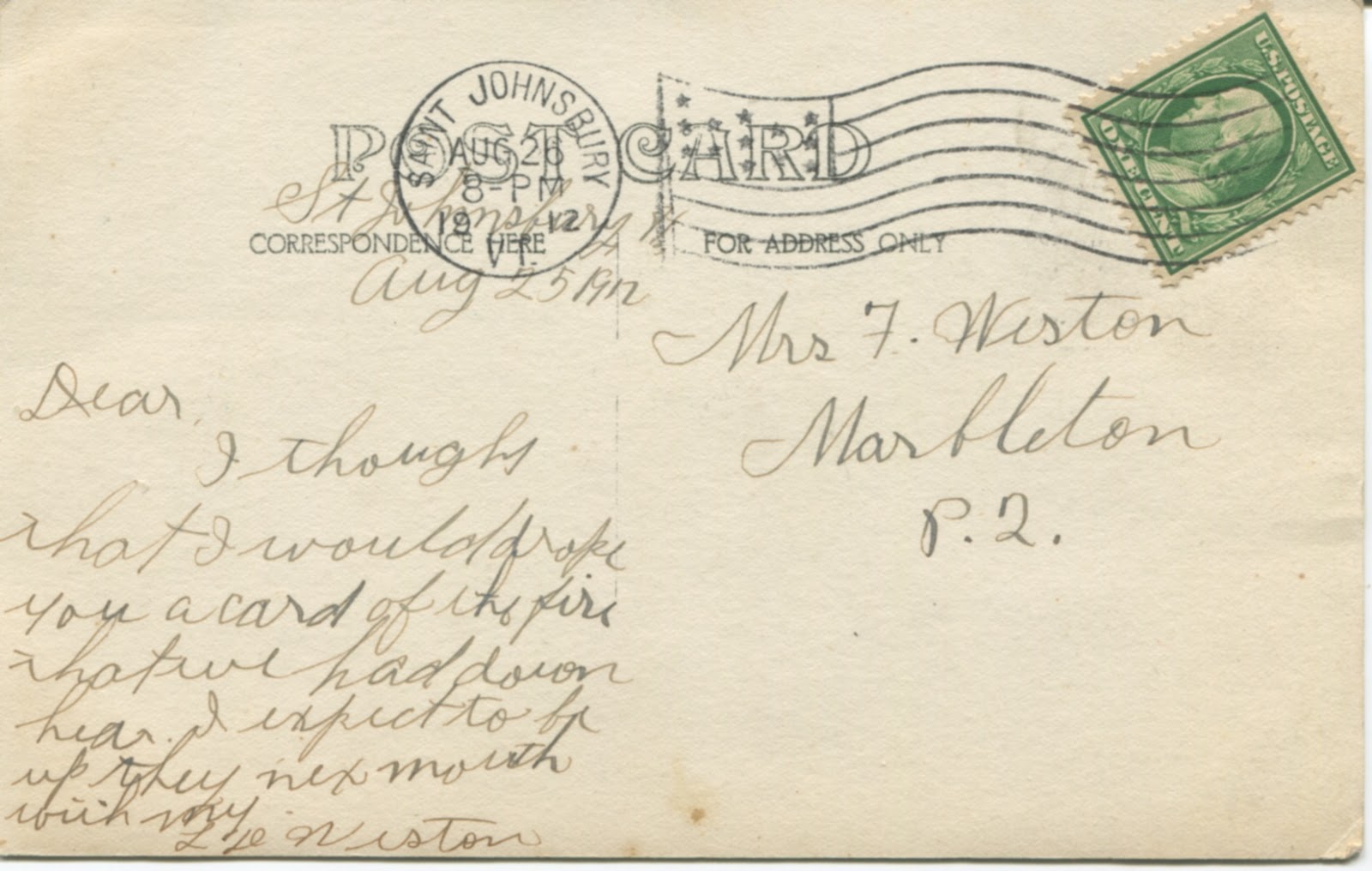
So this postcard became one of our Big Finds for 2015. It is what's called a "real photo postcard" -- someone photographed an actual scene and event, and had the picture made into cards. Three things alerted us to excitement here: the scene, which is after a disastrous fire; the postmark and hardwritten date, August 26 (25), 1912, in St. Johnsbury, Vermont; and the writer, L. D. Weston, who notes that he's writing to "Dear" Mrs. F. Weston, in Marbleton, Quebec, Canada.


We were wrong in almost all of our early assumptions about the card, though! The name "Weston" immediately rang a bell for us, as we know there's a household including that name in East St. Johnbury today. We wondered whether it was connected to today's family, and whether the image showed a farm fire.

Each of us -- Dave and I -- investigated in different directions. Soon we learned that today's Weston family didn't have a record of someone of that name in East St. Johnsbury (then known as "East Village") in 1912; then we found that L. D. Weston had lived in Lyndonville but was employed for a while by the railroad in St. Johnsbury. Finally Dave used the Library of Congress archives to unearth newspaper coverage of the 1912 fire -- which, oddly enough, turned out to have happened in East Village after all! I typed the news report up, and circled back to Edward Lee's "East St. Johnsbury Vermont" (1984) booklet to confirm the story from another direction. Lee's account makes it clear that the devastation of the East Village fire on August 7, 1912, had three contributing factors: no firefighting system in the village beyond the traditional "bucket brigade"; the fact that when the first motor-powered firetruck in St. Johnsbury itself (some 5+ miles away) tried to reach the fire, it was interrupted (according to the newspaper, three times!) by frightened teams of horses along the route; and a delay in getting a hand pumper from the Fairbanks Scale factory (about 6 miles way) to the fire via the railroad -- the pumper was placed on a flat car for transport along the rail line that linked the two villages, but had to wait for the passenger train from Portland, Maine, to arrive first.

Lee's account also includes the intriguing mention that firefighting villagers considered dynamiting the Moulton house next door to the church to stop the fire from traveling as far as the church! It appears this was a last resort that didn't actually happen.

A final note from Lee's accounts: By 1928 the East Village had its own fire station, next to the large store built a century earlier by Silas Hibbard. Perhaps one of today's readers can tell us when firefighting left East Village again, to be focused in "downtown" St. Johnsbury instead.

Here is the promised newspaper article:

-->
St. Johnsbury Caledonian, August 14, 1912

FIRE IN EAST VILLAGE
Four Houses and Four Barns Completely Destroyed and other Buildings Damaged.

            The little village of East St. Johnsbury suffered the worst fire it its history last Wednesday afternoon when in about three hours four houses and four barns were completely destroyed and another house and the Congregational church were considerably damaged. It was a case of no water system and all that save at least three more houses and the church was the sending of a hose cart and a hand pump with several volunteer firemen from this village to assist their brethren in misfortune.

            The fire was discovered about half past twelve when smoke was seen pouring out of the roof and along the ridge pole of John Nolan’s house on Main street. All the men in that section were away at their work and Mrs. George Dodge spread the alarm along the street. When the flames burst through the roof the top of the house was all on fire and all it was possible to do was get Mr. and Mrs. John Nolan Sr. out of the house and the family’s furniture, clothing and bedding were all lost. The fire quickly reached the barn which was filled with this season’s cut of hay and everything there was burned. Mr. Nolan received $1930 insurance on the buildings and furniture and that practically covers his loss.

            George Dodge’s house stood next to the Nolans and the fire soon leaped across the space and began devouring those buildings. Enough people had gathered by this time to remove most of the furniture and articles from the barn and they were saved in a somewhat damaged condition. The Dodges received $1,000 insurance which practically covered their loss on the buildings. There was a loss of over $200  on the hay, wood and furniture.

Assistance From St. Johnsbury

            When it was seen the fire would spread the authorities of St. Johnsbury were telephoned, and they ordered the new automobile fire truck to the scene. The truck had to come to a full stop three times on account of frightened teams and then made the trip in nine minutes. The buildings were so far done before the truck arrived that the chemicals were of no use and as the village had no water pressure the hose could not be used. Word was sent back to St. Johnsbury and an out of town alarm was sounded. The firemen quickly responded and soon had the hose cart with a hand pump loaded on a flat car and with about 20 firemen was ready to start. The special train was held however until the eastbound express pulled out and then was run to East Village. The firemen arrived there about quarter of three and soon had the pump throwing a good stream of water from the river on the fire.

More Buildings Destroyed

            Before the St. Johnsbury men arrived the fire had swept through the house and barn of Miss Charlotte Morrill a[n]d practically leveled the house and barn of Francis Brown. It had also caught on one side of the buildings of Lois Moulton and an attempt was being made to tear down that house in an effort to keep the blaze from the Congregational church. In their fright the people damaged the furniture considerably and they tore out the pews, windows and carpets of the church and some furniture was taken from the house of Eugene Shasteny beyond the church In a few minutes after the stream from the pump was started it seemed that the blaze would be stopped at the Brown house and the destruction of furniture was stopped.


Sick People Carried Out

            During the excitement Mrs. Moulton and Mrs. Shores were nearly overcome by fright and had to be helped to places of safety. Aunt Honor Brown, a woman about 85 years of age who lay in bed with a broken hip, were carried out of the Brown house. George Babcock was quite badly cut over one eye by a piece of furniture which was thrown from a house. The Brown invalids were taken to St. Johnsbury and the whole Brown family are there at present stopping with relatives. The Brown buildings were insured for $800 which covers the loss of them but Mr. Brown lost a lot of nice wood and some furniture. It is doubtful if they rebuild.

More of the Insurance

            The church was allowed $200 damage by the insurance company and Lois Moulton was allowed $350 insurance which will hardly cover her loss. The loss on the Morrill house was $1,243 but the loss is above $1,600.
            John Nolan and his family stay through the day at the abandoned house on their farm outside the village, but they stay nights at Charles Bowman’s as they lost all of their bedding. Mr. and Mrs. George Dodge have taken rooms as Oscar Wallace’s and will rebuild their house at once. Miss Charlotte Morrill is stopping with the Rev. Edward Lee and he sister, Mrs. M. S. McCurdy, who was spending the summer with her. is stopping at George Copp’s. Mrs. Moulton is also stopping there until her house is made habitable.

The Morrill House

            The house of Miss Charlotte Morrill was one of the oldest and best known residences in the village. It was partly built by the Rev. Silas Gaskill in 1825 and completed by Judge Calvin Morrill in 1850. It has been the residence of the Morrill family since the marriage of Calvin Morrill and Sophronia Lee in 1834. The family consisted of one son and three daughters of whom only the daughters, Mrs. M. S. McCurdy of Andover, Mass., Mrs. Elizabeth Chapman of South Part and Miss Charlotte Morrill, a member of the faculty of Adelphi College in Brooklyn, N.Y., survive. For years it has been occupied by the Morrill family as a summer residence where they had entertained many other guests.
            Miss Morrill plans to rebuilt the house at once. ###

A final note from Beth: Each of my novels somehow includes a fire, I find ... probably because of the one that made such a change in my own family's life. More on that, some other time. Finally, Dave and I are pretty sure this postcard is indeed of the East Village fire -- but a curious side issue is, it seems to be the only existing image of the fire. So if, after all this, you think we are mistaken and you have a good reason to say the card is of some other place or time ... let us know. We are always learning, and eager to learn more. -- BK

Thursday, July 9, 2015

A Conversation in Lines of Words

Looking up Eastern Avenue in St J during road repairs. The café is at ground level, at the rounded corner of the brick building.
Can you find Heaven in a coffee shop? How would you look for heaven at the Café at Gatto Nero, the coffee shop on Eastern Avenue in St. Johnsbury, Vermont? Wordsmiths are invited to provide poetry and short prose at the CGN Facebook feed -- or in the notebook at the coffee shop, marked "Heaven, Looking For" --  and to come join me for a poetry conversation on Pascal's wager, life in "God's country," and other sorts of heavenly topics, Wednesday July 29 at 7 pm at the CGN. 

Postscript, for a question that Michale asked:

This poetry conversation can take place anywhere, but to connect with the others (and make it a real conversation!), post your poems at the Facebook page for the Café at Gatto Nero (https://www.facebook.com/cafeatgattonero?fref=ts), or write them into the notebook at the café counter. We'll gather on Wed. July 29 at 7 pm to hear some of what we've all been writing or thinking about as we consider looking for Heaven at the Café at  Gatto Nero.

Pascal's wager is a way of thinking about whether it's better to live according to the guess that god and heaven exist -- you can find it here: https://en.wikipedia.org/wiki/Pascal%27s_Wager

I look forward to sharing poems with you!

Sunday, May 17, 2015

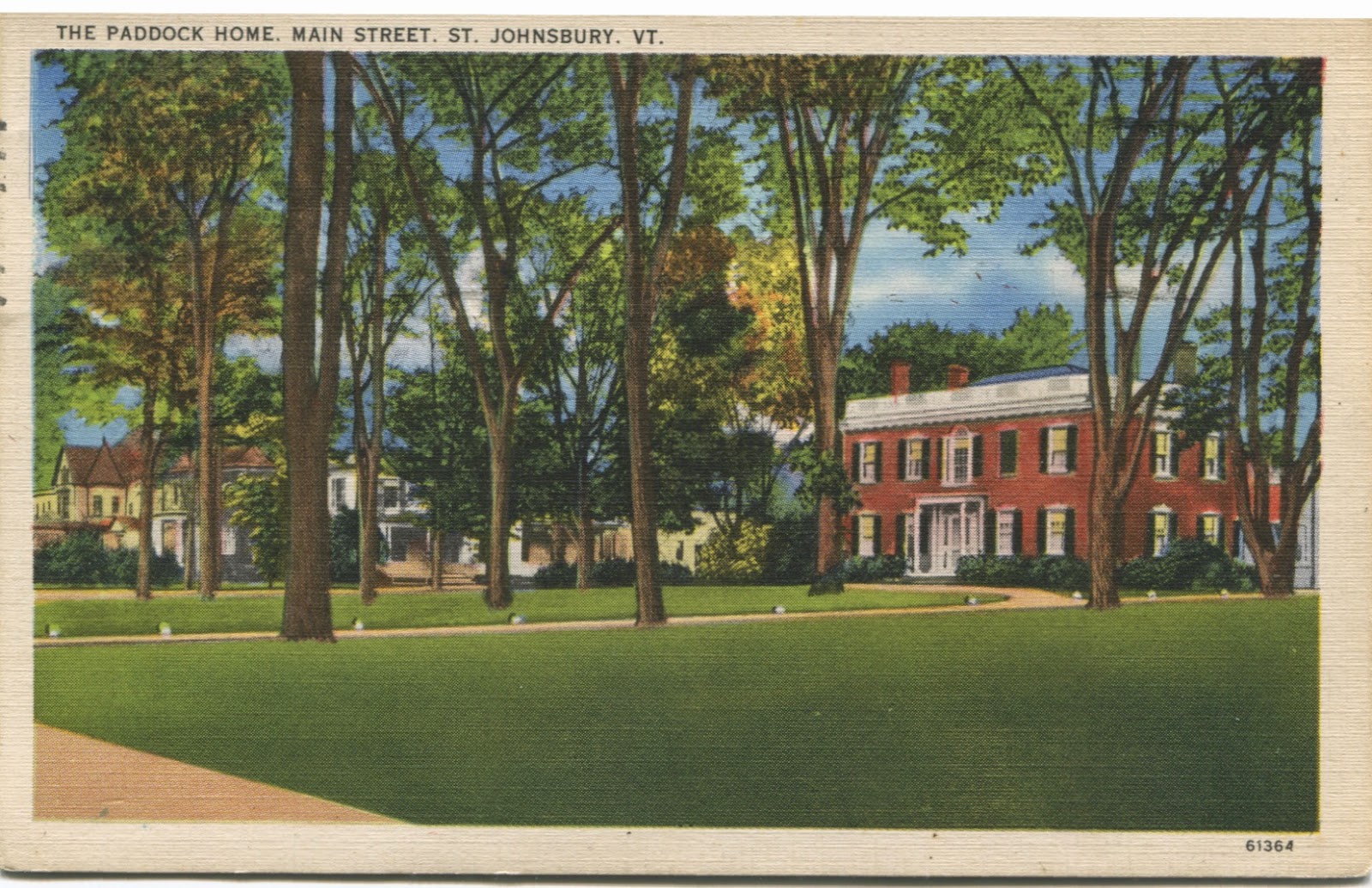
The Real Houses, for the Stories: The Paddock House


My husband Dave recently gave me a postcard image that shows one of the important locations in my 1850 Vermont adventure, THE LONG SHADOW (2018 update: now published by Five Star/Cengage). This is the house where Alice Sanborn and her friends decide they have no other choice -- they race for the horse and carriage and ... but I'm getting ahead of myself. Here, instead, is how the book begins:


THE LONG SHADOW

-->
North Upton, Vermont, March 1850
             
           
            Uncle Martin wiped his plate with a thick slab of graham bread and pressed the gravy-soaked slice all into one mouthful, brushed his hands off on his jacket, and pulled a rustling handful of newsprint out from under his chair with a flourish.
            “Your man’s gone soft of thinking,” he told my father as he shoved the pages toward him. “Webster the golden orator has turned coat on us. What use is the Union to us all, if we let the stinking reek of slave-holding move into the Territories after all?”
            My mother made a small sound of protest. Thump, came my uncle’s fist on the table, and the dishes rattled. At the same moment, I heard a light tap at the kitchen door. At my mother’s nod, I rose to see who had arrived.
            Standing in the dooryard, faces flushed with cold, were my two sweetest friends, both speaking at once. “Alice, school’s finished for the week, the doctor said it’s too close a space, and the Hopkins twins are fevered,” Jerushah announced in a burst, overcoming Sarah’s softer voice. “So will you come across after supper to sew with us? We’ve only one guest at the house, you know, and there’s no stage arriving until Monday, and my mother said to ask your mother.”
            Jerushah was the most beautiful girl in North Upton, Vermont. Her hair shone like black silk, and her clothes were always the latest styles. I loved the way her eyes crinkled with merriment, and her mouth smiled naturally, even when she was at her books. And Sarah, well, she was our adopted sister, we say: a sister dark as tanned deerskin, with deep brown eyes that hold the hurt and horror of all the Africans pressed into Southern slavery. The moment we first saw her, bundled off the stagecoach into the inn as a frail armful, Jerushah and I had pledged ourselves to her. Sarah’s parents still lingered under the wicked South’s cruel lash. But transported north, Sarah stayed safe with us. Though as best anyone can tell she was only some twelve years of age, she had brightened and sharpened in our care so that she studied with Jerushah and me at the schoolhouse. We were both more than fifteen years of age ourselves, nearly out of the schoolroom and into an age of preparing our womanly selves for the years ahead of us.
            I held up a hand to my friends for their patience and slipped back into the steam-fragrant house to ask my mother’s permission. Distracted by a loud interchange between my father and his brother, she gave a short nod and told me to send the others on their way, for my own dinner lay cooling on the table. This I did, dashing back out the kitchen door to brush a quick kiss onto Jerushah’s cheek and then Sarah’s, promising I’d be at the inn across the road as soon as the day gave way to dark evening.
            A roar and more table thumping came from within the house, and I told my startled friends, “It’s news of the Senate and Daniel Webster himself. I’ll tell you everything, later.” They laughed with me, knowing how men love to argue politics, and I watched them pass back to the road before I took a final thirsty breath of the clear March air and returned to the family dinner.

Monday, December 15, 2014

Things Change: In Small Towns in Vermont, Often via Disaster

When my husband Dave and I began investigating the people and events indicated by an 1880 postcard mailed from one small town near us, to another, I opened up a resource that I'd purchased a few years ago, knowing it would be significant -- but at the time, I'd finished one project related to it, and didn't need the details. It was a doctoral dissertation by Northeast Kingdom historian Allan Yale, and gave details of operations at E. and T. Fairbanks, or, as it was locally called more often, the Mill -- or today, "Fairbanks Scale."

Thanks to Scott Wheeler, editor/publisher of Vermont's Northland Journal, I pulled together all the research around the postcard into a story of discovery, with some suprises in it. And that will be an article in the February issue of Scott's magazine.

I gave to Scott images of the front and back of the postcard. I really wanted to also send along images of a building that has an important role in the story, the company store that the Fairbanks factory operated. But I got frustrated, trying to find a good image. This shows the structure at that location, more or less "today," in brick with the name FAIRBANKS inset up high on the building. But I wasn't sure it fit with the 1880s, and didn't know how to find the right version of the building.
Left to right: St Johnsbury Athenaeum, St. J. Fire Dept., "Fairbanks" building, dental office. Circa 2005.


Well, you know how "collecting" can be -- my puzzle inspired Dave to keep searching in his own "ephemera" (the fancy name for items that have a very short lifetime, especially old paper). He found a lovely old stapled booklet of photos of the town, and called me to his work space in triumph: there it was, the Fairbanks company store, probably photographed around 1880 to 1900.

But what a difference from today's lineup of structures! In fact, it's clearly made of wood, not brick, and even the "St. Johnsbury House" next door is not the same building we see today.

Fairbanks company store, left; St. Johnsbury House, right. 1880-1890?


More or less today's St. Johnsbury House. Photo postcard about 1950.
What happened?

Sadly, we know the answer is likely to have been: Fire.

Next task -- find the record of the local disaster that wiped out those earlier structures, and put a date to the change. Even in the past 15 years, St. Johnsbury has seen more than its share of fires in the wooden or wood-framed downtown structures. Someday, the idea of towns that are forced to change via fire, or even via flood (more on that at another time), will seem quaint to us. But today it's still very real. We wish our extended neighborhood a safe winter, and hope this will be a year when fire does not escape its proper place.

Wednesday, October 29, 2014

Galway Kinnell: It's the poem ... it's the story ... it's the poet


Word online is that our "neighbor" (about 30 miles distant) and gentle friend Galway Kinnell died yesterday -- and since The Poetry Foundation and Wikipedia have already closed his entry with that date, I suppose there is no real chance that the word is wrong.

What a loss ...

These photos (thank you, St J Academy -- were these taken by Denise? Jean?) are from the last time we helped create an event at St. Johnsbury (Vermont) Academy for Galway, in November 2007. He read just five poems -- but braided them together with generous stories about each one that kept the students (and the rest of us) captivated. I learned a lot that day about what it is to care about your audience: the people you write for, and the people you read your poems to.

There will be many longer pieces written in the days to come about this great poet who has left us with such treasures. I wish he could have stayed longer ... and with my husband Dave, we offer sympathy to his family and to his many friends and readers around the world.

If you don't yet know the poems of Galway Kinnell, here's a place to start.

Saturday, December 14, 2013

Change Happens: History of The Farmer's Daughter, St. Johnsbury, Vermont


Last year it looked like our region of Vermont had lost, forever, a tourist icon we'd enjoyed for decades: the Route 2 gift shop called The Farmer's Daughter. Jim Young's family had closed the business and although there was a steady trickle of customers for the ongoing stock sale (stuffed moose toys; postcards a bit faded but still capturing memories; Chinese-made coffee mugs that said "Vermont"), the building had an air of sorrow and darkness.

But Anna and Bruce Cushman stepped in to buy the business, and it's been a busy and happy year in the barn -- where the couple and their family offered ice cream and fresh-picked berries, plus live animals (goats, ducks, chickens) to photograph and pet (https://www.facebook.com/pages/The-Farmers-Daughter/370443859742497).  Now it's December and they are still resolutely open each weekend until Christmas, despite the bitter cold of the barn in this season. They feature Vermont products, including fudge they make themselves, as well as the work of local crafters.


Anna showed me a page from an old atlas, where the property was featured from way back in the 1800s, and not long after, I found the same page "at auction" online and purchased it. Here's the atlas page:


And here's an old photo of the farm in use, brought to Anna by a customer:


And a map that includes the property:


The property owner was J. G. Hovey, and here is an ad from an 1894 church cookbook bearing his name:


Now -- the Big Question -- why is all this important?

1. It's research: It tells us the reality of both the property that's now the Farmer's Daughter, and the changes that time and commerce bring.

2. It's human: J. G. Hovey as farmer is one thought, as bank director is another. And are there recipes in this cookbook from the women in his life? Women's history before the 21st century is much less documented than men's; this gives us a route into those other documents. Recipes, clothing, family ... the 1800s are rich with artifacts of these.

3. For me, it opens up story possibilities. I'm as interested in Anna's life as current (and shivering!) store owner (take heart, Anna, the days begin to get longer next week, and spring will warm the building again), as I am in the Hoveys, whose history is significant for both St. Johnsbury (did you ever buy clothing at the Hovey Shops?) and Waterford (see the Hovey Place farm: http://waterford-vt-barn-census.blogspot.com/2013/09/hovey-barn-date-unknown-farm-dates-to.html). Will they be background characters in my next novel ... or maybe I'll borrow one of them for a "model" on which to base a protagonist.

Some of the best stories are the real ones. And sometimes it takes a novel to reveal the history underneath.

Saturday, May 25, 2013

Memorial Day Weekend, Concord, Vermont


Honoring the Four Chaplains.
A few weeks ago, Dave and I took a drive to Gilman, Vermont, a village of many names -- it's a village within the town of Lunenburg and was earlier named Fitzdale, but adopted the surname of the industrialist and philanthropist who changed its history: Isaac "Ike" Gilman. The lone Jew in town, Ike Gilman created employment, funded the church, provided in many ways for enrichment of village life. It's a bigger story than that, but I'm leaving it to Dave to collect the research and do the telling.

Just before reaching Gilman, we paused in another village, East Concord -- part of Concord, Vermont. Concord has an amazingly rich history, including the first teacher training school in the state (a "normal" school as the label was then), and a home where poet Robert Frost lived for a year or two. Home to many an agricultural enterprise, it also hosted Abenaki (Native American) presence, in part due to its location along the Connecticut River and its lakes and streams.

House where Robert Frost lived, Concord Corners.
East Concord has a serene white church building; a park; and a state history marker honoring the Rev. George Lansing Fox, one of the famous "Four Chaplains" whose sacrifice made such an impression during World War II. You can read the story here: http://en.wikipedia.org/wiki/Four_Chaplains

On this Memorial Day weekend, we motored over to the Concord Historical Society to see a special exhibit on Fox and the other three chaplains, including many magazine and newspaper articles, a video, and a state proclamation honoring Fox. It seemed a perfect time for the town to reflect on its homegrown hero, a man who never fired a weapon in the war but whose action saved lives.

We lingered among the other exhibits, appreciating the town's farm and logging heritage as well as its schools, doctors, and more. What I hadn't realized was the role of stone in Concord, until I saw this lovely old business sign up on the wall for Keach & Calacci -- Granite, Marble, Bronze. In Vermont history, the Italian stonecutters are usually found around Barre, where the Rock of Ages granite quarry continues to provide material for these artists. I knew they had also reached the Northeast Kingdom town of Ryegate, where there were (and still are!) also granite sheds. But I was surprised to find the Calacci family all the way over in Concord, and noted the business in records from 1928, 1930, and 1935 (listed here).

Last but not least, here are two posters that are tacked high over one of the doorways at the Concord Historical Society -- the one on the left is the shows at Tegu's Palace, one of the two St. Johnsbury theaters that I wove into my 1930/Waterford "history-mystery," The Darkness Under the Water. What a gem! And the one on the right, I am guessing, belongs with a street sign that I noticed outside East Concord during our road trip: Dance Hall Road. (It runs into Oregon Road -- more on that, another time.)

In case it needs saying, what these signs and stories say to me, more clearly than ever, is that hundreds of stories wait to be told, weaving the daily events and places of the past century into the adventures of the people, "real" and fictional, who live and lived in Vermont. I can hardly wait to discover more.

Saturday, April 13, 2013

Research Bookmark: Matching the Photo and the News Report

I've had this photo (blurry though it is) on the Pinterest site for COLD MIDNIGHT for a while now -- it's the result of the 1909 fire in St. Johnsbury, Vermont, which retired firefighter Dave Brown told me was the disaster that moved the town to purchase up-to-date firefighting gear; the ladders then in use were simply not long enough and fatalities resulted. Now, thanks to Researcher Extraordinaire Dave Kanell (yes, I'm married to him), here's a news report of the fire. Thanks also to Stu Beitler, who posted the piece online in 2007.

***
NINE PERSONS DIE AT FIRE

St. Johnsbury, Vt., Suffers Great Loss of Life.

Four-Story Block Burned so Rapidly That Firemen Were Helpless to Save Imprisoned Victims.

St. Johnsbury, Vt. -- Nine lives were lost in the fire which destroyed the principal business building of this town. Two other persons were fatally burned, and two were taken to a hospital suffering from severe but not dangerous burns. The property loss is estimated at $50,000, partly covered by insurance. Of the nine persons killed, two fell from the upper stories of the building in an attempt to reach safety by means of ropes, while seven were burned to death, their bodies not being recovered until several hours later.
The list of dead follows:
S. D. CUSHMAN and MRS. S. D. CUSHMAN and their child;
L. E. DARLING, forty years old, a laborer;
MISS MAY SLEEPER;
CHARLES TANNER, a painter;
MRS. CHARLES TANNER.

MRS. JEANNETTE DAVIS and LOUIS POPE, thirteen years old, son of MR. And MRS. WILLIAM POPE, were those fatally burned. The others injured are WILLIAM POPE and ROY SMITH, who will recover.

The block, a four-story brick building, was a combination of stores, offices, tenements and assembly halls. It was owned by the Citizens' Savings Bank. The fire is believed to have originated in a restaurant in the basement.

Though the alarm was given on the instant and the firemen came in with all speed, the inside of the four-story building was a furnace before help arrived, an elevator well having furnished a flue through which the flames swept to all of the floors.

When it was seen that the ladders would not reach, ropes, which were evidently in the building for such an emergency, were brought into use. Women apparently feared the attempt at descent and RANLETT attempted to come down, hand over hand, to reach he top of the ladder. He lost his balance and fell to the sidewalk. His skull was fractured and he died instantly. DARLING, the other man, lost his grip and fell in attempting to grasp the swinging rope from a windowsill. He lived only a few minutes.

The Cranbury Press New Jersey 1909-11-05

Saturday, November 3, 2012

82 Years Ago, in St. Johnsbury, Vermont ...

In the holiday season of 1921, local men who survived the terrible trench warfare of the Great War -- later known as World War I -- were home. But they hadn't been here long: Although the war ended in 1919, many soldiers remained in Europe for another year and a half, either taking part in "the peace" by choice or by orders, or detained in medical treatment. That means they came "home" in 1920 and 1921.

Claire Benedict's father in COLD MIDNIGHT is one of these men, and as the autumn turns to winter in 1921, Claire is increasingly upset that her father, home for a few months, hasn't yet gone to work. Shell-shocked and coughing, her dad is not able to come through for Claire and her mom, the way Claire had imagined things would work out.

At the same time, a very different holiday season is unfolding for a man Claire doesn't even realize lives in her blue-collar Vermont town: a Chinese man who owns a laundry not far from the railroad station.

COLD MIDNIGHT -- which releases today, at stores in the Northeast Kingdom of Vermont (and Montpelier's Bear Pond Books), and also at www.BethKanell.com -- is a mystery and adventure novel that draws firmly on the real town of 1921 and a real murder that took place. I don't want to spoil the story by telling you too much now, but when you've read it, you'll find notes in the back of the book to make connections to what took place here.

Meanwhile, to get you in the mood, here is a real postcard, sent in 1921 as a holiday greeting, postmarked St. Johnsbury. It's a small world, so if you happen to know something about the sender, or the addressee, please do let me know!


UPDATE, November 7, 2015:  Earlier this week, I enjoyed a phone conversation with Tanya Conly, who lives in a part of East St. Johnsbury that was once known affectionately as "Conlyville," for all the family members living there. She reported with pleasure that John Conly -- who, with his wife (Mr. and Mrs.), signed this postcard -- was her the brother of her grandfather Herbert William Conly. It's a very small world, because Tanya Conly lives about half a mile from Dave and me! I'm glad she spotted this post and let us know that the card does indeed connect "here at home."

PS -- There are many more postcards and photos of the town here: http://pinterest.com/bethkanell/cold-midnight-climbing-on-roofs-at-night-solving-c

"This Is the Real Thing": THRESHOLDS, an Exploration of Transitions

My new book of poems. Available in bookshops and online. My buddy B and I shared a long lunch at a community restaurant today, and wrapped i...