Showing posts with label creative writing. Show all posts

Tuesday, September 9, 2025

The Poetry of Transitions: Re-Shaping for an After-School Group


There's always someone creative taking charge of after-school groups of students who want to spend a few hours doing something "interesting."

So when one reached out to me a few weeks ago, asking what I could offer to her eager and probably very active students, I spilled out my enthusiasm about this new niche of mine, the poetry of transitions. I explained how it could become a nifty activity after school. I guess I had seventh and eighth graders in mind.

But these kiddos are younger than that, it turns out. So, the leader asked, what did I have up my sleeve that might suit that crew instead?

It took me back to my early years of poetry, when my mother modeled how to craft a birthday or Christmas card by making up a rhyme about the person, the occasion, or the things you love, like snow falling on a quiet evening or the first ringing bells of a holiday.

I emailed back:

How about "poems for special occasions" -- where we could lay out a range from birthdays and Christmas to completed homework, awesome book reports, new friends, broken friendships, and more. 

And that, of course, spun me into wanting to write some of those childhood rhymes again. It's always fun, and often surprising. The following is NOT, of course, for an after-school program, but thoughts on where my own poems have been wandering.

Over Labor Day weekend, one of the poets I studied with, Rachel Richardson, suggested ways to make a collage out of lines that others had already written. Using lines from e.e. cummings, Walt Whitman, Ted Kooser, Dyaln Thomas, and Nick Laird (new to me that day), I put this together:

my father moved through dooms of love
Captain, oh my captain
although I miss you every day
do not go gentle into that good night
what are the ceremonies of forgetting?

It's actually not a bad place to start, as I approach another anniversary of my father's death. And indeed, what a "transition" that was, 27 years ago, for me and for my siblings. 

Now, where will I take this? Where will you take your own? Can you still talk with your father face to face, or do you summon up his spirit for conversations while you're making a long drive? What would he say if you surprised him with --

Go ahead. Let a line form in your thoughts. That's the point of poetry ... or one of them, anyway. 

By the way, if you're curious about what poet Rachel Richardson achieves with her poetic collages -- check out her newest collection of poems, SMOTHER. I bought a copy to treat myself. 

Friday, March 7, 2025

Lyric, Lyrical, and Is It Poetry Yet? A Story About Writing

Barnet VT post office, Wikimedia Commons, photo by Jared and Corin (Thanks!).

I've signed up for a class this weekend on the lyric poem. The price to enroll equaled a week of groceries. Trust me, at that price, I spent some time soul-searching before pressing "Register" for the class.

The moment that changed "everything" for the way I write happened at a rural post office in a small village many years ago. And it wasn't about a poem -- but about a story I'd written, fictional but framed with things I'd experienced, and published in a very small regional newspaper.

My mail carrier was just coming out to his truck when I was entering. He stopped me at the door, beaming with pleasure. "That story of yours, that was a good one, did it really happen?'

"More or less," I said. He grinned. 

An explosion was taking place in my chest. THIS. This was why I was writing. For my neighbors to read all the way to the end of a story or poem and wonder, Did this really happen? Or, equally good, So someone else has felt the way I did, imagine that!

This episode saved me.

I'd already been to a couple of sessions of the Bread Loaf Writers Conference, where people I'd never heard of stood at the front of the lecture hall and read aloud their work, most of it so foreign to my life (like, tied to Greek heroes, or braiding together angels and the Irish with some foreign words as well) that I felt smaller and smaller. I'd brought my very best poems, the ones I really cared about, and one of them made it to a critique session. The mostly unshaven poet in charge, who lived in a city a thousand miles a way, lifted my page, waved it in the air, and said "This says nothing to me." He dropped it back on his desk and went on to someone else's poem. Frozen into stillness, I watched my page flutter to the floor.  

At the post office, though, later that year, I finally understood: When I'm writing a poem, I can't care whether a city resident from a very different culture "gets it." It would be nice, sure, but ... what I care about is whether my neighbor recognizes that same feeling about the bird feeder, or the cold spell, or the pain of wanting to fix your grown child's life and make it all better ... and knowing it's no longer your business to do that.

Literally decades later, after the death of my much-loved (much-missed) husband Dave, I took another long look at what was going on with my poems. Maybe you knew Dave -- if so, you won't be surprised to hear that he didn't really "get" my poems. But oh man, did he ever love to bask in a poetry reading by an outstanding poet like Jane Hirshfield or Galway Kinnell or Donald Hall or Ellen Bryant Voigt. No fancy language or critique from my darling, though. He'd push back in his seat afterward, look at me with glowing eyes, and say "That was the real thing."

So now, even with Dave's body out of reach, I wanted to bring my poems up to a level where if Dave were blindfolded and the sound was distorted so he didn't know it was his own spouse, he might listen for forty-five minutes and say what he said about those other poets. Not for everything I write, maybe, but for some of them. Workable goal? 

I began by applying to my stash of poems some lessons that Vermont (and nationally awarded) poet Sydny Lea gave me one afternoon on the front porch of Robert Frost's home in Franconia, NH: Circle any "new" language -- the surprising phrases and twists. Cross out bland words. Pay attention to how lines of poems end and begin, making them stronger.

It was working, I thought. But the handful of poems that I mailed or emailed to publishers and contests still resulted in polite "canned" rejection notes.

Then another Vermont poet, a woman I trust deeply, suggested that I take a class with poetry professor Ellen Bass -- thanks to the pandemic, the class would be online. This time the price, covering six sessions, added up to three weeks of groceries. In the fine print though was an invitation to explain your situation if you'd like a scholarship. I did (husband recently dead, finances a disaster, barely scraping by) and golly gee (as people used to say), a response said Yes. Scholarship awarded. Come learn.

It would take more than six weeks to explain now all that I learned from this gifted teacher, as I kept taking more of her classes, and carefully setting aside the money in advance to pay properly. But I can give you the single most important thing that I inked onto a piece of posterboard and taped to a nearby wall: 

"All poems live or die on their capacity to lure us from their beginnings to their ends by a pattern of sounds." 

That's from another poet who liked to teach, James Longenbach.

A pattern of sounds. When I added that kind of attention to how I was writing and revising, poems began at long last to get published beyond my local paper. Dave would be excited about that ... 

So that's why I'm blowing the price of another week of groceries on a class focused on "lyric" poetry, because I suspect that's the proper term for what I'm writing now. I really enjoy it.

Oxford Languages describes lyrical this way: expressing the writer's emotions in an imaginative and beautiful way.

Watch for the poems. With Dave out of the room, I'm counting on you to let me know when it's "the real thing."


Sunday, August 21, 2022

Now I Know What It Is -- What It Lives Like

One of my earliest stories.

I started to "write" -- that is, to put writing in front of everything else, no matter what kind of writing, and in the beginning it was reporting for a little weekly "shopper" newspaper -- I started at age 22, while I was still working as a chemist in New Jersey and living with R, the man who'd become my second husband.

In that first breathless savoring of writing-by-choice, instead of writing for school or writing work reports, what exhilaration I found! Nothing else mattered as much. Fortunately for my partner and my income, at that point I wrote something once a month for the paper. Life could go on, in between.

Poems, those were different. I grew up writing poems; my mother wrote them, not the deep kind but the happy rhyming ones that were for children or to enliven an evening party. By 1972, when I graduated from college, I'd write a poem any time; if I liked you, I'd give you a poem. I didn't revise. I didn't re-think. I didn't think a whole lot, really, just scribbled them down. Thanks, Mom.

In 1996 I wrote The Adventure Guide to Vermont, for a plain fee, for Hunter Publishing; the editor said "it's your book" but it was work-for-hire in my life.

Then a Vermont novel seized me, and I wrote The Darkness Under the Ice, was told I'd written the wrong book, and started over, writing The Darkness Under the Water (published in 2008). With that, I discovered the heady sensation of creating characters and their world, and marveled that in one day, something came alive that hadn't existed before.

But I'll tell you now -- it was always Work. Triumphant when done, but ... Work.

What would it be like to be obsessed, compelled, by something I was writing? To breathe it in, around the clock? To find my life's core, the way I did when I found DK and gave him my heart and received his?

Now I know.

I'm writing a book that is always on my tongue and in my pulse. At night I turn the bedside light back on, to write a note about something for the next chapter. In the morning, I am impatient with breakfast and dishes and ordinary earning a living, because I have more notes all over my desk and they all involve what I will write when a pocket of time opens, later today or early tomorrow. (I meet commitments to others, before I indulge.)

It's waiting for me. I miss my DK, of course, always. But he'd understand what is happening, probably better than I do, and if there's a sort of post-life cheering section, he's standing at the front of it, pounding the air with a fist, and singing something by Arethra. He really loved Arethrea. Also Alicia Keys. I'll tell you about that, some other time.

Right now, there's a new segment waiting to be written, and I'm in love.

PS Don't expect me to vacuum in the corners. As I said: There's a new segment waiting. https://bethkanell.medium.com/

Wednesday, April 29, 2020

Always a Blue Sky Just Ahead

It's an April Showers week according to the forecast here in northeastern Vermont, but there have been long stretches of blue sky anyway, and I'm touched by delight many times in each day.

For me, it's also a writing week. I'm working on a memoir at the online site Medium, trying to forgive and enfold the past and see how its tough moments made room for the delight of 17 years with my beloved, my b'shert (meant to be), Dave. Now that I've walked into the second year of mourning, I spend fewer minutes in pain, and more in appreciation. That's a good trade.

I'm also writing a couple of novels (they are very different from each other; one historical, one present; one YA, one much older characters). And of course the poems. Mostly I post the poems in "second draft" form on Facebook. Please stop in to visit when you can.

I wish you solace today, and joy in the small lovely portions. Love your neighbor as yourself -- which means, start with yourself. It's time to put the kettle on again.

Wednesday, July 10, 2019

Luck and Faith in the Writing Room

Old-time authors used to say the bare necessities for writing were paper and pencil (or pen). That's where I started, some 40 years ago, when I wanted to move from writing poems for myself, into writing stories and novels for others.

It wasn't enough.

And in 1984, when my home caught fire on a harsh subzero December night, one of the unexpected benefits of losing all our possessions was the ashing of a couple of really bad novel manuscripts, as well as old poems written more to please myself than to reach out to others.

Today, I'd say there are three things that keep me writing:
  1. Seeking fresh experiences. Some are small and almost routine, like climbing the ridge here and asking questions about the plants and animals and weather along the way. Some are life-shifting, like a course in how character development meshes with plot, or an afternoon spent listening to poets read their work aloud and talk about how their writing connects with what they want to give or receive.
  2. Making lists. I know that sounds odd, but there are many moments—a muggy afternoon, a frustrated morning, a tired evening—when I don't actually itch to sit down and write. Having a list of what I expect from myself helps a lot. And if I can't summon up the energy and enthusiasm for item #1, I may find it's still a good moment for item #4.
  3. A place that's intended for writing.
For me, a writing room includes scraps of knowledge that resonate for me ("Can you be grateful for everything? No, not for everything. But in every moment. It is a chosen response." -- Brother Steindl-Rast), objects that have meaning (a quilt; a special seashell), and work by others that I want to live up to. I keep relatively few books in the room with me, just the ones that seem to mean the most for this time. The rest sit in the next room, the "research room." And beyond.

My house is on the market now, because many of the outlines of my daily life are shifting. I'll carry the objects and confidence of this room with me, wherever I go. And with those, I'll tote a sort of faith that's come partly from experience, partly from determination to listen for and work with a Higher Power that gives meaning to my actions. For me, that's a combination that's effective and joyous.

What about luck?

Six full-length books came to life in this room, and five of them have publishers. (I haven't given up on the sixth and I'm still revising it.) If luck is a matter of considering the odds, this place has been lucky for me. I suspect it will give the same kind of track record to the next person who jumps into creative labor here.

But I'd rather say that "luck" is a shorthand for the results of something else: Long-term love. From the quilt on the wall to the seashells to the paintings and to the quotations treasured, and even the computer here, most of what surrounds me is evidence of love ... from my husband, sons, brothers and sisters-in-law and sister, friends, and colleagues. (And that Higher Power.)

I know there's a New Family who'll discover this house and its blessings sometime soon, and I'll move on to a smaller place and my own next chapter. Maybe they'll move here because they already love the place, its many rooms, wide vistas, ample gardens, eager apple trees.

Maybe they'll fill it with their own love. And get lucky.

[Here's the link for the house.]

Friday, February 1, 2019

For Classroom Use: Black History Month and a Teen Poet

Teen poet Phillis Wheatley. (Photo courtesy of deutschlandreform.com)
Welcome to February 2019 -- designated as Black History Month for the year. Based on a recent school visit, I wrote up the "why" for celebrating Black History Month, and added material you might want to use in your own or your child's classroom. (If you're home schooling, it might also be a good fit.) I'd love to hear how you put it to use ...


Black History Month: February 2019

New England settlers from the year 1620 onward wrote a lot of things down: how they planned to make decisions together, who would own how much land, what the weather had been, and what the gardens and forests and hunting trips provided.

They passed this tradition to their children, who kept passing it on. As a result, lots of American history was written by people with roots in New England. They wrote about the world they saw and how they celebrated it.

What they wrote wasn’t complete. They left out things they didn’t care about, or didn’t trust. And of course they left out what they didn’t know about America and the world.

Missing from a lot of our written history is the history of people with dark skins in America. Whether they were Native Americans, or forced immigrants from Africa, their voices weren’t often heard in the pages of history here.

Two people who made early changes to that were named Phillis Wheatley and Frederick Douglass.

1. Phillis Wheatley was born in the beautiful lands of West Africa, probably in 1753. Find the countries of Gambia and Senegal on a map of Africa; that’s where she came from. When she was just eight years old, a local man sold her to a trader passing through, who took her on a ship to Boston, the biggest city of New England at the time. The trader sold her again, to make a profit, and she became a slave to Boston residents John and Susanna Wheatley. Their teen-aged kids Mary and Nathaniel began helping Phillis to read and write, and when she was 12, she could already read Greek, Latin, and the Bible.  At 14, she wrote her first poem, called “To the University of Cambridge, in New England.” Then she sent a poem to George Washington. Soon she began collecting her poems into a book. When she was 20, her book of poems was published, and the Wheatley family honored her by giving her freedom from enslavement.

I was sad to discover that as an adult, a hard marriage and a life of poverty followed for Phillis, and she died when she was only 31. But she still amazes us as a teenaged poet. You can find some of her poems in collections in books, and online.

Like Phillis Wheatley, you live in New England, and you have learned to read and write. What kind of poems might come from your life? Are there famous people you would like to share them with? Would you write differently if you thought your poem might last for 250 years? Who might read your poems?

2. Frederick Douglass traveled all around New England when he grew up, including visits to St. Johnsbury, Middlebury, Ferrisburgh, and Castleton. When he visited St. Johnsbury, he probably gave a talk at the St. Johnsbury Athenaeum – so when you walk up the stairs there, you are walking where he once stepped.

Mr. Douglass is celebrated as a Black American, and he had ancestors from Africa, as well as Native Americans and “white-skinned” settlers. He believed in the equality of all peoples, including women, recent immigrants, and people of various skin colors. He surprised many of his audience members with how sophisticated and elegant his speeches were. It was important for New Englanders to listen to Mr. Douglass this way, because it helped them remember that education and a desire to learn could make any person, of any gender or skin color or background, into a strong thinker and a good communicator.

He fought against racism all his life. But he also fought FOR people: for their freedom, and their right to vote. The last meeting he went to was about rights for women, in 1895, a few days before he died of a heart attack at about age 77. He didn’t know his real birthday, but he always celebrated it on February 14, which is now Valentine’s Day.

Black History Today

Written history still gives more pages to people who are famous, rich, and especially look important. We are still catching up with the life stories of people with darker skin.

You can find some exciting stories of the changes Black Americans have created, in their lives and in the world. Scientists George Washington Carver, Mae C. Jemison, and Neil deGrasse Tyson are considered Black Americans. So are musicians Marian Anderson, Louis Armstorng, Count Basie, and 50 Cent, plus of course Beyonce. You can look for Black American artists, writers, inventors, and explorers. Today there are also many Black American politicians, like former President Barack Obama and General Colin Powell. Local author Reeve Lindbergh wrote the story of pioneering airplane pilot Bessie Coleman, whose heritage was both African American and Cherokee. 

When you learn about Black Americans who have made a difference in our world, and tell their stories, you are helping to balance out the silence about Black Americans that Frederick Douglass and Phillis Wheatley found in the books they read. You are making a stronger, braver, more complete America with your own words about them.

One Special Note for Fiction and Poetry Authors

Because I write novels and poems, I am very interested in the idea called #ownvoices. You might recognize the label as a hashtag, like the ones you might see on Twitter or Facebook or other social media. #Ownvoices is a way to suggest that the best people to write about the experience of being different kinds of Americans are the people who really live that way. Like Black History Month, #ownvoices is helping to repair unfairness from the past, and to make the future more fair for people whose voices need to be heard. You might want to talk about this and think about how your own stories and poems reflect your own life – and what kind of imagined lives you’d like to write about, too.

-- Beth Kanell, author

Tuesday, January 16, 2018

The Weather Inside and Out (A Robert Frost Moment)


As I've listened to guests from around the world coming to explore "America," and especially New England, I've found Robert Frost's poems are among the ones they have most often memorized. People who live around here, in Vermont, also mention two of this California transplant's most significant poems: the one about good fences making good neighbors, and choosing which of two roads to follow (choosing the one less traveled by). In this season of frequent snowfalls and deep plunging temperatures, Frost fans also gravitate to the poem about the man who stops his horse while on errands, and wraps up by saying "I have promises to keep, and miles to go before I sleep."

I have three favorite Frost poems, and one matters a lot to me today: "Tree at My Window." You might be aware that it's a violation of copyright to post an entire poem by someone else (actually most people don't know this! I found out when I erred by posting one, blush). So I'll just give the final verse of this Frost poem here, which begins with the poet's persona talking with the tree just outside his window:
That day she put our heads together,
Fate had her imagination about her,
Your head so much concerned with outer,
Mine with inner, weather. 
Out on the mountainside today, the snow keeps taking different shades of white, oyster, light gray, even a very pale blue, as the clouds thin and thicken again in front of the well-hidden sun. A few snowflakes fall occasionally; steadier snow is expected this evening, when I'll be doing some errands of my own, so I'm paying attention to the forecast. It's a classic January day, but it's also a bit March-ish, that sense that the snow's been here a long time and isn't in any hurry to leave.

Interior weather: I've just let go of a manuscript that's lived in my heart (and on scraps of paper, in notebooks, and on the computer screen) for three years. It's both wonder-filled and terrifying to send it out into the world, where the staff of a publisher will look at it in very different ways from mine.

At these moments, I usually change the writing room, to find fresh vision and focus for the next effort. I have three books being built now: one just at the starting point, with the title "A Necessary Holiness"; another, poems of prayer and praise, perhaps half assembled; and the third, the set of stories I completed as 2017 raced to an end, where a good two days of rigorous revision should wrap up the project. But you know how life is ... setting aside those two important days will take planning.

So the room, especially the desk and walls, become part of the preparation. The photos here show what I've changed -- and where I'm going, I think.

All of this is especially necessary because I'm also stepping into the final 100 days before publication of my new adventure novel The Long Shadow and I'll be talking about that book often ... but the deep digging of the work-in-progress must continue. Wish me luck. No, on second thought, please wish me a well-crafted balance. And good weather.

Sunday, July 30, 2017

This Strange and Exquisite World

Red eft, courtesy of Vermont Fish and Wildlife.
It's good to have "city" company hanging around -- someone who is as astounded by the greenery and the explosions of blossoms as I was when I began garden-tending in Vermont. These many years later, I am still daily astounded, but in different ways: I see things with fresh eyes on the best days, honoring that joy that seems to link our eyes, breath, mind, and soul together. But I also look harder, with questions.

In the past week or two I've indulged in evening walks. They are by definition very different from morning ones: The light is fading instead of brightening, the breeze quiets to a whisper, stars begin to show up in the darker segments of the sky. This week there's the arc of a waxing (growing) moon, too; when it's full, we'll start the countdown of another month left before we have to watch for early frosts. But not yet.

Still, the evenings can be chilly here on the mountain ridge. I saw a skunk hump across the road two nights ago, fur fluffed up for warmth. It crossed where I saw the porcupine last week. With this year's questions and hypotheses, I make a guess that the marshy area that lies on both sides of this stretch of road is more than a deer path (I've seen their tracks, no need to guess that part), is also -- maybe because its vegetation is low and soft -- a path for other mammals.

The chill of the evening caused one "crossing creature" to be stranded on the cold road a few evenings ago. Its bright red skin and delicate limbs fascinated me. Definitely a red eft, the juvenile stage of the Eastern spotted newt. Without enough air or land warmth, and without the ability to make its own, the creature stood still, about a quarter of the way across the road. Car alert! Hazardous crossing!

Well, of course talking to it wasn't any use. I tenderly lifted it onto my palm -- the warmth turned the eft into a lively squirming tangle of legs and tail almost immediately, and I had to hurry across the road to release it before my fingers -- so much larger than its limbs! -- would damage it. It immediately hurried into the greenery, vanishing at once. Then I finished my walk, happy to have seen something that so rarely crossed paths with me.

This week I also read the novel BORNE by Jeff VanderMeer. It's a dystopian novel, set on a world or part of a world where an inventive "Company" has destroyed natural life and seeded the terrain with "biotechs" that can be very threatening and smart. The protagonist, Rachel, sets a new pattern in motion when she gives maternal attention to a bit of tech-made flesh that she takes home -- something that was clinging to the fur of a monster, and which becomes her pet, or her child ... she has "borne" it, and names it "Borne."

The powerful thread that ties the characters and their perils together in BORNE is a question: What is a person? If you love some creature, and it loves you in return, does it have personhood?

(I hasten to say the book does not appear to be indicating anything about the age of personhood for a human fetus or baby.)

Rachel, her friend Wick, and Borne become the testers of their world, determining whether compassionate survival is possible. I like the book; I'd recommend it to anyone curious and questioning and willing to suspend disbelief in what the future of Earth could be. Age 10 and up, I think. It will mean more to adults -- and to those who've read other dystopian novels -- but the tenderness and kindness embodied in VanderMeer's world, page after page, fit the book for skilled younger readers as well. I'm glad it was on that list of "7 Books to Read After ..." (see my earlier post).

Yes, this is how I feed the source of All Good Writing. By reading, exploring, and asking questions. Hope you have a few minutes to explore the rest of this writer's blog.

Wednesday, July 26, 2017

The "Wonder Woman" in My Heart

It's been a busy few months -- I resumed writing short stories, thanks to a crazy Saturday spent reading the stories I wrote in the 1980s that I'd forgotten all about. Still pushing daily for the "handles" of entry into the poems for a collection of "Pleas and Praise/Prays." And, of course, editing (my income-earning task). Hiking the ridgelines. And tending the gardens.

But above all, this season took me back into my newest novel, which Five Star/Cengage will release in April 2018: THE LONG SHADOW. Working with an insightful editor, I didn't just tidy up loose ends (fresh eyes help so much!). I looked into my heart to discover why I wrote this book, in which three teenage girls in 1850 confront Vermont's confusing mixture of attitudes toward abolition ... try to take care of each other ... and suffer the consequences.

As I wrapped up the responses to the editor, the film Wonder Woman arrived at the local theater. By that point, I needed to catch up on editing again, though, and with a sense of loss, I missed the chance to see the movie. (Hope I'll catch it in a few months when it's on a streaming service.) The reviews made it clear to me I'd missed a really good one -- one that asks questions about what it is to be both a woman and a hero. The questions I tackle in every book, story, and even poem that I write.

So when I saw a related list online, "7 Books to Read After Watching Wonder Woman," I figured I'd at least start tucking those books into my evening reading hours. My fabulous local librarian, Jen, tackled getting the books with enthusiasm and power, and I've just finished reading the one I chose for "first": AMERICAN WAR by Omar El Akkad (publisher's author website here; public radio interview, not so great but still interesting, here).

What a novel! Dystopian in the sense that The Hunger Games series is ... featuring a strong and relentless woman ... set in the American South, which I always realize is like another country, for this Yankee woman to visit ... and testing what people will do to each other in the name of politics and manipulation, as well as love.

Most important to me at the moment is also the detail that the woman of interest in AMERICAN WAR, Sarat Chestnut, is dark-skinned, tall, and with frizzy hair, and loved wholeheartedly by her not-identical twin sister, who is shorter, light-skinned, and has the smooth hair that I always envied in my own sister. (It's the little things, it's always the little things. My sister will read this -- her courage astounds and touches me. Meanwhile many Other Big Things sneak up on us, in fiction and in life.)

What will our nation be like after climate change forces the seas to rise above the coastal cities? How will religion-based terrorism ever resolve? Will our nation of 50+ interdependent states remain United? And what do we exchange, for the satisfaction of following through on our own longing to become Wonder Woman within the bounds of our very diverse lives?

AMERICAN WAR spoke insistently to me. I expect some of the echoes to penetrate what I write next: the sequel to THE LONG SHADOW (already underway), the prayer/praise collection, the long work on aging, the very personal novel I'm working on for an editor who trusts my ability to get there in the end. There are things worth crying about. And many, many people worth supporting, as we all struggle to make a good life, one that's honest and deep and caring.

Onward.


Wednesday, January 21, 2015

New Term for the Day: "Wall Dog," and the Reason Why

Every writer's process is different -- and, making it more confusing, sometimes every book takes an author on a different kind of path. I'm crafting a mystery that is mostly set in Lyndonville, Vermont, in 1899-1900, and -- the same way I did with North Danville, when I was writing The Secret Room -- I visit the town often and take photos of places that might crop up in the book, like the railroad crossing, and a back driveway with a sign that says "Angie's Alley." But I've also become fascinated by the painted advertising signs lingering in town ... with no real expectation that they would show up in my novel.

Today I did some basic research into who painted such signs, and when, and how. I don't yet have the northern New England names of the (probably) men who did these, but I'm confident that I'll find them, eventually. And meanwhile, was excited today to learn a new term: wall dog. Apparently it wasn't entirely complimentary, but it fit the profession: painters who covered walls with signs, and "worked like a dog" for their wages, often in blistering hot summers. On the website PaintedAd.com are interviews with some wall dogs; here is a sample from site author Wm. Stage, who has a book on these (I'm ordering a copy!):
In 1983, I spoke with Art Hunn, then 82 and an administrator with the Painter’s District Council No. 2 here in St. Louis. His recollection of life as a signpainter stretched back seven decades to that day in 1916 when he signed on as an apprentice with the Thomas Cusask Co.
“Each spring as many as fifteen two-man crews would go out on the road three or four months at a time,” Art began. “We’d go into a town, and back then the Williams Company had lots of gas and oil signs leased, so we’d paint bulletins on filling station lots.” By 1924, Hunn and his partner were driving around Illinois, Missouri and Iowa in an “old broken-down Dodge,” punctuating scenic vistas with signs of the times—Bull Durham Tobacco, Pillsbury Flour, and Coca-Cola. Each crew, said Art, was expected to complete a sign a day.
Last week I showed this photo of the Gold Medal Flour painted ad in Lyndonville.

And here's one for Coca Cola, from the White Market outer wall:

Of course, wall art advertising isn't limited to the "old days" -- here are two (or more) pieces from Angie's Alley.

More to learn, every day -- and all of it keeps me writing.

Sunday, January 18, 2015

One Shelf Closes, Another Shelf Opens ...

Part of the research behind The Long Shadow (done, done, done -- for now!)
Last night at about 8 pm, in the little writing room at the far end of the house with one lamp on and deep winter darkness outside, I finished the revisions for an 1855 historical novel, an adventure/mystery set in northern Vermont: THE LONG SHADOW.

This journey included years of research, as well as asking a professional editor to help me prune an early draft in order to accelerate the pace and open the adventure further. Now, of course, the book moves to the part of the process where I feel much less skilled: looking for the right publisher. But I can do this!

And while that takes place, I have two more books in process that involve historical research (thank you, Dave!). Gathering the books and documents makes up maybe half of that -- and the rest is legwork and photos and thinking. For instance, here are some of the town record pages from the earliest settlement years in Barnet, Vermont. Look closely and the first one and you'll see shillings and pence! The second suggests the town was keeping track of people's work hours on some collaborative projects in 1789. Who would have guessed? There's no better way to put the late 1700s into perspective than to search for, find, gently touch, and think about pages like these. Right?


So I'm taking my vitamins, making sure to get out in the crisp January air for a bit each day, and reading the best material I can find by other authors, to keep myself overflowing into this writing life I've chosen. And, oh yes, I need to schedule a bit of work in the "reference room" to open up a new bookshelf. There's more research piling up, and it needs to be sorted, stacked, filed, and omigosh, kept in mind all the time. That's where the plot twists take root.

So, if you are reading this week -- what are you choosing to put into your own creative soil?

Thursday, January 8, 2015

Research = Stories. Which is what I love about this stage of the book.

It's pretty cold up here in the Northeast Kingdom of Vermont today. Morning began around minus 24 degrees (F), full of bright sunshine, and I pulled out my "long johns" and layered up for an excursion to the nearest frozen pond -- and also to deliver a book to a neighbor, and pick up our mail. It's good to realize, after more than half my life spent here, that I really do know how to dress for comfort, even in such extremes.

Plus, of course, it puts me back into the mind of Almyra, the young woman in the book I've just started writing (no title yet, but the first chapter begins right after a snowstorm: "The silence woke her. That, and the cold."

Almyra would be outdoors on a day like this -- she had little choice! And she'd add layers the way I did, although I doubt that she would have worn the pair of brightly striped Ecuadorean knitted legwarmers that made my final-layer fashion statement of the morning. But she would have loved my fuzz-trimmed hood! I already know that she seeks comfort, at the hardest moments of her life, in going to a quiet place outdoors and letting her heart become calm. Me, too.

But other than her personality, everything else about Almyra's story, set in 1899, depends on research to frame it. So I walk a lot in the nearby towns, looking for signs of the "old days" along the way. The "Gold Medal Flour" advertisement on an upper wall of the "Brick Diamond" building in Lyndonville (better known locally as the building where Edmund's Drug Store used to be) captures a bit of that 1899 commercial feeling.

The Census from 1900 also provides details that I need -- here is one of its pages showing my "target of reseacrh," Albert Stern, still living at home with mom and dad even though he's 19 -- but then again, so is his older brother Samuel, 23, and their sister Clara, 25 ... or was it just something like a family meal that brought them together with the younger teens at home, Isabelle (17) and Benjamin (15)? Here's where the author's choices take over from the facts.

Also on target this week: the Poor Farm in St. Johnsbury, Vermont, as mentioned in an article from the Vermont Historical Society; Census pages describing the Dolgin family, which didn't arrive in the area until 10 years later; an oral history project with a couple of the Dolgin family members, giving the feel of the early century; and photos of trains in snowstorms.

What's next? Well, I know it's hard to imagine, but in the next post here, I'll show you something with shillings and pence ... from Vermont!

Sunday, December 21, 2014

Outside the Writer's Room: Writing in the Kitchen on a Snowy Day in Vermont

I know writers are supposed to barricade themselves in private soundproof rooms, where they can keep the outside world away while they create new worlds on paper. So, why do I find myself writing in the kitchen so often? Maybe it's the closeness of the tea kettle. Maybe it's the light. Or maybe the expectations loosen up and it's just more fun ...

At any rate, I was sitting at the kitchen counter scribbling a first draft of a poem (shown at the bottom), which kept getting changed each time I looked at it (multiple drafts; and can we still call it "scribbling" on a computer? well, why not?), and out of the corner of my eye caught something in motion outside the kitchen window. In one coordinated leap, I grabbed the binoculars and made it to the window, and then ran to the next one, pulling out my cell phone and adjusting its bold little camera to "zoom." And here's the result: a fox that wove back and forth along the field, then came right down to the edge of the yard where the gardens begin, where a mouse must have been traveling under the snow. I watched the fox pounce, dig down, and snap up its snack and chew (with mouth open, eeyew).

It paused to look toward me -- movement at the window drew its attention, I'm sure -- before heading back toward the woods at the top of the field.

And THAT is why writing by a kitchen window is a Very Good Idea. Forget the desk, for today.

***

Religion

I was seven, my brother five, my cute little sister
just three years old. We played tag
with lots of other kids in the neighborhood.
The Slaines were Catholic, lived across the street,
and their girl my age – was it Nancy? –
had a “wedding dress” when she turned seven
and made her First Communion. How envious
I was of her cuteness, and her day of lacy
beauty. The little girl who lived on our other side,
Eileen, sat on the wooden edge of our sandbox
and edged her words with scorn:
“Nancy’s Catholic,” she emphasized in a new way,
a pout of her rosebud lips indicating
a form of disgust. Even then, I knew it must be
something she’d learned from her parents.
Then she announced, with pride,
“I’m Protestant!” – sure, we had heard that label in our house.
My brother grinned, bobbed his crewcut head, agreed.
I had curly hair (too curly said my mother),
which bounced even with my neutral nod.
Then my little sister, rising to the call,
stood up, saluted, and said, “I’m American!”

-- BK

Saturday, November 1, 2014

November: Month of Gray Poems and New Writing Projects

On this first day of November 2014, I'm celebrating -- most especially, the gift of photography that a smartphone makes so accessible. Here is the vista from the end of our road:


And here is a lovely detail from the little cemetery that I walk past, in order to get there. It's the edge of the stone for George Russell, at the Cushman Cemetery in Waterford, Vermont. I love the detailing, making even the edge of the stone cared for and lovely. I hope Mr. Russell's life felt that way too, at least from time to time.


Writers have fresh reason to look forward to November 1, as it's the start of Nanowrimo, a brilliant way to encourage us to start new work and perhaps even finish a first draft by the end of the month. Really! Check out the details at the official website. I haven't signed up on the site (I tried it once but it rubs my introvert nature in the wrong direction!), but I'm starting another adventure novel today, with much exhilaration. I'm happy the outside world is a bit less exciting in this month! (Yes, this means I'm working on two novels, one poetry collection, and one Christmas book this month. And then there's my day job ... and cooking for Dave.)

Finally, for all of us who know tidbits of this poem, the full version from London poet Thomas Hood, dated 1844:

NOVEMBER by Thomas Hood (1799-1845)

No sun - no moon!
No morn - no noon!
No dawn- no dusk - no proper time of day -
No sky- no earthly view -
No distance looking blue -

No road - no street! -
No "t'other side the way" -
No end to any Row -
No indications where the Crescents go -

No top to any steeple -
No recognitions of familiar people -
No courtesies for showing 'em -
No knowing 'em!

No mail - no post -
No news from any foreign coast -
No park - no ring - no afternoon gentility -
No company- no nobility -

No warmth, no cheerfulness, no healthful ease,
No comfortable feel in any member -
No shade, no shine, no butterflies, no bees,
No fruits, no flowers, no leaves, no birds,
November!

Sunday, September 7, 2014

What the Young Squirrel Showed to Me

Walking uphill on our dirt road on Friday, I noticed a very large and long "pinecone" that had been run over -- still mostly attached together, but fringed and shattered along its edges. Ten minutes later, headed back down the hill, I found this very young squirrel digging into it, extracting the protein-rich seeds.

The little squirrel (a red one) stayed on task and let me get closer than most adult squirrels permit. But finally he/she grabbed the biggest chunk of the cone and bounded off into the scrub and woods next to the road.

The squirrel's attention to the cone pushed me to wonder more about it. I looked up the cone today -- and that's why I put the term "pinecone" into quotation marks, as these fibrous seed carriers come on spruces and even birches, not just pines. But it does seem from my Audubon Society Field Guide to be a cone from a white pine.

I was really surprised to see the "cones" on birch twigs in the book. All these years admiring birches, and I've never looked at them closely enough to see what carries their seeds! A few pages later are photos of acorns; why didn't I even stop to notice that different kinds of oaks present different shapes and colors of acorns? Guess I was always just pleased to be able to say "oak" and "acorn."

As I look at the neighboring town of Lyndonville with intent to frame a YA mystery there (probably in 1898), I'm finding the same surprise at what I've walked or driven past without questioning, noticing, or naming. Lyndonville suffered two devastating fires in the first part of the 1900s, wiping out one side of its main street, then the other. Yet there are structures that date to 1898 on most of the "town center" streets. And only recently, my husband Dave (who lived in that town for two decades and has a great collection of postcard images of it) and I realized how many portions of the massive railroad complex from, say, 1855 to 1950 linger in town, repurposed or quietly shuttered and overgrown.


Soon I'll choose names for the teen and the two older women who'll make up the main characters of this book-being-planned. While those details come together, I'll also look around the town for traces that remain of the people I'm envisioning. I've already seen evidence of their lives (the real ones, not my fictional versions) in Census documents and 1890s advertisements.  Crafting a good story from these "seeds" means paying attention to the names and existence of what's already there.

Thanks, Red Squirrel. You've got me asking questions and seeking answers. Way to go.


Tuesday, July 15, 2014

Multimedia, Hyperlinks, and a Village Event in Peacham, Vermont

Peacham is considered one of Vermont's most photographed towns -- in part because at least one Vermont Life photographer lives there, and many more have visited. It's not just the hill-and-vale arrangement of church, town center, and farms that's drawn photographers here, but also the strands of local tradition and history. The Peacham Historical Society is constructing new climate-controlled storage space for its archives; the Peacham Library hosts a weekly coffee hour; and the town's small school is neighbor to a professional-level astronomy observatory.

Seven of us "local authors" joined the Peacham Library on July 4, to focus some interest on books. There was a sale of used books inside the library, and outside, under a tent, we seven offered copies of our creations, along with signatures of course. Since business was slow, we also had plenty of opportunity to share aspects of both research and the writing life with each other -- for instance, we listened to Jerry Johnson's poems set to music and performed (on CD) by Jon Gailmore, while archivist Lynn Bonfield described the Gold Rush-era diary that brought her from California to Peacham, children's authors Lynda Graham-Barber and Tanya Sousa compared notes on their paths, Alec Hastings confirmed that he's now writing a teen adventure based on the river logging of the early 1900s, and memoirist Gary Schoolcraft and I planned more author collaborations.

But equally of interest to me, especially as I reflect on overheard conversations that day, is how many media had roles in the day's offerings. Not only were we authors discussing printed books, e-books, and audio books, but we shared Internet research techniques and access. Young reporter Caleigh Cross (a novelist herself) captured images of the famous Peacham tractor parade for the local newspaper's advance website coverage. And visitors pointed to the village store buildings and talked about the films that have used them as backdrops, like Ethan Frome and The Spitfire Grill.

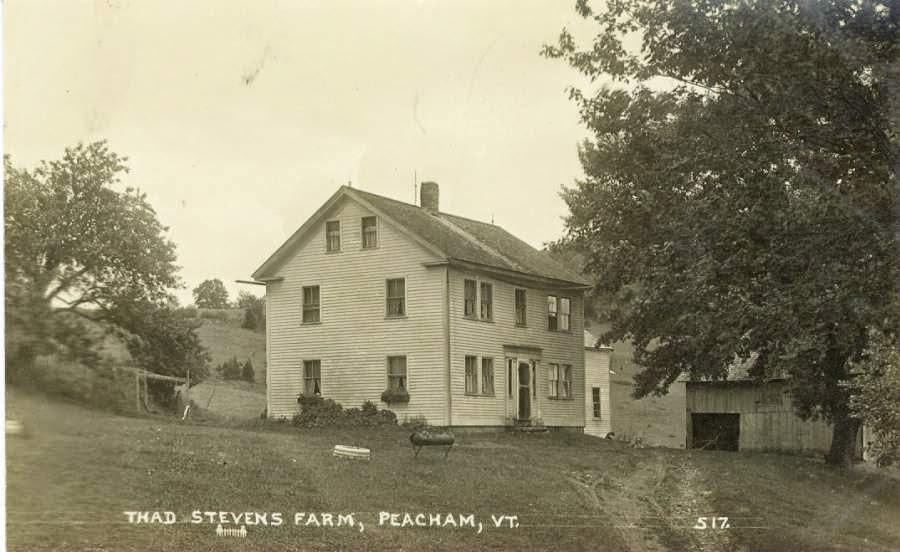
As for me, I was also thinking about Peacham history, "then" and now. I'm particularly pleased with the fresh interest locally in Thaddeus Stevens (1792-1868), who lived in Peacham as a child and became an ardent abolitionist and legislator based in Pennsylvania. The recent film Lincoln gave him a memorable face and role, played by Tommy Lee Jones. Just as important to me are the postcards Dave and I recently acquired, one showing an earlier view down "South Main Street" from where we authors stood, and the other of the house labeled here "Thad[deus] Stevens Farm."* These old postcards were the "social media" of their time, half Facebook-ish with their images, half Twitter-esque with the limited space for a message. As I collect these, along with memories of a congenial community event, I feel like a human version of a hyperlink, myself.


Our future is rooted in our past; how lovely to savor the present, and look in both of those directions.

*Note from archivist Lynn Bonfield: "The Stevens house on the hill (seen from the village) was the one he bought for his mother—he never lived there.  He was raised in a house on the Peacham–Barnet border, up the hill from the West Barnet church."

Tuesday, April 29, 2014

Learning the Downy Woodpecker's Call(s): Why That Matters in Writing Today

I watch for when this spring's robins start tidying up last year's nest.
Walk for 20 minutes in the morning and your brain lights up with oxygen delivery in the areas that feed the writing process. The brain scans are quite clear about this effect!

But it's a bit more complicated to say why I am so excited that I learned the call of the downy woodpecker a few days ago. (You can hear it -- in fact, you can hear three different calls, the "pik," the "whinny," and the "drum" -- on the Cornell University ornithology site: http://www.allaboutbirds.org/guide/downy_woodpecker/sounds.) When I first starting trying to notice birds more deliberately, I realized I had an odd assumption left from childhood: If I already recognized a bird by its plumage and knew its name, I believed the bird was "common." And if it was new to me, I assumed it was "rare" because I hadn't become acquainted with it before. Wow, was I wrong! The birds I already "knew" turned out to be the ones my mom could name, so she taught them to me when I was a child: robin, sparrow, chickadee, bluebird, cardinal. My mom always wanted to see a hummingbird, but never had, and she considered them exotic.

Turns out that hummingbirds are common! I can see a dozen or more in a summer, now that I pay attention to them. So are woodpeckers, and in the trees around my home there are downy woodpeckers and pileated woodpeckers (the ones that remind me most of "Woody Woodpecker" from cartoons, because of the tall red crest of feathers on their heads). I think there are hairy woodpeckers, too, but I'm not yet good at differentiating them from the downy ones.

How do you learn to "see" a woodpecker? For me, it came from learning to hear one! Not just the rap of the beak on the tree -- that could be any of the three I've named, or even a "sapsucker" (more on those, another day). But the downy woodpecker has a distinctive call, and if I notice it and look up right away, it's so easy to see the black-and-white bird after all.

How different a lilac bud looks, compared to the eventual flowers!
Bringing the invisible, the unnoticed, the mysterious and marvelous, into a poem or novel makes a huge different to how vivid and memorable the writing becomes. It also helps me reach more fullness of characters, and to question, in the best of ways, why I'm choosing a particular path for a work. So each day, on my 20-minute walk, I question what I'm seeing and hearing, asking names, changes, explanations, and yes, seeking the invisible within the story at the same time. It matters to me.

Sunday, March 17, 2013

Where Plot Ideas Come From: Tracks in the Snow

Turkey track, solo ... or so you might think

Two clusters of turkey tracks crossing the stream: Look closely.

Mourning dove, "pigeon toed."
It's cold here this weekend -- bursts of snow keep arriving, and it was nine degrees when I went outside. Although the chickadees call (their two-note mating call) in early morning, the woods go nearly silent later in the day, as we all hold our warmth close, self-protection in what can still be wild winter on the ridge. Tonight's forecast threatens subzero temperatures, not unusual for mid March, although it won't last. The trees are signaling buds and more.

Silent though the woods can be, the larger birds are on the move. With the snowcover down to a fragile couple of inches, seeds are everywhere for them with just a quick scratch. How different they are from one breed to another, though. See the solo turkey track in the first photo? It could fool you if you don't follow further -- the second photo, taken not far from the first, reveals that a family of at least half a dozen turkeys passed along here, crossing the stream around the same point.

The third photo means a lot to me as I work slowly to bind all the plot threads together in my "Nancy Drew-style" mystery, ALL THAT GLITTERS. I'm in the last few chapters and it has to go "right" in order to build to the climax I want. There are homing pigeons involved in the plot -- and the tracks in photo 3 are of mourning doves, the wilder sort of pigeon here on the high ridge. I hear their plaintive calls all morning. See how the footprints angle back to each other, always crossing, as the round-bodied bird appears to waddle along? That's where we get the expression "pigeon-toed" -- to walk with one's toes pointed inward, so the right and left feet appear to leave crisscross trails.

The cold air, the photo, the reflection on pigeons, and then, breakfast with strangers at Polly's Pancakes in Sugar Hill, NH, where you often share a table as the staff packs everyone in -- that's what it took to move me to the next component of ALL THAT GLITTERS. Suddenly, I know what's coming next.

PS - You can read the chapters as they are written, at WattPad: http://www.wattpad.com/3668250-all-that-glitters-chapter-1-all-that-glitters-by.

Sunday, July 29, 2012

Finding the Personal in History

photo courtesy of anna
Whether in a classroom or a community group, with youngsters or adults, when I talk about American history and the stories I write, I'm talking PERSONAL. A fascination with the timeline of history begins as we see our own lives pinned to the numbers. So that's where I like to start.

1. Draw a number line of from the year 1900 up to this year. Mark your birth year and "today."

2. For adults, this next part is easy -- for youngsters, it may require a homework item "interviewing" parents at home or by e-mail or phone (be aware that 50% of American youngsters eventually live with both a birth parent AND an adult who is not their birth parent -- which means some other parent is "off site"). Mark the birth year and, if applicable, the marriage year and (if it's already happened) the death year for each of your parents, step-parents, and grandparents.

3. Make a list of the "big wars" from 1900 until today, with their years. If you need to do some research (or help a classroom do some research) on the actual years, that's great. You're becoming accurate! Be sure to include at least World War I, World War II, the Korean War, the Vietnam War, the first Gulf War, and your view of the most recent wars that America has participated in. Mark the years of the conflicts onto your timeline.

4. Pause and reflect: For each of the important family members on your timeline, connect the person with the "big history" of the nation's conflicts. Ask yourself: How was my father (grandfather) affected by the start of that conflict? What did my mother (grandmother) know about it? How did she or he cope with family changes taking place during that time? What happened to family finances there? What marriages or births were scheduled around those larger events? What "stories" of my personal history could I discover by asking family members or examining documents? What "stories" would I prefer to imagine and use as creative writing prompts? 

5. Not writing a story or history yet? Add another layer to your timeline: Brainstorm the big inventions and social changes that took place during that time. Here are some examples: electricity arriving at homes in your town, invention of plastic, women's right to vote, Prohibition, the invention of "Social Security," x-ray machines, milking machines, home telephones, antibiotics, polio vaccines, artificial knees, co-ed colleges, the Civil Rights movement, assassinations of key political leaders, long-distance trucking, home refrigerators, personal computers, electric cars, space travel, movie theaters, cell phones. Now consider how each of those changes affected the people you've marked on your timeline.

You've now created a project that interweaves math, history, sociology, critical thinking, and, most of all, your own personal history. Do what professional historians do at this point: Photograph your timeline and place that photo in an archive of some kind.

Then make a plan: What do you want to know more about? What do you want to tell or write about from your discoveries? Your curiosity and your capacity to reflect and question will be your biggest assets in this project. And guess what -- we all have those two assets, and the more we use them, the stronger they become.

"This Is the Real Thing": THRESHOLDS, an Exploration of Transitions

My new book of poems. Available in bookshops and online. My buddy B and I shared a long lunch at a community restaurant today, and wrapped i...