Showing posts with label young adult mystery. Show all posts

Wednesday, October 16, 2024

Three Teenaged Girls in 1850s Northern Vermont: My Protagonists for The Winds of Freedom


When I wrote THE LONG SHADOW, the story of Alice Sanborn's discovery of injustice and loss in her home village of North Upton, Vermont, I reached for integrity: not just for Alice and her family as they continue their commitment to the abolition of American enslavement, but also for how we see that time, that piece of our past. I wanted to give readers an experience of aromas and tastes as much as possible, along with the binding constraints of the layers of women's garments at the time, and the ways family could be both supportive and harsh. When Alice's uncle rages about the politics of the time, I want you to feel with Alice the scary and exhilarating moment of seeing someone take a stand for a difficult position.

In fact, I was so immersed in this 295-page novel that when I completed it. I was startled to hear the editor at Gale/Five Star, the publishing house, say "I hope we'll be seeing more of Alice!" "How much more are you thinking?" I asked. She responded, "Until everyone is free." That is, from 1850 to 1865.

Well, why not? Alice's interactions with her younger Black friend Sarah and the innkeepers' daughter Jerushah came to a natural end at the end of that novel. But as we all know, when one friendship ends or changes, another often comes along.


For THIS ARDENT FLAME, I chose a very different sort of new friend for Alice: Caroline Clark. Because of her inability to hear, Caroline's spent her school years in a boarding school for the deaf and hearing impaired, in another state. Returning to North Upton for Caroline could be far more traumatic if it weren't for Alice. As the two teens learn to communicate in a layered set of "languages," they learn more about the diverse people around them, and develop their own fierce commitment to abolition, as well as to the linked issue of women's roles and rights.

Readers may have been startled by the decision of these characters at the end of the book: They are headed West, to a place where their presence may be critically important to how America develops the laws and freedoms of its added territories, soon to be states. How could the Winds of Freedom series continue? Was it moving West?

Not at all. When the editor invited me to develop a series for this "young adult crossover" genre -- that is, one that features young adults (teens) as protagonists, but is read enthusiastically and with curiosity by adults, including parents and grandparents -- I saw right away that pushing the sequence by a year at a time, all the way to 1865, would mean a much longer and slower sequence than I wanted to write ... and, more urgently, it would mean that after the first few titles, the main characters would no longer be teens. Not only would that break the genre, it would take me into a kind of novel that didn't interest me. I really like writing "YA crossover."

So I came up with a plan: Each book would jump forward two years, not one; and the protagonists would shift with the timing, like a relay race, passing the action to another girl growing into the responsibility of working for a more moral nation and for the freedoms of those around her.
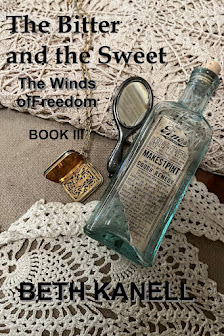


That's why book 3 in the Winds of Freedom series, THE BITTER AND THE SWEET, features would-be minister in training Almyra Alexander, whose Boston mother has passed away and whose politically active father is far too busy to raise a teenager (other than perhaps planning a marriage for her!). Readers met Almyra in book 2, when she was a pesky newcomer, dressed in city fashions and ignorant of rural ways, but already interested in the role she embraces in book 3: to become qualified to lead her own church. What about the push for abolition, a necessity for a moral person of her time -- will that get in the way of becoming a minister? And who ever heard of a woman leading a church??

I'm eager to learn what you think of Almyra's choices and adventures (including with a notorious counterfeiter) in THE BITTER AND THE SWEET. Please do let me know.

And when you've finished the book, tell me who you think the next young woman (teen!) is that I've chosen for the focus book 4. Think carefully, and remember the two-year jump involved. Can you guess the right one? I want to hear your thoughts, of course!

Wednesday, March 13, 2019

Thinking Pink, A Happy Year from My Last Radiation Treatment

Last weekend the Boston Globe ran an opinion piece that said people shouldn't have to crowdfund to pay for their health care. The piece described a man with critical diabetes who fell $50 short of his fundraising goal -- and as a result, the piece implied, he died.

I'm not sure the article made complete sense. But I get the point: Health care should be better than this. Sick people shouldn't have to go out and ask their friends and total strangers to donate, to save them. It's terrible.

Equally shocking, a quick Google search shows that crowdfunding is now supporting cancer research (both breast and prostate, say the articles, showing gender equity).

Wait, does that mean if the lab falls $50 short on donations, it doesn't get the testing equipment or microscopes? Sheesh.

I'm happy to celebrate a year this month since my last radiation treatment for very ordinary, very treatable, and still very scary breast cancer. Great treatment doctors and teams, top-notch support. And thanks to waiting until I was over 65 for the diagnosis, my health care insurance (part Medicare, part gap coverage) took me through this, brilliantly. Without added health care debts. Thank you, thank you, thank you!!! (I try not to remember that if I'd dared to get the diagnosis a year before 65, which might have been wiser in terms of cancer's action, I'd be hundreds of thousands of dollars in debt. Truth.)

There is one other small downer, though: Since I'm self-employed, even though I worked really hard and completed every assignment last year, I didn't have the extra energy for a while to go chasing extra work—and these days, the routine assignments don't cover all the living expenses. Fact of life. For 2019, I'll do better. But gosh darn it, I've still got to make up for that slowdown in 2018.

So I've taken a tip from the Big Research Labs and the little uninsured and everyone in between who's running behind these days financially, and done it my way:

Crowdfunding publication of my awesome (and already award-winning!) Vermont mystery, ALL THAT GLITTERS.

It's simple: Pre-order a copy of the book (click here to see it and browse). You get your money's worth as the book goes to print (we need 750 pre-orders for that), and I'll get a share after that happens, which ought to make up a chunk of the difference in what I needed last year, versus what I earned.

Oh, and if you pre-order three copies -- you get your name into the book as a sponsor. (So, like, you could sign the book next to your own name, really!) One thing I especially like about this route is, you can read the book for free on the website and make sure you're going to like it. (Sure, click here.)

This crazy notion comes via Inkshares, which is printing some really lovely books, on nice paper, well bound, well made ... and without a fuss. I love it!

So if you're in the mood to "Think Pink" may I suggest buying this mystery? You'll have a lot of fun, and you won't have to walk five miles or make people sign your pledge page or call the radio station or any of that. Just click here, and sign up for a book.

Then tell a couple of friends about it. That's how the real "crowdfunding" works. Because getting through modern life takes a lot of help. And trust me—I'll be signing up for YOUR crowdfunder next year.

Hugs and hope to you all!


Thursday, November 8, 2018

Which of These Did You Read as a Teen?

What makes a book into a good one for "young adults" or "middle graders"? When do adults start reading those same titles? This and more, on Saturday as I take part in "Writing for the Younger Set," a panel at the annual conference of Sisters in Crime New England. Here's what I have in mind ...


Writing for the Younger Set – Notes from Beth Kanell


In the 1800s, “Books for Young Persons” included The Swiss Family Robinson, Waverly (Walter Scott), Oliver Twist (Dickens), The Count of Monte Cristo (Dumas), Great Expectations, Alice in Wonderland, The Adventures of Tom Sawyer, The Adventures of Huckleberry Finn, Kidnapped (Stevenson), and Kipling’s The Jungle Book. According to a Wikipedia author, these were books that “appealed to young readers, though not necessarily written for them.”

In the 1960s, the market for “adolescents” blossomed – and in 1973 Deathwatch by Robb White won the Edgar Award for Best Juvenile Mystery. I’ve heard it said often that the true impetus of the “young adult” genre came from librarians, who saw a need for good books that wouldn’t push young readers into areas that were too mature for them.

But in the 1980s, that taboo was broken by books that dealt with rape, suicide, parental death, and murder – perhaps more at the YA (young adult) level than for middle grades (MG). With this trend came the teen romance novel, wrapped in adventure and with a more frank sexuality, even if the characters “resisted.” Contrast this with the Lord of the Rings trilogy, long a favorite among teens but containing no sexuality at all!

The Harry Potter series and the Hunger Games trilogy broke the barriers down further, making it clear that the important cultural questions, when addressed in fiction, could command a mixed audience of middle graders, young adults/teens, and adults. A book positioned deliberately for such a mix is now called a crossover – especially prominent today are “YA crossover” books, intended for adults as much as for teens.

Some aspects of writing “YA crossover” that intrigue me within the history-hinged mystery area are:

* The protagonist is a teen and thus by definition not very experienced – which leads to an “unreliable narrator” in a good way.

* The emotional value of the book comes with the teen’s confrontation with the world in some form, leading to “coming of age” – maybe not all at once.

* Issues that adults think are obvious or settled become open to new experience for teens: racial injustice, gender walls, technological windows, even illness and death.

I also spend a lot of thought and energy on issues around “who speaks for whom” and the amounts of violence and explicit physical awareness (which includes sexuality) when I write.

Most deeply, I believe the writer for young adults owes the audience three things: integrity, a chance to reach different conclusions than the writer’s, and a sense of hope for the future of each individual.

Beth Kanell lives in northeastern Vermont, with a mountain at her back and a river at her feet. She writes poems, hikes the back roads and mountains, and digs into Vermont history to frame her “history-hinged” mystery novels: The Long Shadow, The Darkness Under the Water, The Secret Room, and Cold Midnight. Her poems scatter among regional publications and online. She shares her research and writing process at BethKanell.blogspot.com.

(for November 10, 2018)
 
-->

Wednesday, August 28, 2013

Explosive Material: The Young Adult Mystery

Did you ever read Tom Sawyer in the original version -- not condensed or modernized? How about Huckleberry Finn? These are now mentioned often as prototype "young adult" novels, along with To Kill a Mockingbird. And the reason they are classified in this way is simple: The characters in them are not yet grown up, and they experience a marked change in their lives: one often described as a loss of innocence.

I think it's important to notice that these labels and even this "loss of innocence" are relatively recent concepts. When I was a kid, the Mark Twain books were seen as accessible (if you were willing to work hard at reading them), but not sorted into "adult" and "young adult." Life on the Mississippi and A Connecticut Yankee in King Arthur's Court could be fit reading for anyone who could stick with the pages -- although clearly, you'd get more from Twain's bouts of satire if you were a more experienced reader.

Today's "young adult" (YA) category is generally recognized as especially the creation of librarians (as well as teachers) who wanted to offer worthwhile material for teens without pushing them into emotions they weren't yet ready to experience -- like the self-doubt that can result from reading sexually explicit material at too young an age, or the callous disregard for loss of life that marks some thrillers. YA material also has often involved recognizing the challenges most teens face: how to stay true to yourself in the face of peer pressure, how to avoid the cost of substance abuse, how to separate from parents without losing "home."

One of the books most recognized as an enduring YA novel is A Wrinkle in Time by Madeleine L'Engle. It shaped some of my ideas about what it is to be a young woman, a scientist, and a brave person. I still keep a copy on my shelf. In her 1983 Newbery Award acceptance speech for this book, the author said:
Because of the very nature of the world as it is today our children receive in school a heavy load of scientific and analytic subjects, so it is in their reading for fun, for pleasure, that they must be guided into creativity.
She added, quoting from another author, that we help our children avoid a limited universe "by providing them with 'explosive material capable of stirring up fresh life endlessly.'"

Even newer than the YA novel is the special genre of the YA mystery.  A good one has to include the elements that make a mystery for "grownups" worth reading: a plot that makes sense, twists that are both surprising and believable, characters who risk something and who make choices that matter. And a good dash of suspense and tension! Plus for the YA area, the mystery also has to be what L'Engle called "explosive material." I can stand behind that statement firmly. "Explosive" in this way doesn't need to mean objectionable or even shocking -- but it must mean that the reader experiences a possibility of change and growth.

With those challenging aspects in mind, I'm glad to welcome two new YA mysteries to the shelf. One, by Michelle Gagnon, is sci-fi crossover, in which a half dozen teens from various nations find themselves abruptly waking up in an emptied world where dinosaur-size monsters are hunting them. Published by Soho Crime, Gagnon's STRANGELETS compels the teens to share their pasts and wrestle with each other, to discover what has pushed them into this frightening situation -- and whether there is a chance to have their familiar world back again, ever. Criminal activity has indeed taken place. And courage is required. I like Gagnon's earlier thrillers very much, both the adult ones and the YA medical thrillers (Don't Turn Around and Don't Look Now). To me, STRANGELETS pushes the boundaries of the medical thriller, with plenty of intriguing science and tons of suspense. Seventeen-year-olds Sophie and Declan became part of my world while the book lasted. I do think this one is closer to sci-fi than to the traditional medical thriller, but ... it didn't bother me after the first few pages. Above all, Michelle Gagnon is a powerful storyteller and if she wants to call this one a thriller, well, I'll bend a bit.

The second is a firmly traditional mystery, in a less conventional setting: Jacquelyn Mitchard's WHAT WE SAW AT NIGHT. If the title evokes a hint of The Curious Incident of the Dog in the Night-Time (Mark Haddon), I think that's no accident -- because in Mitchard's book as well as Haddon's, the people we care about are separated from the rest of "us" by conditions of difference that arrived with their genes. In Mitchard's book, Allie Kim and her best friends Rob and Juliet suffer from xeroderma pigmentosum, a "severe allergy to sunlight." (The scientist part of me insists on clarifying: The condition actually means that the body cannot repair damage caused by ultraviolet light. But hey, if we can call alcoholism an allergy to alcohol, I guess the allergy motif works here, too.) The result of this shared disorder is that the three teens mostly emerge at night. Add their fascination with the discipline and daring of parkour -- an extreme sport -- and Allie, Rob, and Juliet take to climbing tall buildings in the dark. Inevitably, they see something criminal. But they're up against a very crafty psychopath with the skills and knowledge to make the teens appear to be the guilty ones. Not only that: It looks like Juliet is being compelled to submit to abuse, with her friends as hostages.

Mitchard demonstrates that the ages of YA protagonists can actually increase the tension and risks of a thriller; the decisions that Allie Kim faces are indeed explosive, stirring up fresh importance of life. I'm glad there's clearly going to be a sequel!

So, let me wrap up this long-ish post by saying: If you have a favorite YA mystery or novel ... is there something about it that's explosive in this way? Share, if you feel so moved.


Thursday, October 4, 2012

Setting a New Novel: Getting to Know Montpelier, Vermont (Better)


"The Sleuth of Montpelier, Vermont"

A Writer's Research Adventure

In a little “study” under the stairs, my father labored with ruler and Number 4 pencil on a single sheet of blued paper on which he could make scaled drawings. Nearby, curled in an armchair, the 10-year-old “me” read her Nancy Drew books, and understood that the secret panels and hidden rooms within the mysteries began their lives with someone else’s version of Dad’s blue pages.

There were trap doors, like the one in the floor of the wardrobe in “The Secret of the Wooden Lady,” which also included two cleverly crafted panels that Nancy discovered with her careful fingers; in “The Sign of the Twisted Candles,” the girl sleuth examines a camouflaged back stairway, then with her boyfriend Ned begins a hunt for the dead homeowner’s treasures: “Every panel in the ceilings, walls, and floorboards was carefully examined. … Ned cried out, ‘Nancy! Come here! I think I’ve found something!” She ran to his side in the rear hall. ‘Look! The grasss cloth on this wall is a little different from the rest and a twisted candle has been worked into the design.’” There’s a safe hidden behind the significant design element.

Now that I’m writing a “Vermont Nancy Drew” series set in Montpelier, I’ve tuned in to the wide range of design trends that resulted in the many-aged downtown architecture of Vermont’s capital. If I want my sleuth, Felicity “Lucky” Franklin, to discover a hidden room or secret panel, what structure will she explore? In this case, it has to be (for plot reasons) both the State House and the Blanchard Opera Block, now home to the bookstore that belongs to Lucky’s mom (the real store owner is collaborating) and once host to grand performances in the early 1900s, including the arrival of young elephants with the touring circus!

A behind-the-scenes exploration of the State House with ardent conservation curator David Schütz convinced me that the structure’s major idiosyncrasies lie in its dome, which sits atop the legislative “box” but is a unit unto itself. “My” sleuth will find clues there, among the oddly positioned timbers and scrawled graffiti. In the Blanchard Opera House, though, she’ll discover an actual hiding place.

Could Montpelier architect and sometime mayor George Guernsey, who designed the Blanchard Opera House, actually have ensured a concealed area in the building? Norwich University student Megan Morse and Putney preservation pro Lyssa Papazian tracked Guernsey’s work and life (1839-1900) in detail. The era fits that of Lambert Packard, St. Johnsbury’s major architect (1832-1906), and at least one of Packard’s buildings has a hidden panel next to a fireplace. Guernsey himself favored intricacy and Italianate detail. Although none of his documented structures in Montpelier show false walls, hidden doors, or secret panels, the grace of fiction allows me to insert one with a relative amount of believability.

But that’s not quite enough for the kind of fiction I’m writing, which always hinges on some aspect of Vermont history, as well as a puzzle rooted in the life stages of teenagers. So I have two more components of Guernsey’s real life to weave in: his local nickname of “King George,” and his death of tuberculosis.

In the process of crafting these mysteries (the first of is “All That Glitters”), I hope to also bring attention to George Guernsey himself and to his structures, which probably number in the hundreds, whether churches, houses, commercial blocks, or public buildings like libraries and schools. A little extra knowledge may yet make the difference in a decision to maintain a George Guernsey building at a valued town or city location – whether there is a secret panel in it, or not.

[Photos of details of a George Guernsey building, the Edward Dewey house, courtesy of Don Shall.] 

Friday, July 13, 2012

Welcome, Guest Author Carole Shmurak: When Teens Solve a Murder (in 1865!) -- How the Matty Trescott Series Started

Under the name Carroll Thomas, Carole Shmurak co-authors (with Tom Ratliff) the "young adult" mystery series featuring dauntless Matty Trescott. But it wasn't clear at the beginning that this would even be a mystery series. Here's what happened. And thank you, Carole, for bringing us into the "story of the story." -- Beth


Ring Out Wild Bells was nominated for the Agatha Award for Best Young Adult Mystery of 2001, but it didn't start out as a mystery. My co-author Tom Ratliff and I had created a book we called Matty's War, about a sixteen year old girl who disguises herself as a boy and goes to fight for the Union army in the Civil War. It was based on a 1994 article in Smithsonian magazine about the 400 women who actually did this — a little-known part of American history.

After four years of writing and revising the manuscript and several years of receiving rejection letters from publishers, we were offered a contract by a small press — IF we would turn Matty's adventures into a three book series. We were able to write a prequel to Matty's War fairly quickly because we had already alluded to many events in Matty's life before the war, and now we just had to elaborate upon them; this became the book Blue Creek Farm, which describes Matty's life in Kansas just prior to, and at the start of, the War between the States.

But the sequel presented us with a challenge: with the Civil War over, we wondered how to bring excitement and drama to the story. Then the idea of a murder mystery came to us. As the Civil War ends, Matty's war experiences lead her to want to become a doctor. While she is working in a Boston hospital, a dying woman utters some strange last words to her, and Matty and her cousin Neely set off on a quest to find out the meaning of those words. In a world without modern forensics, our young protagonists take on and solve a most baffling murder case.

In 1865, there were two medical schools for women, one in Boston and one in Philadelphia. Since we lived in Connecticut, the Boston school was the easier one to research; the archives from New England Female Medical College reside in the library of Boston University. And the more we learned about Boston in the mid-1860s, the more we became intrigued by the many famous people who were living there or who were likely to be visiting friends there: the scientists Asa Gray, Lydia Shattuck, and Louis Agassiz, novelist Lydia Maria Child, abolitionists Abigail Kelley Foster and Maria Chapman, and women’s suffrage leader, Elizabeth Cady Stanton. So when Neely comes to spend time with Matty, the two young women get to attend a party at which many of the famous Bostonians and their friends are present. Matty gets to hear Stanton's views on women's education and Neely, a science student, eagerly listens to Gray and Agassiz arguing about Darwin and his theory of evolution.

Early on in the book, we have the two cousins discussing one of the important issues of the day: with the passage of the 15th Amendments giving black men the vote, many of the women who had been staunch abolitionists took on a new cause — getting the vote for women. Other feminist causes, like gaining the right to own property and getting the opportunity to attend college, became central to the plot of our book — and to the solution of the mystery.

About the title: Ring Out Wild Bells is a poem by Alfred, Lord Tennyson, published in 1850, which contains the line, “Ring out the old, ring in the new.” Our book begins with the ringing of church bells throughout the city of Hartford, Connecticut, announcing the end of the war, and it ends with the ringing of wedding bells, as one of our major characters is married. And much of the book deals with the changing of old ideas and customs to new ones: the end of slavery, the growing acceptance of the theory of evolution, the beginning of the fight to allow women to vote, and the emergence of higher education for women.

 — Carole Shmurak, mystery author, who co-authors the Matty Trescott series under the pen name of Carroll Thomas.

"The Young Elderly": No Way, No Way!

My "day job" is still editing journals -- that is, sets of articles written by researchers in various fields, from engineering to ...