Showing posts with label young adult. Show all posts

Wednesday, October 16, 2024

Three Teenaged Girls in 1850s Northern Vermont: My Protagonists for The Winds of Freedom


When I wrote THE LONG SHADOW, the story of Alice Sanborn's discovery of injustice and loss in her home village of North Upton, Vermont, I reached for integrity: not just for Alice and her family as they continue their commitment to the abolition of American enslavement, but also for how we see that time, that piece of our past. I wanted to give readers an experience of aromas and tastes as much as possible, along with the binding constraints of the layers of women's garments at the time, and the ways family could be both supportive and harsh. When Alice's uncle rages about the politics of the time, I want you to feel with Alice the scary and exhilarating moment of seeing someone take a stand for a difficult position.

In fact, I was so immersed in this 295-page novel that when I completed it. I was startled to hear the editor at Gale/Five Star, the publishing house, say "I hope we'll be seeing more of Alice!" "How much more are you thinking?" I asked. She responded, "Until everyone is free." That is, from 1850 to 1865.

Well, why not? Alice's interactions with her younger Black friend Sarah and the innkeepers' daughter Jerushah came to a natural end at the end of that novel. But as we all know, when one friendship ends or changes, another often comes along.


For THIS ARDENT FLAME, I chose a very different sort of new friend for Alice: Caroline Clark. Because of her inability to hear, Caroline's spent her school years in a boarding school for the deaf and hearing impaired, in another state. Returning to North Upton for Caroline could be far more traumatic if it weren't for Alice. As the two teens learn to communicate in a layered set of "languages," they learn more about the diverse people around them, and develop their own fierce commitment to abolition, as well as to the linked issue of women's roles and rights.

Readers may have been startled by the decision of these characters at the end of the book: They are headed West, to a place where their presence may be critically important to how America develops the laws and freedoms of its added territories, soon to be states. How could the Winds of Freedom series continue? Was it moving West?

Not at all. When the editor invited me to develop a series for this "young adult crossover" genre -- that is, one that features young adults (teens) as protagonists, but is read enthusiastically and with curiosity by adults, including parents and grandparents -- I saw right away that pushing the sequence by a year at a time, all the way to 1865, would mean a much longer and slower sequence than I wanted to write ... and, more urgently, it would mean that after the first few titles, the main characters would no longer be teens. Not only would that break the genre, it would take me into a kind of novel that didn't interest me. I really like writing "YA crossover."

So I came up with a plan: Each book would jump forward two years, not one; and the protagonists would shift with the timing, like a relay race, passing the action to another girl growing into the responsibility of working for a more moral nation and for the freedoms of those around her.
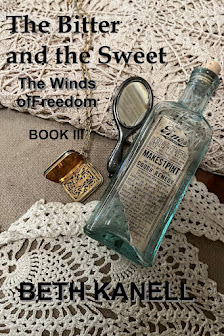


That's why book 3 in the Winds of Freedom series, THE BITTER AND THE SWEET, features would-be minister in training Almyra Alexander, whose Boston mother has passed away and whose politically active father is far too busy to raise a teenager (other than perhaps planning a marriage for her!). Readers met Almyra in book 2, when she was a pesky newcomer, dressed in city fashions and ignorant of rural ways, but already interested in the role she embraces in book 3: to become qualified to lead her own church. What about the push for abolition, a necessity for a moral person of her time -- will that get in the way of becoming a minister? And who ever heard of a woman leading a church??

I'm eager to learn what you think of Almyra's choices and adventures (including with a notorious counterfeiter) in THE BITTER AND THE SWEET. Please do let me know.

And when you've finished the book, tell me who you think the next young woman (teen!) is that I've chosen for the focus book 4. Think carefully, and remember the two-year jump involved. Can you guess the right one? I want to hear your thoughts, of course!

Tuesday, May 25, 2021

Returning to Philip Pullman's THE BOOK OF DUST, Thinking about "Young Adult"


My newest Vermont historical adventure reaches the marketplace on June 23: THIS ARDENT FLAME. Set in a real village not far from where I research and write, in 1852, it probes the very real controversies around ending enslavement in America, from a Vermont point of view.

But for me—and I think for many other authors—a novel takes on legs and spirit of its own, and within a few pages of the start, I knew the teens in this book had complicated lives in which they felt the pain of being "other than" what's expected. They knew romance and dreams. They threw themselves into battles for justice, without full consideration of what it could cost them.

And that, for me, is the point of writing "YA." Teen protagonists aren't just unseasoned; they are passionate. When they recognize the next right thing to do, they can be more likely than careful, thoughtful adults to offer themselves and their abilities. Of course they get hurt this way. But they also grow in leaps that are exhilarating to experience, even as the writer rediscovering them. 

THIS ARDENT FLAME recaps what it meant to be deaf in Vermont before the Civil War. It exposes the pain of families already beginning to split on moral grounds. I hope that in the best of ways, it foreshadows the coming darkness of the war that tore America apart, so fiercely that the wounds have still not healed, 160 years since they began to bleed.

My kind of writing depends on constantly learning. A lot of that is from the scholarship and research of others, especially social historians. But I'm also always working at becoming a better wordsmith, scene setter, tension exposer, painter of love and loyalty. Part of my "training" comes from reading powerful stories told by others. I grew up on Madeleine L'Engle, J.R.R. Tolkein, Frances Hodson Burdett, Arthur Ransome, Robert Louis Stevenson, Louisa May Alcott, and yes, second-tier novelists who brought us important visions, like Harriet Beecher Stowe, who strolled right into THIS ARDENT FLAME and surprised me deeply.

In my non-writing life, I'm doing some hard things right now, involving selling the home where my husband and I lived and loved, and where I tended him in his final illness. I'm learning to talk with (and learn from!) contractors in preparing a new home for myself. I'm packing LOTS of books.

So I'm re-reading YA novels this month. That took me, this week, to Philip Pullman's newest series, "The Book of Dust," which has two published books so far, with the third and final yet to come. As I worked through the first one again, La Belle Sauvage (named for the canoe owned by Malcolm, one of the protagonists), I looked at how Pullman summoned power through his words, and deepened the ideas and passions behind them. 


Around halfway through the book, Malcolm's school gets taken over by a religious crusade that deliberately turns children into spies on the morals of their families and friends. Malcolm observes the effect: "Few pupils were openly naughty anymore—there were few fights in the playground, for instance—but everyone seemed guiltier."

The phrasing made me think of Orwell's Animal Farm. Political manipulation and power depend on making one group feel potent, and another feel guilty and "less than." It's a shocking book, and one that is now embedded as firmly in our culture and thinking as Orwell's other noted dystopian, 1984. 

Is Animal Farm meant for teens to read? I certainly read it first when I was a teen, for school. Recently my 12-year-old grandson read it for school, too. I tried to let him know, without being pushy about it, that I felt the book was dark, even scary. I bet he felt the same way. I hope his classroom reinforced taking a stand against the machinations exposed in the story—and supported the kids who found it painful to read. Lots of people experience the use of power against them, even before they grow up.

I'm torn about whether Pullman's books are "good for young readers." Even today, I find they hurt me, darken my views, open me to more despair. 

If you have an opinion on all this—I'd like to hear yours. Let's talk.

[Hope you'll make time to browse more of my tales here of historical research, writing, and life! Tap the link to reach the rest of the material: https://bethkanell.blogspot.com]

Tuesday, February 12, 2019

Cover Design, Teen Sleuth in Vermont - Updated! ("Young Adult Crossover")

When I started writing ALL THAT GLITTERS, my Vermont teen sleuth mystery, I knew a cover design would be critical to how I'd present the ongoing chapters on some online sites. I took the issue to my sister-in-law Cheryl Minden, whose graphic design career extends from gorgeous paper items and tags, to elegant signage (in some of the loveliest Montclair and Caldwell, NJ, structures), to art shows (she's #bravitasart on Instagram).

All I could offer her as a starting place was the classic #NancyDrew silhouette from those blue-board books of the old days:


And of course, a shot of the classic structure of Montpelier, Vermont, where the action takes place:


Cheryl looked at the first chapter and the synopsis -- the protagonist, Felicity "Lucky" Franklin, is adept with texting and related smartphone functions, and that's how she coordinates with her BFFs Michelle and Sandy. And the further tech expertise of these teens slips neatly into surveillance cameras, Google Earth, and more.

With her teenaged daughter as collaborator, Cheryl designed a cover that clearly states "student" (Lucky is a college freshman), as well as smartphone, and "Capitol" crimesolving.


The last touch turned out to be adding the line at the bottom left, because this is book 1 of a series that follows Lucky Franklin through her college and family and crimesolving crises, to the moment she submits her application for -- well, no, we can't tell you that part yet. But it's a wild ride!


Cheryl says she's not looking for more book design work, sorry ... but watch for her projects if you're in New Jersey. And watch where the book cover shows up next, en route to being published in the spring!

Thursday, November 8, 2018

Which of These Did You Read as a Teen?

What makes a book into a good one for "young adults" or "middle graders"? When do adults start reading those same titles? This and more, on Saturday as I take part in "Writing for the Younger Set," a panel at the annual conference of Sisters in Crime New England. Here's what I have in mind ...


Writing for the Younger Set – Notes from Beth Kanell


In the 1800s, “Books for Young Persons” included The Swiss Family Robinson, Waverly (Walter Scott), Oliver Twist (Dickens), The Count of Monte Cristo (Dumas), Great Expectations, Alice in Wonderland, The Adventures of Tom Sawyer, The Adventures of Huckleberry Finn, Kidnapped (Stevenson), and Kipling’s The Jungle Book. According to a Wikipedia author, these were books that “appealed to young readers, though not necessarily written for them.”

In the 1960s, the market for “adolescents” blossomed – and in 1973 Deathwatch by Robb White won the Edgar Award for Best Juvenile Mystery. I’ve heard it said often that the true impetus of the “young adult” genre came from librarians, who saw a need for good books that wouldn’t push young readers into areas that were too mature for them.

But in the 1980s, that taboo was broken by books that dealt with rape, suicide, parental death, and murder – perhaps more at the YA (young adult) level than for middle grades (MG). With this trend came the teen romance novel, wrapped in adventure and with a more frank sexuality, even if the characters “resisted.” Contrast this with the Lord of the Rings trilogy, long a favorite among teens but containing no sexuality at all!

The Harry Potter series and the Hunger Games trilogy broke the barriers down further, making it clear that the important cultural questions, when addressed in fiction, could command a mixed audience of middle graders, young adults/teens, and adults. A book positioned deliberately for such a mix is now called a crossover – especially prominent today are “YA crossover” books, intended for adults as much as for teens.

Some aspects of writing “YA crossover” that intrigue me within the history-hinged mystery area are:

* The protagonist is a teen and thus by definition not very experienced – which leads to an “unreliable narrator” in a good way.

* The emotional value of the book comes with the teen’s confrontation with the world in some form, leading to “coming of age” – maybe not all at once.

* Issues that adults think are obvious or settled become open to new experience for teens: racial injustice, gender walls, technological windows, even illness and death.

I also spend a lot of thought and energy on issues around “who speaks for whom” and the amounts of violence and explicit physical awareness (which includes sexuality) when I write.

Most deeply, I believe the writer for young adults owes the audience three things: integrity, a chance to reach different conclusions than the writer’s, and a sense of hope for the future of each individual.

Beth Kanell lives in northeastern Vermont, with a mountain at her back and a river at her feet. She writes poems, hikes the back roads and mountains, and digs into Vermont history to frame her “history-hinged” mystery novels: The Long Shadow, The Darkness Under the Water, The Secret Room, and Cold Midnight. Her poems scatter among regional publications and online. She shares her research and writing process at BethKanell.blogspot.com.

(for November 10, 2018)
 
-->

Sunday, August 19, 2018

House of Dreams: The Life of L. M. Montgomery, by Liz Rosenberg


It's daunting to realize how many books and stories L. M. (Lucy Maud) Montgomery wrote, often under conditions of enormous financial or emotional stress, and how well loved they became. This year's biography of the author, by professor and novelist Liz Rosenberg of Binghamton, New York, concludes with a description of the reach of Montgomery's beloved character Anne of Green Gables:
The popularity of L. M. Montgomery's writing continues unabated. Maud's books have sold millions of copies. Her work lives on in dozens of forms -- some of which she never knew, and could not have even imagined. Her writing has been successfully adapted to the stage, the movies, and for television, and is available in books, CDs, and DVDs. Discussions of her work abound in journals dedicated to her writings, and in online blogs and articles.

Anne's House of Dreams was distributed to Polish soldiers during World War II to lend them courage and hope. ... Prince Edward Island estimates 350,000 come to visit Green Gables each year. Kate Middleton, as the newlywed wife of Prince William, flew to Prince Edward Island on her honeymoon in honor of the books, citing Montgomery as one of her favorite and most influential authors. ... Her works are treasured by children and adults all over the world -- they are particular favorites of Japanese schoolchildren, fellow islanders living half a world away. ... Her single most beloved and famous book, Anne of Green Gables, has sold more than fifty million copies worldwide and been translated into more than twenty languages.
Let that be a noted talking point for those explaining the lasting and global effect of children's books and classics about growing up poor and making the best of things. As Rosenberg demonstrates in HOUSE OF DREAMS (a title that reflects the 1917 "Anne" book, Anne's House of Dreams), one persistent and naive author who puts pen to paper every day can eventually see her stories enter the hearts of astonishingly diverse people.

Rosenberg is a poet and novelist, as well as biographer, and these qualities enable her to narrate Maud's own life of heartbreak with passion, insight, and a sense of pace that feels like a well-spun novel, full of complex characters and twists of plot. Trapped in a dysfunctional family through both poverty and her own sense of loyalty to her grandmother -- a brusque and stern woman who nonetheless made enormous sacrifices so Maud could gain an education and become employed -- this lifelong writer created the personality of an orphaned girl with unfortunate red hair, determined to see and name the beauty of the world around her.

There is certainly a circle of courage in Montgomery's "work and life": The character she gave to Anne connected directly to the better days of her own spirited approach to life. But unlike her protagonist, Maud Montgomery had very few "lucky breaks" in life. Repeatedly "orphaned" in terms of people who should have taken care of her as a child, then disappointed in love and entangled with men whose coping strategies tore her apart, she still maintained her discipline of writing, and fought for publication of her work. At one point one of the most highly paid authors among Canadians, she also saw her work become profitable to an unscrupulous and unpleasant publisher (she did not benefit from the vast earnings of the "Anne" films), barely coped with what was probably bipolar disorder, and gave up her peace of mind as well as her fortune to take care of the (mostly) men who depended on her.

The only time that I was able to "put aside" HOUSE OF DREAMS was when I just had to stop to quickly re-read Anne of Green Gables, to feel again the marvelous joy of Anne's self-propelled discoveries of love and life. Then I plunged back into HOUSE OF DREAMS, unwilling to interrupt it again, even through the massive sorrows of Montgomery's pathway.

Many thanks to Rosenberg for this satisfying addition to women's biography, to the insight that an author's life can provide, and to opening a door for younger readers -- from engaged 12-year-olds on up -- to explore how an author and her work can braid and mingle. The publication of this volume by Candlewick Press, with its esteemed standing in libraries, classrooms, and bookshelves of eager readers, makes that intent especially clear. And the tender line drawings by Vancouver, BC, artist Julie Morstad are a perfect match to the book.

I plan to stay grounded in HOUSE OF DREAMS as I set "pen to paper" for my own next novel. What an inspiration to treasure! I'm on my way.

Friday, February 21, 2014

Learning the Words: The Common Core Standards and Joyful Writing

"Scaffolding."
It's easy to think of the Common Core State Standards as something "for teachers" and not for the rest of us. The newspaper coverage emphasizing the standards as related to testing, for instance -- and if you're a writer who has finished your official schooling, testing is something you're probably not going to embrace.

On the other hand, there's an aspect of the Common Core that is making my heart leap with excitement. Yes, really. Here it is: As I understand them, the new standards are saying: "By the time students leave high school, they'll be reading and processing information at an adult level."

To me, that makes good sense -- I want the kids coming out of high school and going straight to the workforce to be able to do so as adults, and even more so, I hope that those teens entering college can do it as adults. When I think about the differences among the college students I know, in terms of who is making the most of the opportunity and who is blowing it off, it boils down to exactly this.

When I pair this idea with "scaffolding" -- a term I learned from a reading teacher, at a workshop maybe 20 years ago -- the role of "young adult" fiction in the classroom becomes more complex and interesting. Not only are we giving readers a chance to experience, vicariously, the challenges, fears, and courage of life; we are also helping them rise up, one grade at a time, to being effective and joyful participants in the world of adults. We build a "scaffold" the way house painters or skyscraper builders do, so we can boost readers upward from where they already stand.

How do we do this? Here's my vocab lesson for the day, teaching myself the ways that teachers are now talking about the process, within the Common Core standards, in terms of the writer's own favorite building blocks: words.
Tier 1 words: These words are basic vocabulary or the more common words most children will know. They include high-frequency words and usually are not multiple meaning words.

Tier 2 words: Less familiar, yet useful vocabulary found in written text and shared between the teacher and student in conversation. The Common Core State Standards refers to these as “general academic words.” Sometimes they are referred to as “rich vocabulary.” These words are more precise or subtle forms of familiar words and include multiple meaning words. Instead of walk for example, saunter could be used. These words are found across a variety of domains.

Tier 3 words: CCSS refers to these words as “domain specific;” they are critical to understanding the concepts of the content taught in schools. Generally, they have low frequency use and are limited to specific knowledge domains. Examples would include words such as isotope, peninsula, refinery. They are best learned when teaching specific content lessons, and tend to be more common in informational text. (a nice version, well spelled out, from a commercial website, http://www.learninga-z.com)
We who are writing YA fiction -- whether it's mysteries or "literary" -- are invited by these standards to play with "Tier 2 words," the words that my teaching friends call "rich vocabulary." What a gift! What a delight! These are the words I've used in my poetry, always; now I'm being invited to use them deliberately and with skill, in everything else I'm writing for grades K to 12, and especially for middle grades and young adults.

See why my Writer's Heart is singing?

Wednesday, August 28, 2013

Explosive Material: The Young Adult Mystery

Did you ever read Tom Sawyer in the original version -- not condensed or modernized? How about Huckleberry Finn? These are now mentioned often as prototype "young adult" novels, along with To Kill a Mockingbird. And the reason they are classified in this way is simple: The characters in them are not yet grown up, and they experience a marked change in their lives: one often described as a loss of innocence.

I think it's important to notice that these labels and even this "loss of innocence" are relatively recent concepts. When I was a kid, the Mark Twain books were seen as accessible (if you were willing to work hard at reading them), but not sorted into "adult" and "young adult." Life on the Mississippi and A Connecticut Yankee in King Arthur's Court could be fit reading for anyone who could stick with the pages -- although clearly, you'd get more from Twain's bouts of satire if you were a more experienced reader.

Today's "young adult" (YA) category is generally recognized as especially the creation of librarians (as well as teachers) who wanted to offer worthwhile material for teens without pushing them into emotions they weren't yet ready to experience -- like the self-doubt that can result from reading sexually explicit material at too young an age, or the callous disregard for loss of life that marks some thrillers. YA material also has often involved recognizing the challenges most teens face: how to stay true to yourself in the face of peer pressure, how to avoid the cost of substance abuse, how to separate from parents without losing "home."

One of the books most recognized as an enduring YA novel is A Wrinkle in Time by Madeleine L'Engle. It shaped some of my ideas about what it is to be a young woman, a scientist, and a brave person. I still keep a copy on my shelf. In her 1983 Newbery Award acceptance speech for this book, the author said:
Because of the very nature of the world as it is today our children receive in school a heavy load of scientific and analytic subjects, so it is in their reading for fun, for pleasure, that they must be guided into creativity.
She added, quoting from another author, that we help our children avoid a limited universe "by providing them with 'explosive material capable of stirring up fresh life endlessly.'"

Even newer than the YA novel is the special genre of the YA mystery.  A good one has to include the elements that make a mystery for "grownups" worth reading: a plot that makes sense, twists that are both surprising and believable, characters who risk something and who make choices that matter. And a good dash of suspense and tension! Plus for the YA area, the mystery also has to be what L'Engle called "explosive material." I can stand behind that statement firmly. "Explosive" in this way doesn't need to mean objectionable or even shocking -- but it must mean that the reader experiences a possibility of change and growth.

With those challenging aspects in mind, I'm glad to welcome two new YA mysteries to the shelf. One, by Michelle Gagnon, is sci-fi crossover, in which a half dozen teens from various nations find themselves abruptly waking up in an emptied world where dinosaur-size monsters are hunting them. Published by Soho Crime, Gagnon's STRANGELETS compels the teens to share their pasts and wrestle with each other, to discover what has pushed them into this frightening situation -- and whether there is a chance to have their familiar world back again, ever. Criminal activity has indeed taken place. And courage is required. I like Gagnon's earlier thrillers very much, both the adult ones and the YA medical thrillers (Don't Turn Around and Don't Look Now). To me, STRANGELETS pushes the boundaries of the medical thriller, with plenty of intriguing science and tons of suspense. Seventeen-year-olds Sophie and Declan became part of my world while the book lasted. I do think this one is closer to sci-fi than to the traditional medical thriller, but ... it didn't bother me after the first few pages. Above all, Michelle Gagnon is a powerful storyteller and if she wants to call this one a thriller, well, I'll bend a bit.

The second is a firmly traditional mystery, in a less conventional setting: Jacquelyn Mitchard's WHAT WE SAW AT NIGHT. If the title evokes a hint of The Curious Incident of the Dog in the Night-Time (Mark Haddon), I think that's no accident -- because in Mitchard's book as well as Haddon's, the people we care about are separated from the rest of "us" by conditions of difference that arrived with their genes. In Mitchard's book, Allie Kim and her best friends Rob and Juliet suffer from xeroderma pigmentosum, a "severe allergy to sunlight." (The scientist part of me insists on clarifying: The condition actually means that the body cannot repair damage caused by ultraviolet light. But hey, if we can call alcoholism an allergy to alcohol, I guess the allergy motif works here, too.) The result of this shared disorder is that the three teens mostly emerge at night. Add their fascination with the discipline and daring of parkour -- an extreme sport -- and Allie, Rob, and Juliet take to climbing tall buildings in the dark. Inevitably, they see something criminal. But they're up against a very crafty psychopath with the skills and knowledge to make the teens appear to be the guilty ones. Not only that: It looks like Juliet is being compelled to submit to abuse, with her friends as hostages.

Mitchard demonstrates that the ages of YA protagonists can actually increase the tension and risks of a thriller; the decisions that Allie Kim faces are indeed explosive, stirring up fresh importance of life. I'm glad there's clearly going to be a sequel!

So, let me wrap up this long-ish post by saying: If you have a favorite YA mystery or novel ... is there something about it that's explosive in this way? Share, if you feel so moved.


Tuesday, March 26, 2013

A Salute to A WRINKLE IN TIME -- and a New Voice in This Year's Fiction

It's hard to believe it, but 50 years have passed since the publication of Madeleine L'Engle's book A WRINKLE IN TIME. "Young adult" fiction before the genre really existed, and providing a powerful journey of spiritual seeking as well as a new definition of courage, this novel is one I've returned to at least every five years or so, to see "how the author did it" -- and why it means to much to me.

Now I'm honored to present a guest post from Ellen Larson, whose November 2013 book, IN RETROSPECT, connected right away for me to the L'Engle classic. Make sure to connect at the end of this post, too -- there's a role for you in what's ahead for Ellen Larson.


A L’Ove L’Etter to Madeleine L’Engle

The Happy Medium. Tesseract. Sport. Magic words to kids like me who read A Wrinkle in Time when it was published in 1962. Such a mysterious, heartrending, and above all inspiring book. My first science fiction read, though I didn’t make that connection at the time. Books were just books to kid me. But I was aware that this book by Madeleine L’Engle was grounded in science, and thus it seemed more real to me than other books I’d read that had a fantasy element, like The Princess and Curdie, or were simply mainstream books like The Lord of the Flies. That bears repeating: More real. Science fiction; more real. What a paradoxical reaction! I was hooked.

In the years that followed, I read Andre Norton, Robert Heinlein, Ray Bradbury, and Isaac Asimov with increasing fervor and preferences. I was never too fond of Heinlein’s big metaphysical hit, Stranger in a Strange Land (didn’t like the sexual politics—though again, I was too young to give my uneasiness a name), but I absolutely loved his lesser known The Door Into Summer, a whimsical love story that hooked me on time travel for life because of its elegant pair of time travel devices. First Heinlein uses have simple cryonics, which allows the hero to go forward in time without aging (hey, it counts!). And second, upon finding himself thirty years in the future, when such things just might be possible, Heinlein introduces a mad genius scientist who has invented a time-travel machine.

What I found compelling about the book—what I find compelling about the best time-travel stories—was that I could literally feel my mind bending as I tried to follow reality as it twisted and seemingly changed. I like that a lot.

As both a writer and a reader I am a fan in intricate plotting, a preference that led me to mystery reading and writing as well, but there is no plotting more complex than a well-told time-travel tale. I crave that moment in the story when reality shifts and appears to rewrite itself, exposing the power of the writer as the plot at last unfolds and the perceived complexity is revealed to be elegant simplicity. And that is only one model of time-travel structure.

In addition to plots like that in The Door Into Summer, in which events remain constant and only perception changes, there are equally mind-boggling tales of parallel universes, altered timelines and epic crossroads in history. This structure generally involves the inevitable happening even though history has indeed been changed by the time-traveling characters. The delight comes from watching the efforts of protagonist or antagonist to cause or prevent the inevitable, in ways we never expect. The iconic Star Trek episode, The City on the Edge of Forever, written by the great science-fiction author Harlan Ellison, is a prime example of this structure. Though she has earned Kirk’s love and our respect, Edith Keeler must die; Kirk must choose between saving her and upending history, or letting her die. All that needs to be answered is the question of how—and how the moral question will be answered.
The Prioress from IN RETROSPECT

When I came to write my own time-travel story, In Retrospect, I started by choosing the structure that would best suit the idea (the conflict) that was bubbling in my head. The Infinite-Number-of-Parallel-Universes approach works great to explore characters. The Door-Into-Summer approach lends itself to deliciously evil plotting. The Edith-Keeler approach leads to great moral conflict for the characters. I excluded parallel universes first, because while tremendous fun in its way (my first run in with parallel universes came with the iconic Dark Shadows in the 1960s, btw) it doesn’t include the mind-bending aspect I crave.

With apologies for skipping Kurt Vonnegut, this left me with a choice that can best be summed up by the question: In my futuristic world, can history be changed via time travel (Edith-Keeler) or not (Door-Into-Summer)?

I made my choice—but I’m not gong to elaborate here, because in fact the answer to the question is germane to the plot itself. It is also the topic under discussion when my protagonist, Retrospector Merit Rafi, first meets Eric Torre, a wave-aspect physicist with whom her life will be forever entwined:
The boy with the wavy yellow hair gave an argumentative snort. “But you haven’t addressed the question! Why can’t you change history?”
“Because you just can’t. Trust me. I’ve been there.” Having settled that issue, Merit raised a paper cup to her lips. Damn, the Rasakans made good wine. She breathed in the sweet summer air and let her gaze roam across the rolling meadows of Bergama. It never ceased to amaze her. Though half the Earth had been destroyed eight hundred years ago by the insanity of their forebears; though the coasts had been redrawn and the climate changed, this land called by the ancients Anatolia, then Asia Minor, then Turkey, had survived, flourished, and—eventually—regained its plenitude. It was a fine day to be sitting on the grass beneath an almond tree drenched in blossoms, a fine day for shooting the metaphysical breeze with new colleagues over a bottle or two between seminars. A damned fine day to be alive.
But the boy didn’t seem to have noticed that the debate was over. “That’s pretense, not proof,” he insisted.
Merit’s attention snapped back into place. “I beg your pardon?” She peered more closely at his freckled face. It looked mighty stubborn, in a cheerful sort of way. “If somebody asks you why she can’t walk on water, don’t you simply roll your eyes and say, ‘Trust me, you just can’t?’ ”
“No.” He shook his finger back and forth—shook it at her, Merit Rafi, graduate of the Oku Science Conservatory, officer of the Civil Protection Force with a full nineteen months’ experience, Select. “I tell her that water molecules are not cohesive enough to support the mass of a human body, nor is the surface tension high enough to resist the static shear—but that if she were a waterbug she could do it.”
It’s been a long journey from the day I first cracked open A Wrinkle In Time—the day that set me on the road to writing a time-travel book of my own. I think a thank-you is long overdue. So thank you, Madeleine L’Engle, and Happy Fiftieth Anniversary!

Beth adds: Ellen Larson is currently running a Kickstarter project to fund the making of the book trailer for IN RETROSPECT. Take a look at this exciting project -- the art is amazing, thanks to concept artist Mike Sissons (that's his painting of the Prioress, earlier), the video is close to completion, and there's a role for supporters right now ... and to salute this author and her work, which in my office will go on the same shelf where  A Wrinkle in Time now stands.


Saturday, November 3, 2012

One Book Arrives, One Book Being Written -- Mysteries!

Although today is the Big Release Day for COLD MIDNIGHT, I'm also working on three (gulp) other books. Here's one of them: Late in the evenings, I write chapters of All That Glitters, the first of eight teen sleuth books featuring Felicity "Lucky" Franklin, in Montpelier, Vermont.

You can watch the book being written -- read the chapters as their first drafts are posted! -- at WattPad. Click here to peek!

On November 5, this writing project gets featured on the blog of author and editor Penny Lockwood Ehrenkranz. Watch for a link to Penny's blog that morning!

The Poetry of Transitions: What Is Poetic Language?

On Thursday July 16 at 6:30 pm in the Davies Memorial Library in Lower Waterford, Vt., I'll be chatting about my new book THRESHOLDS (fr...