Showing posts with label fires. Show all posts

Saturday, October 31, 2015

"East Village" Vermont Fire of 1912: The True Story


The East Village fire of 1912: remains. Photo taken from behind today's Peter & Polly Park. Look for the bell tower of the church, toward the right rear in the card.
Dave and I enjoy collecting old postcards that show locations -- and sometimes people -- around our area, the Northeast Kingdom of Vermont. We've done this since we met, back in 2002, and it's become an important part of the research we each do: Dave for his attention to the college where he worked for 19 years (Lyndon State College) as Assistant Dean of Residential Life (he stays in touch with SO many people, as well as the history of Theodore N. Vail, a founder of AT&T and donor of many of the college town's cultural treasures. And me, well, I'm always hunting down more details of "truth" to add to the historical adventures I write.

So this postcard became one of our Big Finds for 2015. It is what's called a "real photo postcard" -- someone photographed an actual scene and event, and had the picture made into cards. Three things alerted us to excitement here: the scene, which is after a disastrous fire; the postmark and hardwritten date, August 26 (25), 1912, in St. Johnsbury, Vermont; and the writer, L. D. Weston, who notes that he's writing to "Dear" Mrs. F. Weston, in Marbleton, Quebec, Canada.
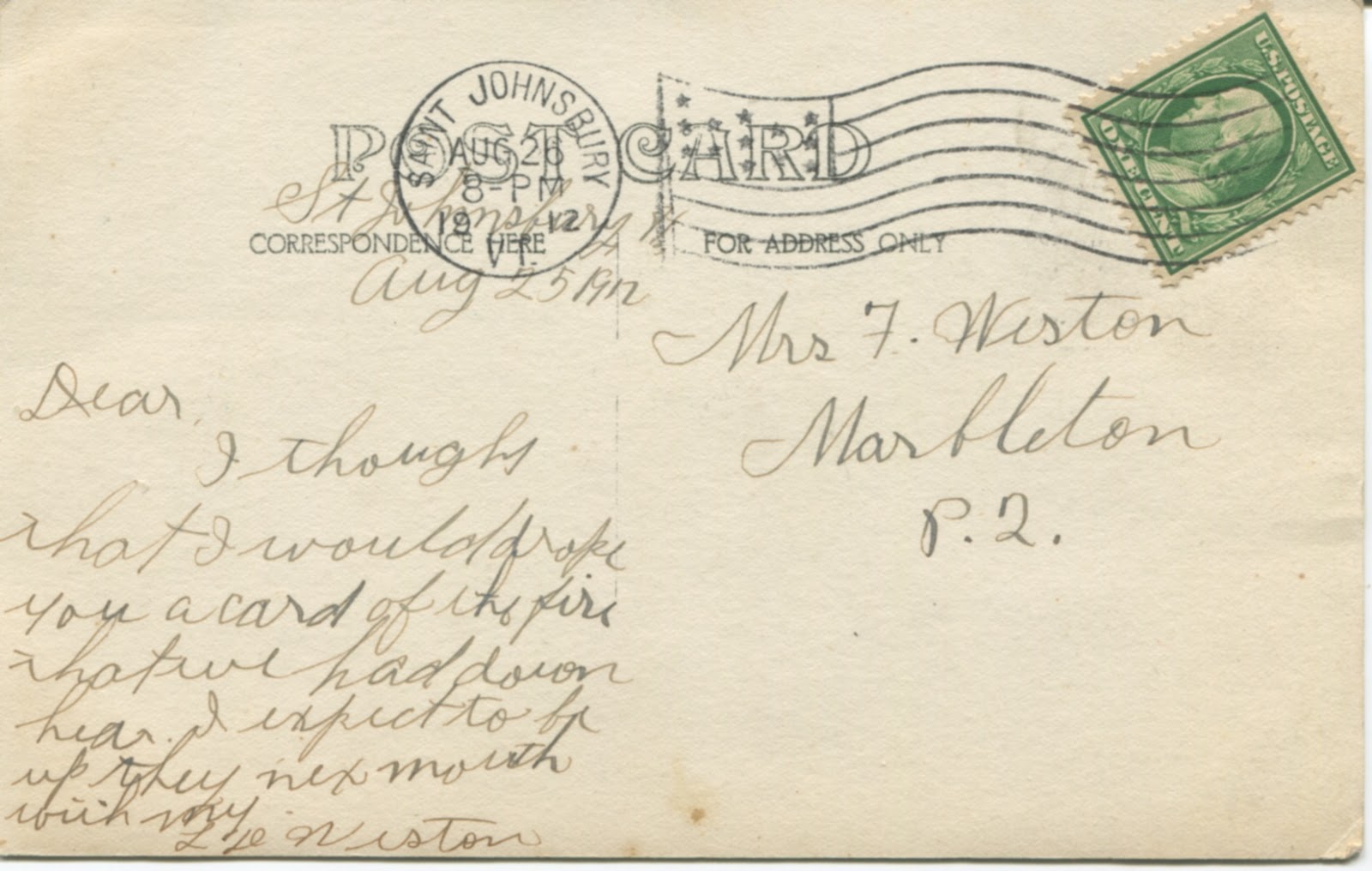

We were wrong in almost all of our early assumptions about the card, though! The name "Weston" immediately rang a bell for us, as we know there's a household including that name in East St. Johnbury today. We wondered whether it was connected to today's family, and whether the image showed a farm fire.

Each of us -- Dave and I -- investigated in different directions. Soon we learned that today's Weston family didn't have a record of someone of that name in East St. Johnsbury (then known as "East Village") in 1912; then we found that L. D. Weston had lived in Lyndonville but was employed for a while by the railroad in St. Johnsbury. Finally Dave used the Library of Congress archives to unearth newspaper coverage of the 1912 fire -- which, oddly enough, turned out to have happened in East Village after all! I typed the news report up, and circled back to Edward Lee's "East St. Johnsbury Vermont" (1984) booklet to confirm the story from another direction. Lee's account makes it clear that the devastation of the East Village fire on August 7, 1912, had three contributing factors: no firefighting system in the village beyond the traditional "bucket brigade"; the fact that when the first motor-powered firetruck in St. Johnsbury itself (some 5+ miles away) tried to reach the fire, it was interrupted (according to the newspaper, three times!) by frightened teams of horses along the route; and a delay in getting a hand pumper from the Fairbanks Scale factory (about 6 miles way) to the fire via the railroad -- the pumper was placed on a flat car for transport along the rail line that linked the two villages, but had to wait for the passenger train from Portland, Maine, to arrive first.

Lee's account also includes the intriguing mention that firefighting villagers considered dynamiting the Moulton house next door to the church to stop the fire from traveling as far as the church! It appears this was a last resort that didn't actually happen.

A final note from Lee's accounts: By 1928 the East Village had its own fire station, next to the large store built a century earlier by Silas Hibbard. Perhaps one of today's readers can tell us when firefighting left East Village again, to be focused in "downtown" St. Johnsbury instead.

Here is the promised newspaper article:

-->
St. Johnsbury Caledonian, August 14, 1912

FIRE IN EAST VILLAGE
Four Houses and Four Barns Completely Destroyed and other Buildings Damaged.

            The little village of East St. Johnsbury suffered the worst fire it its history last Wednesday afternoon when in about three hours four houses and four barns were completely destroyed and another house and the Congregational church were considerably damaged. It was a case of no water system and all that save at least three more houses and the church was the sending of a hose cart and a hand pump with several volunteer firemen from this village to assist their brethren in misfortune.

            The fire was discovered about half past twelve when smoke was seen pouring out of the roof and along the ridge pole of John Nolan’s house on Main street. All the men in that section were away at their work and Mrs. George Dodge spread the alarm along the street. When the flames burst through the roof the top of the house was all on fire and all it was possible to do was get Mr. and Mrs. John Nolan Sr. out of the house and the family’s furniture, clothing and bedding were all lost. The fire quickly reached the barn which was filled with this season’s cut of hay and everything there was burned. Mr. Nolan received $1930 insurance on the buildings and furniture and that practically covers his loss.

            George Dodge’s house stood next to the Nolans and the fire soon leaped across the space and began devouring those buildings. Enough people had gathered by this time to remove most of the furniture and articles from the barn and they were saved in a somewhat damaged condition. The Dodges received $1,000 insurance which practically covered their loss on the buildings. There was a loss of over $200  on the hay, wood and furniture.

Assistance From St. Johnsbury

            When it was seen the fire would spread the authorities of St. Johnsbury were telephoned, and they ordered the new automobile fire truck to the scene. The truck had to come to a full stop three times on account of frightened teams and then made the trip in nine minutes. The buildings were so far done before the truck arrived that the chemicals were of no use and as the village had no water pressure the hose could not be used. Word was sent back to St. Johnsbury and an out of town alarm was sounded. The firemen quickly responded and soon had the hose cart with a hand pump loaded on a flat car and with about 20 firemen was ready to start. The special train was held however until the eastbound express pulled out and then was run to East Village. The firemen arrived there about quarter of three and soon had the pump throwing a good stream of water from the river on the fire.

More Buildings Destroyed

            Before the St. Johnsbury men arrived the fire had swept through the house and barn of Miss Charlotte Morrill a[n]d practically leveled the house and barn of Francis Brown. It had also caught on one side of the buildings of Lois Moulton and an attempt was being made to tear down that house in an effort to keep the blaze from the Congregational church. In their fright the people damaged the furniture considerably and they tore out the pews, windows and carpets of the church and some furniture was taken from the house of Eugene Shasteny beyond the church In a few minutes after the stream from the pump was started it seemed that the blaze would be stopped at the Brown house and the destruction of furniture was stopped.


Sick People Carried Out

            During the excitement Mrs. Moulton and Mrs. Shores were nearly overcome by fright and had to be helped to places of safety. Aunt Honor Brown, a woman about 85 years of age who lay in bed with a broken hip, were carried out of the Brown house. George Babcock was quite badly cut over one eye by a piece of furniture which was thrown from a house. The Brown invalids were taken to St. Johnsbury and the whole Brown family are there at present stopping with relatives. The Brown buildings were insured for $800 which covers the loss of them but Mr. Brown lost a lot of nice wood and some furniture. It is doubtful if they rebuild.

More of the Insurance

            The church was allowed $200 damage by the insurance company and Lois Moulton was allowed $350 insurance which will hardly cover her loss. The loss on the Morrill house was $1,243 but the loss is above $1,600.
            John Nolan and his family stay through the day at the abandoned house on their farm outside the village, but they stay nights at Charles Bowman’s as they lost all of their bedding. Mr. and Mrs. George Dodge have taken rooms as Oscar Wallace’s and will rebuild their house at once. Miss Charlotte Morrill is stopping with the Rev. Edward Lee and he sister, Mrs. M. S. McCurdy, who was spending the summer with her. is stopping at George Copp’s. Mrs. Moulton is also stopping there until her house is made habitable.

The Morrill House

            The house of Miss Charlotte Morrill was one of the oldest and best known residences in the village. It was partly built by the Rev. Silas Gaskill in 1825 and completed by Judge Calvin Morrill in 1850. It has been the residence of the Morrill family since the marriage of Calvin Morrill and Sophronia Lee in 1834. The family consisted of one son and three daughters of whom only the daughters, Mrs. M. S. McCurdy of Andover, Mass., Mrs. Elizabeth Chapman of South Part and Miss Charlotte Morrill, a member of the faculty of Adelphi College in Brooklyn, N.Y., survive. For years it has been occupied by the Morrill family as a summer residence where they had entertained many other guests.
            Miss Morrill plans to rebuilt the house at once. ###

A final note from Beth: Each of my novels somehow includes a fire, I find ... probably because of the one that made such a change in my own family's life. More on that, some other time. Finally, Dave and I are pretty sure this postcard is indeed of the East Village fire -- but a curious side issue is, it seems to be the only existing image of the fire. So if, after all this, you think we are mistaken and you have a good reason to say the card is of some other place or time ... let us know. We are always learning, and eager to learn more. -- BK

Sunday, September 7, 2014

What the Young Squirrel Showed to Me

Walking uphill on our dirt road on Friday, I noticed a very large and long "pinecone" that had been run over -- still mostly attached together, but fringed and shattered along its edges. Ten minutes later, headed back down the hill, I found this very young squirrel digging into it, extracting the protein-rich seeds.

The little squirrel (a red one) stayed on task and let me get closer than most adult squirrels permit. But finally he/she grabbed the biggest chunk of the cone and bounded off into the scrub and woods next to the road.

The squirrel's attention to the cone pushed me to wonder more about it. I looked up the cone today -- and that's why I put the term "pinecone" into quotation marks, as these fibrous seed carriers come on spruces and even birches, not just pines. But it does seem from my Audubon Society Field Guide to be a cone from a white pine.

I was really surprised to see the "cones" on birch twigs in the book. All these years admiring birches, and I've never looked at them closely enough to see what carries their seeds! A few pages later are photos of acorns; why didn't I even stop to notice that different kinds of oaks present different shapes and colors of acorns? Guess I was always just pleased to be able to say "oak" and "acorn."

As I look at the neighboring town of Lyndonville with intent to frame a YA mystery there (probably in 1898), I'm finding the same surprise at what I've walked or driven past without questioning, noticing, or naming. Lyndonville suffered two devastating fires in the first part of the 1900s, wiping out one side of its main street, then the other. Yet there are structures that date to 1898 on most of the "town center" streets. And only recently, my husband Dave (who lived in that town for two decades and has a great collection of postcard images of it) and I realized how many portions of the massive railroad complex from, say, 1855 to 1950 linger in town, repurposed or quietly shuttered and overgrown.


Soon I'll choose names for the teen and the two older women who'll make up the main characters of this book-being-planned. While those details come together, I'll also look around the town for traces that remain of the people I'm envisioning. I've already seen evidence of their lives (the real ones, not my fictional versions) in Census documents and 1890s advertisements.  Crafting a good story from these "seeds" means paying attention to the names and existence of what's already there.

Thanks, Red Squirrel. You've got me asking questions and seeking answers. Way to go.


Monday, April 29, 2013

Recovery from the Christmas Fire: More Photos (St. Johnsbury, Vermont)

Fires continue to ravage the Northeast Kingdom of Vermont, to the point where we need our own version of the Three Little Pigs story ... because the buildings have wood frames, even when the outsides are brick or stone, and we continue to be vulnerable. Saturday night a home in Concord, Vermont, was lost; Sunday, oddly, one of the commuter buses burned.

Today Philip C. Marshall (http://www.panoramio.com/photo/18438727?tag=US_VT_St_Johnsbury) generously gave permission for use of his St. Johnsbury photos, and here is one of the 1879 building -- Bruno Ravel's building, where his parents long operated the Landry Drug Store -- before the Christmas 2012 fire struck.
photo by Philip C. Marshall

And here are some pix that the construction crew allowed me to snap last week: reconstructing the brick frame for the shop windows; the room where the drugstore used to be (see the tin ceiling?); and the back exterior.


Progress indeed ...

Readers of COLD MIDNIGHT: Claire and Ben did not climb this structure (although the author has, from the inside); the Saturday night activities on Railroad Street in 1921 made it far too risky. But it will reappear in the 2014 book I'll be writing, The Fire Curse.

Sunday, March 17, 2013

Rebirth after the Christmas Fire, St. Johnsbury, Vermont

Slowly but surely, St. Johnsbury's "1867 Block" (owned by Bruno Ravel) is rising from the ashes of the structure fire last Christmas; you can see the burned building HERE.

And the news story on the fire, from Dec. 24, 2012, is HERE.

I'm watching closely, because (a) I'm so glad to see the structure rise again, (b) I have a lot of respect for Mr. Ravel, who has long been a downtown landlord who cares about his buildings (this one wasn't insured -- but he's having it rebuilt anyway, out of his own pocket and with some help, and (c) it's part of the "back story" for the novel I'll be writing in 2014, THE FIRE CURSE.

Monday, March 4, 2013

Research for Another Novel: "The Fire Curse"

Historical fiction requires years of research for most of us who write it, and the closer we get to the time of writing, the more "picky" we get about details we need -- the length of a skirt, the exact movie being shown, a song being shared.

I'm still in the "wide open" stage of preparing for a book I've tentatively titled The Fire Curse. Recently the Fairbanks Museum & Planetarium in St. Johnsbury, Vermont, closed for two weeks to allow a team to install a "fire suppression system" -- the sensors, electronics, pipes, and pumps that can fight a structure fire before it takes lives. The museum's staff kindly welcomed me to look behind the scenes, and a couple of installation crew members paused for a few minutes to answer some questions that I had. I won't give you details now --- but I wanted to share these photos, because they show something you'll never see again: the moveable scaffold that the installing team created, to slide along the balcony railings upstairs, giving the crew access to the vaulted ceiling of the museum, where sensors and spray nozzles needed to be carefully place. Can you spot the antlers, polar bear, and other museum artifacts here and there?


Wednesday, January 30, 2013

From the Ashes of a Christmas Fire

On December 23, 2012, a massive six-alarm fire erupted in a downtown building in St. Johnsbury, Vermont. The fire in the "1879 Building" destroyed a much-appreciated florist shop, the homes of at least seven people, and what was once the storefront of Landry Drugs, most recently operated by the French parents of Bruno Ravel, owner of the structure. With his parents' deaths relatively recent, and many of the furnishings of their lives also destroyed by the fire, Bruno's losses were enormous. And the first news stories of the fire declared the building a total loss: http://www.burlingtonfreepress.com/article/20121224/NEWS07/312240021/St-Johnsbury-fire-ruled-accidental

Today, though, with Bruno's savings and much assistance from state and local agencies, rebuilding of the structure is underway. Palmieri Roofing erected scaffolding, and at least four of the roofing company's workers were on site as I snapped this photo.


My novels often include structure fires in them (I've been there, done that -- my home burned in 1984). What intrigues me the most is the courage shown as people choose to rebuild lives, homes, and structures from the ashes. A high-five salute, then, to St. Johnsbury and to Bruno Ravel and the people pitching in -- on this gray late-January day, you point to what matters.

UPDATE: See March 17, 2013, post, as the structure is rebuilt. Yes!!

Sunday, August 19, 2012

A New England Town Re-Shaped by Fire


Yesterday my husband Dave and I browsed a postcard "show" -- really a marketplace, with a dozen or so dealers, and hundreds of thousands of postcards, many of them images of buildings, railroads, and people long gone. It was a historian's treasure trove, and we won't be going out to dinner again for quite a while, because we gathered so many of the 3.5 by 5.5 inch cards to bring home with us. I don't think either one of us purchased a modern "color photo" postcard; we chose the early black-and-white ones, mostly camera shots but some hand drawn or etched, and a few hand-tinted with washes of pastel color.

Probably the most compelling in Dave's batch were a pair that showed the disaster of a winter fire that wiped out half the downtown structures of Lyndonville, Vermont, in 1924. Dave will be doing his own posts about that (at the moment, he "does" Lyndonville and I "do" four other neighboring towns). But I want to share the link to a remarkable video we found that narrates the blaze and its results, as well as showing a number of the postcards that were printed at the time to show the disaster. The video is by Lindsay Marcotte, who was a student at today's Lyndon Institute when she made it. Here it is: http://youtu.be/o0JtuL5SK7Y

It's remarkable that Lyndonville looks untouched today (and there have been other fires since then, too).

In Cold Midnight, the novel I'll bring out in November of this year, Claire Benedict climbs the roofs of St. Johnsbury at night; in the first chapter, she sees a fire being "set." Most downtown structure fires in northern New England have been accidental, but St. Johnsbury and Lyndonville (neighboring large towns) have both seen terrible cases of arson. Two imposing buildings that were lost within the last couple of generations were North Hall of St. Johnsbury Academy, and the Y.M.C.A. building on Eastern Avenue. I've put the postcards showing these onto the Cold Midnight Pinterest board, and I'm placing them here, too, for easy access. North Hall (top image, with South Hall more distant) was lost in 1956, and the Y.M.C.A. building in 1984.

A peek into the possible fiction future: I've started another novel called The Fire Curse that works with all those fires. It's not the next one in my queue to complete, but ... I'll get there, one of these days.

"This Is the Real Thing": THRESHOLDS, an Exploration of Transitions

My new book of poems. Available in bookshops and online. My buddy B and I shared a long lunch at a community restaurant today, and wrapped i...