Wednesday, April 10, 2013

Book Club Bounty: The Best Reason to Get Together!


Last Friday evening, eight women from my extended neighborhood (the closest lives a few houses away; at least one had an hour-long drive) gathered for their monthly book discussion, and I was honored by an invitation -- they had (all but one) just read my newest novel, COLD MIDNIGHT, so I brought a display of photos and old postcards that were part of the research for the 1921 setting, and told the tale of the historically read murder of Sam Wah, a Chinese laundry owner who was 75 years old in 1921, in St. Johnsbury, Vermont. (I keep an even larger collection of related images at the book's Pinterest site, here: http://pinterest.com/bethkanell/cold-midnight-climbing-on-roofs-at-night-solving-c.)

Like another book gathering that I attended a few weeks earlier, this one glowed with the seasoned experience of the women at the table, who brought their complex lives and wisdom to share. It also included a marvelous supper, and I took a moment to photograph my plate, so I could savor the meal in memory! The slice of meat pie at the center of the plate was a special treat for me -- it's the French Canadian "tourtiere," a dish I always enjoy. The crust was flaky, the meat and seasonings savory. And, as you can see, there were many other delights to go with it! But tourtiere was especially significant because of its origin; both COLD MIDNIGHT and my 2008 novel The Darkness Under the Water dip into French Canadian culture and traditions as they've arrived in this northeastern part of Vermont.

Do you meet with a book club? If your club selects Cold Midnight or The Secret Room, I can provide books at a 20% discount; for The Darkness Under the Water, which I have to order differently, I can give 10% off. Just let me know. (Books, prices, etc. here: www.BethKanell.com.) Talking about a book with others who've enjoyed it -- "priceless."

Tuesday, March 26, 2013

A Salute to A WRINKLE IN TIME -- and a New Voice in This Year's Fiction

It's hard to believe it, but 50 years have passed since the publication of Madeleine L'Engle's book A WRINKLE IN TIME. "Young adult" fiction before the genre really existed, and providing a powerful journey of spiritual seeking as well as a new definition of courage, this novel is one I've returned to at least every five years or so, to see "how the author did it" -- and why it means to much to me.

Now I'm honored to present a guest post from Ellen Larson, whose November 2013 book, IN RETROSPECT, connected right away for me to the L'Engle classic. Make sure to connect at the end of this post, too -- there's a role for you in what's ahead for Ellen Larson.


A L’Ove L’Etter to Madeleine L’Engle

The Happy Medium. Tesseract. Sport. Magic words to kids like me who read A Wrinkle in Time when it was published in 1962. Such a mysterious, heartrending, and above all inspiring book. My first science fiction read, though I didn’t make that connection at the time. Books were just books to kid me. But I was aware that this book by Madeleine L’Engle was grounded in science, and thus it seemed more real to me than other books I’d read that had a fantasy element, like The Princess and Curdie, or were simply mainstream books like The Lord of the Flies. That bears repeating: More real. Science fiction; more real. What a paradoxical reaction! I was hooked.

In the years that followed, I read Andre Norton, Robert Heinlein, Ray Bradbury, and Isaac Asimov with increasing fervor and preferences. I was never too fond of Heinlein’s big metaphysical hit, Stranger in a Strange Land (didn’t like the sexual politics—though again, I was too young to give my uneasiness a name), but I absolutely loved his lesser known The Door Into Summer, a whimsical love story that hooked me on time travel for life because of its elegant pair of time travel devices. First Heinlein uses have simple cryonics, which allows the hero to go forward in time without aging (hey, it counts!). And second, upon finding himself thirty years in the future, when such things just might be possible, Heinlein introduces a mad genius scientist who has invented a time-travel machine.

What I found compelling about the book—what I find compelling about the best time-travel stories—was that I could literally feel my mind bending as I tried to follow reality as it twisted and seemingly changed. I like that a lot.

As both a writer and a reader I am a fan in intricate plotting, a preference that led me to mystery reading and writing as well, but there is no plotting more complex than a well-told time-travel tale. I crave that moment in the story when reality shifts and appears to rewrite itself, exposing the power of the writer as the plot at last unfolds and the perceived complexity is revealed to be elegant simplicity. And that is only one model of time-travel structure.

In addition to plots like that in The Door Into Summer, in which events remain constant and only perception changes, there are equally mind-boggling tales of parallel universes, altered timelines and epic crossroads in history. This structure generally involves the inevitable happening even though history has indeed been changed by the time-traveling characters. The delight comes from watching the efforts of protagonist or antagonist to cause or prevent the inevitable, in ways we never expect. The iconic Star Trek episode, The City on the Edge of Forever, written by the great science-fiction author Harlan Ellison, is a prime example of this structure. Though she has earned Kirk’s love and our respect, Edith Keeler must die; Kirk must choose between saving her and upending history, or letting her die. All that needs to be answered is the question of how—and how the moral question will be answered.
The Prioress from IN RETROSPECT

When I came to write my own time-travel story, In Retrospect, I started by choosing the structure that would best suit the idea (the conflict) that was bubbling in my head. The Infinite-Number-of-Parallel-Universes approach works great to explore characters. The Door-Into-Summer approach lends itself to deliciously evil plotting. The Edith-Keeler approach leads to great moral conflict for the characters. I excluded parallel universes first, because while tremendous fun in its way (my first run in with parallel universes came with the iconic Dark Shadows in the 1960s, btw) it doesn’t include the mind-bending aspect I crave.

With apologies for skipping Kurt Vonnegut, this left me with a choice that can best be summed up by the question: In my futuristic world, can history be changed via time travel (Edith-Keeler) or not (Door-Into-Summer)?

I made my choice—but I’m not gong to elaborate here, because in fact the answer to the question is germane to the plot itself. It is also the topic under discussion when my protagonist, Retrospector Merit Rafi, first meets Eric Torre, a wave-aspect physicist with whom her life will be forever entwined:
The boy with the wavy yellow hair gave an argumentative snort. “But you haven’t addressed the question! Why can’t you change history?”
“Because you just can’t. Trust me. I’ve been there.” Having settled that issue, Merit raised a paper cup to her lips. Damn, the Rasakans made good wine. She breathed in the sweet summer air and let her gaze roam across the rolling meadows of Bergama. It never ceased to amaze her. Though half the Earth had been destroyed eight hundred years ago by the insanity of their forebears; though the coasts had been redrawn and the climate changed, this land called by the ancients Anatolia, then Asia Minor, then Turkey, had survived, flourished, and—eventually—regained its plenitude. It was a fine day to be sitting on the grass beneath an almond tree drenched in blossoms, a fine day for shooting the metaphysical breeze with new colleagues over a bottle or two between seminars. A damned fine day to be alive.
But the boy didn’t seem to have noticed that the debate was over. “That’s pretense, not proof,” he insisted.
Merit’s attention snapped back into place. “I beg your pardon?” She peered more closely at his freckled face. It looked mighty stubborn, in a cheerful sort of way. “If somebody asks you why she can’t walk on water, don’t you simply roll your eyes and say, ‘Trust me, you just can’t?’ ”
“No.” He shook his finger back and forth—shook it at her, Merit Rafi, graduate of the Oku Science Conservatory, officer of the Civil Protection Force with a full nineteen months’ experience, Select. “I tell her that water molecules are not cohesive enough to support the mass of a human body, nor is the surface tension high enough to resist the static shear—but that if she were a waterbug she could do it.”
It’s been a long journey from the day I first cracked open A Wrinkle In Time—the day that set me on the road to writing a time-travel book of my own. I think a thank-you is long overdue. So thank you, Madeleine L’Engle, and Happy Fiftieth Anniversary!

Beth adds: Ellen Larson is currently running a Kickstarter project to fund the making of the book trailer for IN RETROSPECT. Take a look at this exciting project -- the art is amazing, thanks to concept artist Mike Sissons (that's his painting of the Prioress, earlier), the video is close to completion, and there's a role for supporters right now ... and to salute this author and her work, which in my office will go on the same shelf where  A Wrinkle in Time now stands.


Sunday, March 24, 2013

Sugaring at the Cemetery?

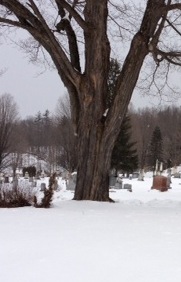
I'm headed into writing the last few chapters of ALL THAT GLITTERS, so as I drove to Waitsfield, Vermont, yesterday, I detoured into the downtown of Montpelier to photograph a couple of locations that are featured in the book. Then I paused outside town at Green Mount Cemetery for some quick photos. When I looked at the big maples that edge the cemetery, I paused and stared. Look closely: Can you see the galvanized-metal sugaring buckets fastened to both sides of the maple tree here?? They were on the entire row of trees along the Route 2 edge of the burying ground.

Talk about not wasting any potential for making maple syrup!


Sunday, March 17, 2013

Rebirth after the Christmas Fire, St. Johnsbury, Vermont

Slowly but surely, St. Johnsbury's "1867 Block" (owned by Bruno Ravel) is rising from the ashes of the structure fire last Christmas; you can see the burned building HERE.

And the news story on the fire, from Dec. 24, 2012, is HERE.

I'm watching closely, because (a) I'm so glad to see the structure rise again, (b) I have a lot of respect for Mr. Ravel, who has long been a downtown landlord who cares about his buildings (this one wasn't insured -- but he's having it rebuilt anyway, out of his own pocket and with some help, and (c) it's part of the "back story" for the novel I'll be writing in 2014, THE FIRE CURSE.

Where Plot Ideas Come From: Tracks in the Snow

Turkey track, solo ... or so you might think

Two clusters of turkey tracks crossing the stream: Look closely.

Mourning dove, "pigeon toed."
It's cold here this weekend -- bursts of snow keep arriving, and it was nine degrees when I went outside. Although the chickadees call (their two-note mating call) in early morning, the woods go nearly silent later in the day, as we all hold our warmth close, self-protection in what can still be wild winter on the ridge. Tonight's forecast threatens subzero temperatures, not unusual for mid March, although it won't last. The trees are signaling buds and more.

Silent though the woods can be, the larger birds are on the move. With the snowcover down to a fragile couple of inches, seeds are everywhere for them with just a quick scratch. How different they are from one breed to another, though. See the solo turkey track in the first photo? It could fool you if you don't follow further -- the second photo, taken not far from the first, reveals that a family of at least half a dozen turkeys passed along here, crossing the stream around the same point.

The third photo means a lot to me as I work slowly to bind all the plot threads together in my "Nancy Drew-style" mystery, ALL THAT GLITTERS. I'm in the last few chapters and it has to go "right" in order to build to the climax I want. There are homing pigeons involved in the plot -- and the tracks in photo 3 are of mourning doves, the wilder sort of pigeon here on the high ridge. I hear their plaintive calls all morning. See how the footprints angle back to each other, always crossing, as the round-bodied bird appears to waddle along? That's where we get the expression "pigeon-toed" -- to walk with one's toes pointed inward, so the right and left feet appear to leave crisscross trails.

The cold air, the photo, the reflection on pigeons, and then, breakfast with strangers at Polly's Pancakes in Sugar Hill, NH, where you often share a table as the staff packs everyone in -- that's what it took to move me to the next component of ALL THAT GLITTERS. Suddenly, I know what's coming next.

PS - You can read the chapters as they are written, at WattPad: http://www.wattpad.com/3668250-all-that-glitters-chapter-1-all-that-glitters-by.

Thursday, March 7, 2013

Listening to Local (Vermont) History

On Sunday morning at 7 a.m. on WIKE-AM radio in Newport, Vermont (1340 AM), Scott Wheeler provides an intriguing conversation each week that delves into this region's culture -- that is, into Northeast Kingdom life, past and present. Today Scott and I savored a conversation about old photo postcard images of Newport and Derby and how they can instigate new work in historical fiction. At least, for Scott and me, they always set the imagination rolling, along with a hunger for more research and more details. Here is the actual radio show: http://www.northlandjournal.com/audio/bethKanell.mp3

One of the images we talked about is this one from the 1880s of the Memphremagog House, a tourist hotel that could shelter about 400 people! Built in 1838, it was a response to the unusual pattern of New England tourism in the 1800s: People would pack their trunks full of necessities and literally leave the city for six months, to enjoy "country air" and escape the fumes of urban life. You can see how close the train tracks ran to the hotel -- passengers could step down from their rail car and stroll up the path to the front door. Scott pointed out that this was one of several hotels at the time; today's regeneration of Newport's downtown has a lot to live up to!

When I'm writing historical fiction, I'm usually working from more than just a place like this hotel, though, and the historical tidbit that I shared with Scott today (it's hard to find one he doesn't know, but I did!) was about Governor George Prouty, a Newport resident. In 1909, the governor's chauffeur took a "joy ride" in the governor's car, crashing into a parade on the west side of the state (part of the 300-year celebration of explorer Samuel de Champlain) and killing a child in the process. The governor made the national news (the New York Times) when he came forward to stand for the $5,000 bail called for, for the chauffeur's manslaughter charge.


Scott and I also talked about these three Derby Line postcards -- partly for the amount of detail each one captures. In addition, I mentioned that I hope local residents will collect these images before the Internet sells them all to collectors in other places. These are evidence of what life was like, and we need them, in order to hold onto the treasures of our past. They're not just for historical fiction research; they are also for our sense of place, pride, and integrity. Plus, they take up a lot less room than collecting books! (That's a warmly meant family jest, considering how many bookshelves we've filled over the years.)

Other topics: a mention of a Troy resident, Amasa Tracy (1829-1908), the 2004 Phish concert in Coventry that many recall (Scott covered it; he publishes The Northland Journal), and some details of my most recent book, Cold Midnight. Hope you'll tune in for the radio show and catch all of the conversation! Thank you, Scott, for a marvelous half hour.

PS: The two Kelly's postcards are in the Middlebury College collection, which can be searched by town name online: http://middarchive.middlebury.edu/cdm/search/collection/vtpostcards

Monday, March 4, 2013

Research for Another Novel: "The Fire Curse"

Historical fiction requires years of research for most of us who write it, and the closer we get to the time of writing, the more "picky" we get about details we need -- the length of a skirt, the exact movie being shown, a song being shared.

I'm still in the "wide open" stage of preparing for a book I've tentatively titled The Fire Curse. Recently the Fairbanks Museum & Planetarium in St. Johnsbury, Vermont, closed for two weeks to allow a team to install a "fire suppression system" -- the sensors, electronics, pipes, and pumps that can fight a structure fire before it takes lives. The museum's staff kindly welcomed me to look behind the scenes, and a couple of installation crew members paused for a few minutes to answer some questions that I had. I won't give you details now --- but I wanted to share these photos, because they show something you'll never see again: the moveable scaffold that the installing team created, to slide along the balcony railings upstairs, giving the crew access to the vaulted ceiling of the museum, where sensors and spray nozzles needed to be carefully place. Can you spot the antlers, polar bear, and other museum artifacts here and there?


Sunday, March 3, 2013

The Underground Railroad in Vermont: Call It the "Aboveground Railroad" Instead!

Jane Williamson, director of Rokeby, Vermont's premier authenticated Underground Railroad site, often points out how literal the thinking is of third graders, who arrive at her historic center, eager to see the "trains that run under the ground." She has many other things to show and teach them, but sometimes they are still baffled that they haven't yet found the train.

With adults, both director Williamson and I find widespread attachment to the romance of the Underground Railroad myth in Vermont. As she says, it would be better to call the movement of African-American fugitives here in the 1800s "the Aboveground Railroad." Most Vermonters believed slaveholding was immoral, and that all humans should own their own lives. Dark-skinned fugitives arriving in the state weren't just assisted in their travels -- at places like Rokeby, they also could polish their skills for independent living and move toward owning their own land and businesses, from earned wages that they saved. Moreover, Vermont was so far from the slaveholding states of the American South that the vision of the fugitive cowering in a hidden room while the slavehunter passed by was a fiction; African Americans worked on farms, established homes, and nurtured their families here.

Many otherwise well-informed adults still leap to the conclusion that a "hidden room" in Vermont had a connection to the heroic labors of the Underground Railroad. Usually there are other reasons for such rooms: for hiding alcoholic beverages, or money, or, much later, Chinese migrants barred from entering America from 1882 to the First World War. Sadly, some rooms may have been the final resource of family members who weren't "fit to be out in public." Increasingly, rooms found near chimneys or in much-rearranged homes are remnants of homeowner layout changes -- say, changing from a wide old fireplace to a narrower chimney for a furnace.


At the Goodwillie House in Barnet, Vermont, a site that plays a role in my book The Secret Room when Shawna and Thea visit to test some of their ideas about the Underground Railroad, there is a double-walled section of the cellar that long had a rumored description as an underground railroad hiding place. I'd rather see it as a place the Rev. David Goodwillie -- who served Barnet as pastor, postmaster, and more -- might have put a few things he didn't want all his relatives to see. Or perhaps his wife stored the best potatoes and carrots there, to still have a few by the time the winter dining reached Easter Sunday!

Here's a newly acquired portrait of the Rev. Goodwillie, as well as a photo of the brickwork inside the house. There's a lot to explore here, and a lot to discover. Historical research backs up the best of the stories of the Goodwillie House, and one of my favorite bits is knowing that the family here had the first sheet-iron stove in town, and even added pipes to bring water inside the house, quite an innovation at the time.

The Barnet Historical Society opens the Goodwillie House several times each year, and often the town's eighth graders welcome visitors. Inquire for details or make an appointment: http://www.barnetvt.org/historical.php

Friday, February 8, 2013

History Mysteries: Beverly, Mass.

Me, happily preparing for another session at The Waring School
Recently I visited The Waring School in Beverly, Mass., where students filled me in on Waring's two basic commandments ("Don't be mean. Don't be stupid.") and what it's like to take part in this intense and people-focused 15-student college preparatory school. I learned a lot -- and enjoyed sharing writing skills, revision systems, and the three books I've brought forth so far that are historical fiction, hinged where our view of "what happened then" is being changed by our culture and our ability to study the past. These books are also mysteries, with young adult protagonists fighting for truth (The Darkness Under the Water; The Secret Room; Cold Midnight).

Here are some possibilities for launching "history mysteries" set in the rich history of Beverly, Mass.; if you teach a group where your local version of this could be of use, or are a student who'd like a set of these for your classroom, e-mail me (BethKanellAuthor at gmail dot com) and I'll be glad to work up a set for your town!

BEVERLY, MASS., HISTORY MYSTERIES STARTING POINTS

1.  1626, Richard Conant and his "company of fishermen" arrive from Cape Ann, in Naumkeag territory: (a) Who were these fishermen? What secrets did they leave behind them in Cape Ann -- could one have "needed" to leave the larger town, due to a feud or other family disaster, and drawn the group along with him to disguise his real motives? (b) The Naumkeag river Native American village was "ancient" and was a "trading center" in the past. Suppose one of the traders had been immoral in some significant way -- and the new settlement reveals what he did. Who will "police" the settlement? Can justice be served? (c) (for those who like paranormal thrillers) Just how "ancient" was that Native American village? Do the voices and passions of its leaders linger? How might they appear, even today, if not yet appeased in terms of who is using their land?

2. "The John Balch House (circa 1679, but for many years was purported to have been built in 1636), located at 448 Cabot Street, Beverly, Massachusetts,  is one of the oldest wood-frame houses in the United States." The age of the house was established in 2006 through "dendrochronological testing" (that's related to trees and wood, right?). Find out the details of the testing. Who could have had a motive for wanting the house to stand as 1636? Who could have set the testing equipment (maliciously) out of kilter, or broken it the first time it was used? Maybe the testing team includes a descendant of John Balch ... and the timing of the house will determine whether this person might inherit rights to some extremely valuable land, or to a painting, or to water rights. Also, who was John Balch -- could there be a mystery about why certain people in his family die young??

3. Beverly is the "Birthplace of America's Navy" because the first US military ship, the schooner Hannah, was outfitted at Glover's Wharf and first sailed from Beverly Harbor, Sept. 5, 1775. Marblehead disputes the claim of birthplace. (a) Set a mystery on board the Hannah where an important Revolutionary War battle or declaration could depend on what or who the ship is carrying. (b) Try a modern-day feud between Beverly and Marblehead town leaders that seems to be about water treatment but in reality is about being able to claim the naval birthplace title -- for the sake of, say, being able to host a prestigious sailing regatta. Crime involves both the research into the schooner, and a drug run during the regatta.

4. Why did Beverly become the site of America's first cotton mill in 1787? Set a mystery among the child laborers there, and it can include a cache of gold dubloons from piracy (common in the early years of the nation). Add a romance component -- were women allowed to work in the mill? How could you find out?

5. Beverly's separation from Salem took place during a religious disagreement. Track down the parties who disagreed, and their descendants. Can you tie this to the Salem Witch Trials (which took place on terrain that's now part of Danvers)? (for those who want to write paranormal thrillers) Could there be something geological or geographical about Beverly that draws religious controversy? What if a witch trial arose there today, based perhaps on resistance to vaccinations (which many people now believe could affect the incidence of autism spectrum disorder)?

6. The buildings that were once the United Shoe Machinery Corporation (1902-1987) developed in the late 1990s into a campus of high-tech companies and medical offices. Suppose the x-ray and other imaging technology accidentally revealed a double wall in one of the buildings, and evidence suggested a 20th century Mafia connection, long since vanished -- who would want to silence the discovery? Who might profit from it?

7. How did President Taft decide to rent a summer White House in Beverly? (1909, 1910, 1911, 1912). What made the experience so important -- as revealed by Beverly Hills, California, being named for Beverly, Mass., in 1907, because Taft had vacationed there? What secrets do Presidents leave behind? Could the start of World War I have been avoided, if Taft had made a different choice during his vacations in Beverly? Look into whether there were German residents at the time, and whether any diplomatic visits from England or France took place in Beverly then.

8. Beverly's current groundwater pollution issues stem from (presumably) the old Nike missile site on L. P. Henderson Road, and the Casco Chemical company. Suppose a whistle-blower had brought attention to the issues earlier; what atmosphere of threat could have followed? Would the town leaders have wanted the issue covered up at a particular time -- say, when the Vietnam war protests were happening? Who might your lead characters be: perhaps a draft protester? A reclusive chemist? A fishing captain who suspects why the catch has changed?

Wednesday, January 30, 2013

From the Ashes of a Christmas Fire

On December 23, 2012, a massive six-alarm fire erupted in a downtown building in St. Johnsbury, Vermont. The fire in the "1879 Building" destroyed a much-appreciated florist shop, the homes of at least seven people, and what was once the storefront of Landry Drugs, most recently operated by the French parents of Bruno Ravel, owner of the structure. With his parents' deaths relatively recent, and many of the furnishings of their lives also destroyed by the fire, Bruno's losses were enormous. And the first news stories of the fire declared the building a total loss: http://www.burlingtonfreepress.com/article/20121224/NEWS07/312240021/St-Johnsbury-fire-ruled-accidental

Today, though, with Bruno's savings and much assistance from state and local agencies, rebuilding of the structure is underway. Palmieri Roofing erected scaffolding, and at least four of the roofing company's workers were on site as I snapped this photo.


My novels often include structure fires in them (I've been there, done that -- my home burned in 1984). What intrigues me the most is the courage shown as people choose to rebuild lives, homes, and structures from the ashes. A high-five salute, then, to St. Johnsbury and to Bruno Ravel and the people pitching in -- on this gray late-January day, you point to what matters.

UPDATE: See March 17, 2013, post, as the structure is rebuilt. Yes!!

Wednesday, December 12, 2012

More About the Chinese in Vermont, 1921

At Saturday's library event for COLD MIDNIGHT, I told the real (documented) story of Sam Wah, a man born in North China in 1846 who opened a laundry in St. Johnsbury, Vermont, in 1886 and lived here until his untimely death in 1921. Mr. Wah's murder was headline news for the town at the time, and ministers preached that the criminal must be captured -- there must be justice, for Mr. Wah was not "only a Chink" -- he was a Christian and part of the community.

Although that language may seem a bit forced to us now, there's no doubt that the town put its money down to seek justice. The town hired a famous detective, Jason Wood, from Boston, and the business community collected funds to purchase both a plot at the cemetery and a large, plain stone that says, "Sam Wah, Died December 27, 1921."

One of the attentive listeners on Saturday posed the question, "Did that mean there was very little racism in the town at that time?" Although I give full credit to what was done after Mr. Wah's death, and it's also well documented that the laundry owner socialized with the businessmen at the noon dinner in the local restaurant, as well as evening poker games -- I think it would be accurate to say there was an accepted form of racism in town that really hadn't particularly been thought through. Chinese were assumed to be a certain way, just as "Injuns" and black people were. Friendships across the lines of race were unusual, just as they also were often strained across the lines of religion and ethnic origin. (Irish Catholics and French Catholics had separate churches in the town until 1966.)

Moreover, the postcard shown here, with its colorful image as if one were traveling abroad, is of Chinatown in New York in the 1960s, and my husband Dave, who contributed it, transcribed the material typed on the back:
Chinatown-New York City

[Dated on back Sept 13, 1968]

Looking East on Pell Street-Chinatown
New York City. A touch of the Orient is its
most interesting feature. Here one will find
a great variety of curio shops, restaurants,
exotic foods, theatres, etc.
The terms "curio shops" and "exotic foods" still (40+ years after Sam Wah's death!) carry that sense of the mystical "Orient." At a guess, from the postcards we've put together, as well as documents, people in 1921 -- even in "fair-minded Vermont" -- probably saw Asians as "exotic," "inscrutable," and even malicious. Hence the emphasis on "Christian like us" for Sam Wah.

Interested in reading more about perceptions of Chinese in America in the late 1800s and early 1900s? Here are some informative websites, provided by Professor John Jung:
I have another postcard to share, one from a couple of years after Sam Wah's murder; we're confirming some details in the historical research, and I look forward to sharing it with you soon.


The Poetry of Transitions: What Is Poetic Language?

On Thursday July 16 at 6:30 pm in the Davies Memorial Library in Lower Waterford, Vt., I'll be chatting about my new book THRESHOLDS (fr...