Thursday, July 16, 2015

Harper Lee, "Mockingbird," and "Go Set a Watchman"


Today I left this "comment" for Laura Tavares at the "Facing History Blog," and look forward to more conversations on the topic. This morning, I want to bring you all into this ... and hope you'll write something about your own perspective on the Harper Lee books, as well as family secrets that propel you toward seeking justice, or perhaps on The Darkness Under the Water.

My mantra for the examined life has become: "We are all in this together." Right?
Thank you, Laura Tavares, for writing of this new publication as "an invitation to read both books with a more realistic, complex, and sophisticated analysis of morality." I find the sequence of change in the two books very believable, because the same thing happened in my life while writing "The Darkness Under the Water" -- a book that first was "only a mystery" and soon became an effort to probe the Vermont Eugenics Project and its generations-long effects on those of Abenaki heritage. At the time of publication, I carried my own secrets and guilt based in a dual family heritage of Surviving the Holocaust (my father was a German Jew) and certainty that we are morally obliged to step forward against injustice (my mother was a lapsed Quaker). In the seven years since my book's publication and very mixed reception, I've learned far more history and gained further moral imperatives toward the endless struggle for justice. Just as my first and second versions of the book were vastly different, so would be the book I would now write. Harper Lee may well have had the same experience. I hope so -- there is goodness in growing and deepening. 
See more of the Facing History and Ourselves conversations at http://facingtoday.facinghistory.org.

Thursday, July 9, 2015

A Conversation in Lines of Words

Looking up Eastern Avenue in St J during road repairs. The café is at ground level, at the rounded corner of the brick building.
Can you find Heaven in a coffee shop? How would you look for heaven at the Café at Gatto Nero, the coffee shop on Eastern Avenue in St. Johnsbury, Vermont? Wordsmiths are invited to provide poetry and short prose at the CGN Facebook feed -- or in the notebook at the coffee shop, marked "Heaven, Looking For" --  and to come join me for a poetry conversation on Pascal's wager, life in "God's country," and other sorts of heavenly topics, Wednesday July 29 at 7 pm at the CGN. 

Postscript, for a question that Michale asked:

This poetry conversation can take place anywhere, but to connect with the others (and make it a real conversation!), post your poems at the Facebook page for the Café at Gatto Nero (https://www.facebook.com/cafeatgattonero?fref=ts), or write them into the notebook at the café counter. We'll gather on Wed. July 29 at 7 pm to hear some of what we've all been writing or thinking about as we consider looking for Heaven at the Café at  Gatto Nero.

Pascal's wager is a way of thinking about whether it's better to live according to the guess that god and heaven exist -- you can find it here: https://en.wikipedia.org/wiki/Pascal%27s_Wager

I look forward to sharing poems with you!

Sunday, May 17, 2015

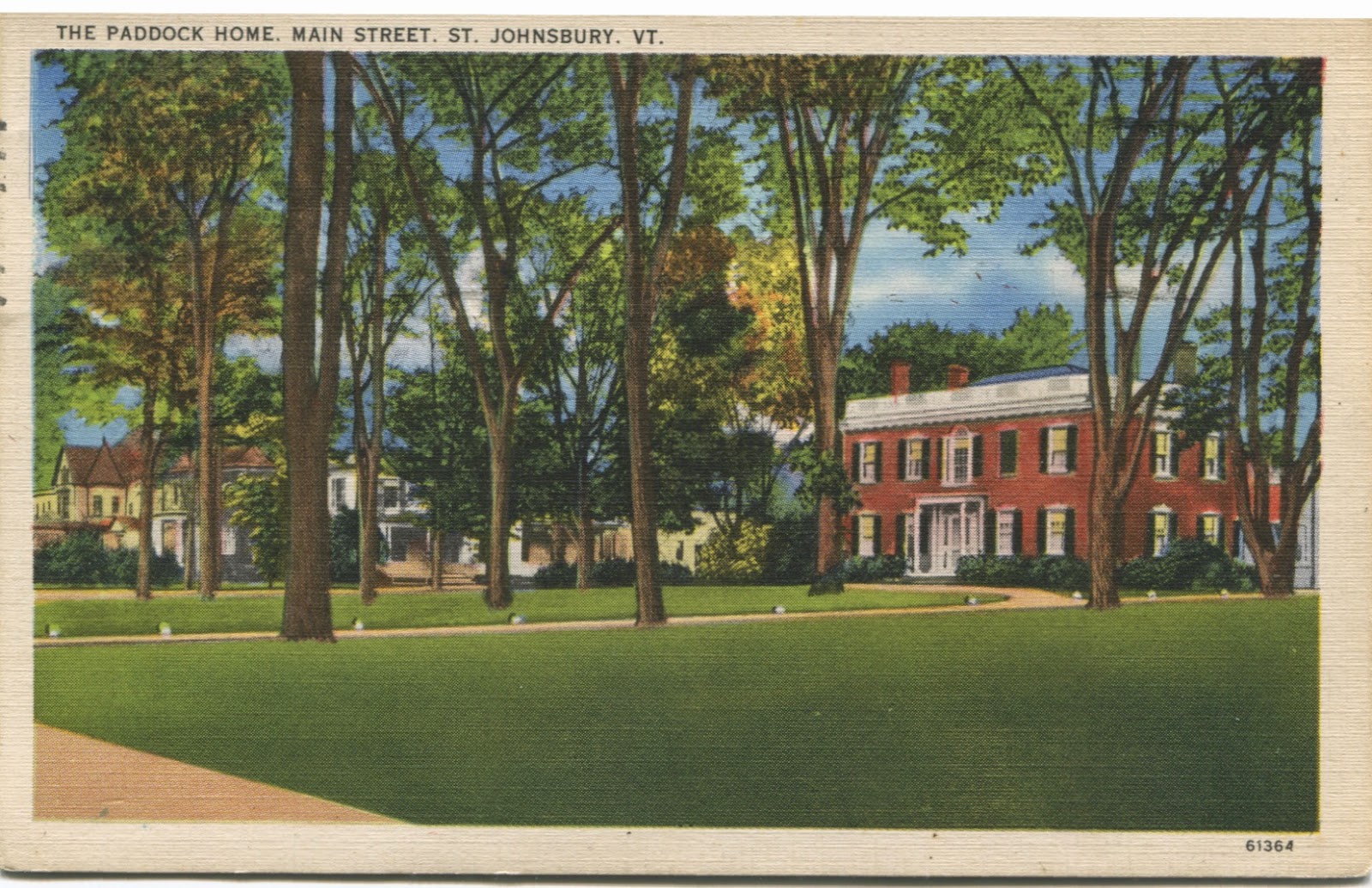
The Real Houses, for the Stories: The Paddock House


My husband Dave recently gave me a postcard image that shows one of the important locations in my 1850 Vermont adventure, THE LONG SHADOW (2018 update: now published by Five Star/Cengage). This is the house where Alice Sanborn and her friends decide they have no other choice -- they race for the horse and carriage and ... but I'm getting ahead of myself. Here, instead, is how the book begins:


THE LONG SHADOW

-->
North Upton, Vermont, March 1850
             
           
            Uncle Martin wiped his plate with a thick slab of graham bread and pressed the gravy-soaked slice all into one mouthful, brushed his hands off on his jacket, and pulled a rustling handful of newsprint out from under his chair with a flourish.
            “Your man’s gone soft of thinking,” he told my father as he shoved the pages toward him. “Webster the golden orator has turned coat on us. What use is the Union to us all, if we let the stinking reek of slave-holding move into the Territories after all?”
            My mother made a small sound of protest. Thump, came my uncle’s fist on the table, and the dishes rattled. At the same moment, I heard a light tap at the kitchen door. At my mother’s nod, I rose to see who had arrived.
            Standing in the dooryard, faces flushed with cold, were my two sweetest friends, both speaking at once. “Alice, school’s finished for the week, the doctor said it’s too close a space, and the Hopkins twins are fevered,” Jerushah announced in a burst, overcoming Sarah’s softer voice. “So will you come across after supper to sew with us? We’ve only one guest at the house, you know, and there’s no stage arriving until Monday, and my mother said to ask your mother.”
            Jerushah was the most beautiful girl in North Upton, Vermont. Her hair shone like black silk, and her clothes were always the latest styles. I loved the way her eyes crinkled with merriment, and her mouth smiled naturally, even when she was at her books. And Sarah, well, she was our adopted sister, we say: a sister dark as tanned deerskin, with deep brown eyes that hold the hurt and horror of all the Africans pressed into Southern slavery. The moment we first saw her, bundled off the stagecoach into the inn as a frail armful, Jerushah and I had pledged ourselves to her. Sarah’s parents still lingered under the wicked South’s cruel lash. But transported north, Sarah stayed safe with us. Though as best anyone can tell she was only some twelve years of age, she had brightened and sharpened in our care so that she studied with Jerushah and me at the schoolhouse. We were both more than fifteen years of age ourselves, nearly out of the schoolroom and into an age of preparing our womanly selves for the years ahead of us.
            I held up a hand to my friends for their patience and slipped back into the steam-fragrant house to ask my mother’s permission. Distracted by a loud interchange between my father and his brother, she gave a short nod and told me to send the others on their way, for my own dinner lay cooling on the table. This I did, dashing back out the kitchen door to brush a quick kiss onto Jerushah’s cheek and then Sarah’s, promising I’d be at the inn across the road as soon as the day gave way to dark evening.
            A roar and more table thumping came from within the house, and I told my startled friends, “It’s news of the Senate and Daniel Webster himself. I’ll tell you everything, later.” They laughed with me, knowing how men love to argue politics, and I watched them pass back to the road before I took a final thirsty breath of the clear March air and returned to the family dinner.

Thursday, April 16, 2015

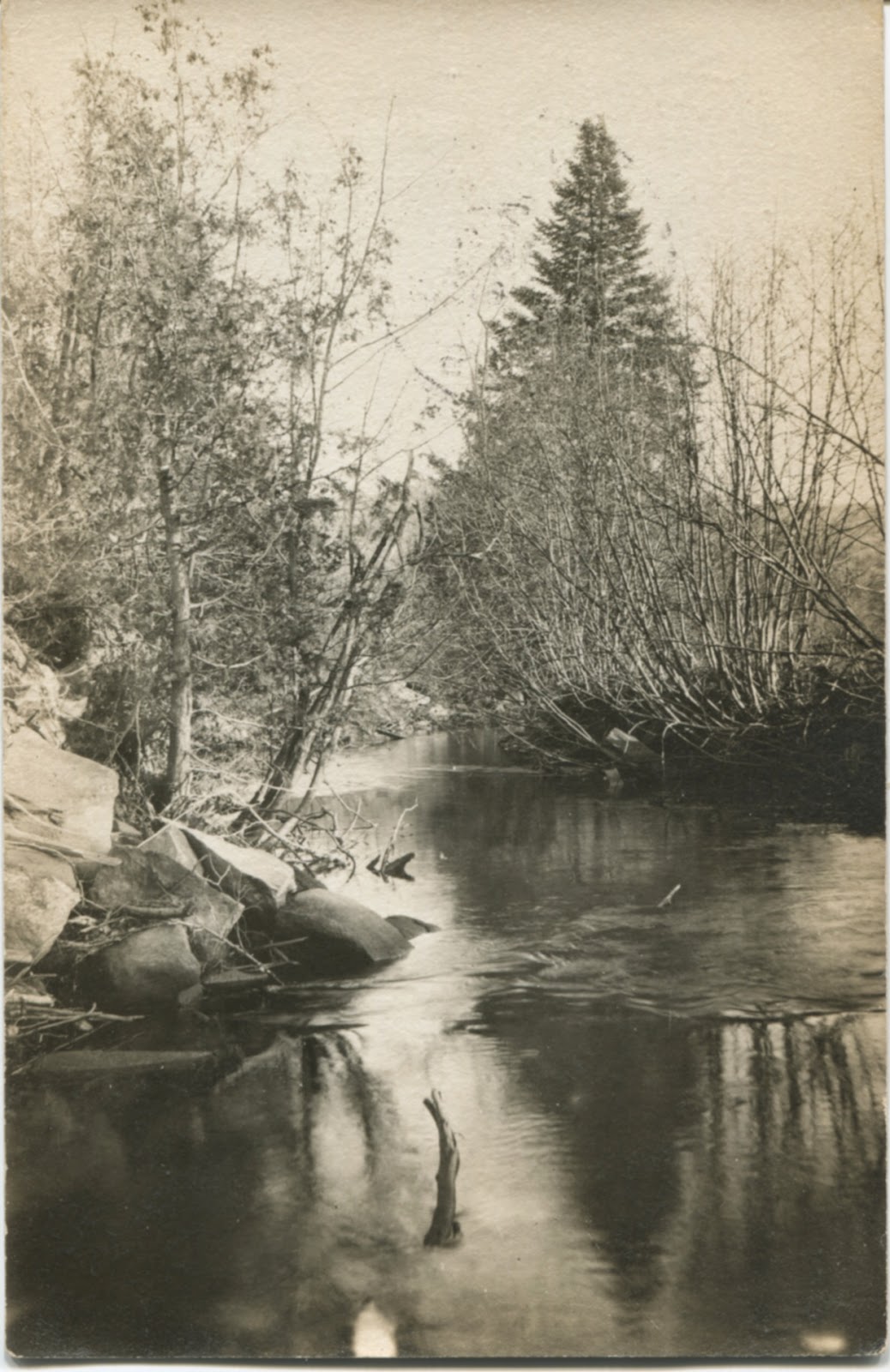
Every Postcard Tells a Story -- This One, in Vermont in 1907

(front)

(rear)
One of the mysteries I'm now writing is set in 1899 -- which makes this 1907 postcard "close enough" in terms of noticing how people write to each other. I find it particularly intriguing because of the sender's signature. But that's getting ahead of the story.

Charles Augustus Choate Jr., known to his friends as "Chubb," lived and farmed in Barnet, Vermont. He was born in 1871, and on August 19, 1903, he married a "girl" 10 years younger than himself, Pearl May Field (born May 9, 1881, in Brookline, Vermont). In the records that refer to his wife, she's always called "Pearl M. Choate" -- very reasonably.

But on this postcard -- showing a photo of the stream near her farm home --which she sent to her somewhat older friend Mrs. Jessie M. Titus (b. 1862) in Springfield, Vermont, with Christmas greetings in December 1907, she signs herself "Pearl Field Choate." Why?

The suggestion is that her friend Jesse may know the Field family in a meaningful way. Some confirmation comes in looking up where Brookline, Vermont -- Pearl's birthplace -- is. It turns out it's a small town south of Springfield. Good backing for this guess!

Finally, one more curious note about this card: It's easy to find Pearl M. Choate's marriage, and the years that belong with her husband Charles (1871-1930) -- but the Choate family trees online don't show Pearl's date of death, and neither do the Vermont records. It took some searching to figure out what happened: In 1949, the long-widowed Pearl May (Field) Choate married Joseph Devins of  nearby Ryegate. Her Vermont death certificate is under the name Pearl Devins, October 17, 1962, in St. Johnsbury, Vermont.

I hope some of the keepers of the Choate family trees will ink in this detail; I think it's sweet that Pearl had another marital chapter, and hope it was a very happy one.

Friday, March 6, 2015

East, West, Home's Best -- For Writing, Too

My favorite from this winter.
"Think globally, act locally." I liked the expression when I first heard it. Today, it means a lot more -- because I apply it to what I'm researching, learning, writing ... and to conversations with readers (that means YOU!).

I can see a lot of the past winter in the photos I've taken: Many of them show the deep blue skies that a Vermont winter offers (Gail Pison Montany says they come that way in Colorado, too), but there are also simple homey moments with, say, a dozen lovely eggs from my neighbor Marsha's hens.

Here at the computer, I've reached back to the 1920s in recording oral history with Mrs. Irene Dolgin Goldstein, out across the oceans learning about Syrian migration to Vermont around that same time period and earlier, and into universities, asking very knowledgeable professors for help with, say, geology or archaeology or the stories of place names. And then there was the very nice person in New Jersey who provided permission to use a photo (shown here: Martin Turner, of Barnet, VT, and Monroe, NH).

One novel starts ... right here.
Although a lot of my writing time this past season has been revision for the three novels I wrote on most recently, I found two new ones starting for me -- each one beginning very close to my own home, and including research that reaches Russia and Kansas, as well as Boston and Lyndonville (VT) and St. Johnsbury (VT).

Although most authors dream of reaching readers across the country, I'm enjoying especially being in touch with my "neighbors" -- that is, people who live within an hour's drive of the back road where I walk most mornings. It's an honor to have a historical article on Martin Turner and his "very modern" 1929 house in Vermont's Northland Journal (check out this regional treasure on Facebook), and a deep and lasting pleasure to share my poems in the Green Mountain Trading Post, the little northeastern Vermont paper that's meant so much to me for 37 years (yep, that long; anyone recall the writing of Georgeanne Poe, who moved to Maine? -- her work gave me the courage to write from my own life and window).

Now spring's around the corner, and I know I'll be on the road a bit more often, listen to more people in different places, extend research, look for publishers. But I'm a hometown gal at the end of the day, and here is where I want to be. Glad to be able to share it, with you.


Wednesday, January 21, 2015

New Term for the Day: "Wall Dog," and the Reason Why

Every writer's process is different -- and, making it more confusing, sometimes every book takes an author on a different kind of path. I'm crafting a mystery that is mostly set in Lyndonville, Vermont, in 1899-1900, and -- the same way I did with North Danville, when I was writing The Secret Room -- I visit the town often and take photos of places that might crop up in the book, like the railroad crossing, and a back driveway with a sign that says "Angie's Alley." But I've also become fascinated by the painted advertising signs lingering in town ... with no real expectation that they would show up in my novel.

Today I did some basic research into who painted such signs, and when, and how. I don't yet have the northern New England names of the (probably) men who did these, but I'm confident that I'll find them, eventually. And meanwhile, was excited today to learn a new term: wall dog. Apparently it wasn't entirely complimentary, but it fit the profession: painters who covered walls with signs, and "worked like a dog" for their wages, often in blistering hot summers. On the website PaintedAd.com are interviews with some wall dogs; here is a sample from site author Wm. Stage, who has a book on these (I'm ordering a copy!):
In 1983, I spoke with Art Hunn, then 82 and an administrator with the Painter’s District Council No. 2 here in St. Louis. His recollection of life as a signpainter stretched back seven decades to that day in 1916 when he signed on as an apprentice with the Thomas Cusask Co.
“Each spring as many as fifteen two-man crews would go out on the road three or four months at a time,” Art began. “We’d go into a town, and back then the Williams Company had lots of gas and oil signs leased, so we’d paint bulletins on filling station lots.” By 1924, Hunn and his partner were driving around Illinois, Missouri and Iowa in an “old broken-down Dodge,” punctuating scenic vistas with signs of the times—Bull Durham Tobacco, Pillsbury Flour, and Coca-Cola. Each crew, said Art, was expected to complete a sign a day.
Last week I showed this photo of the Gold Medal Flour painted ad in Lyndonville.

And here's one for Coca Cola, from the White Market outer wall:

Of course, wall art advertising isn't limited to the "old days" -- here are two (or more) pieces from Angie's Alley.

More to learn, every day -- and all of it keeps me writing.

Sunday, January 18, 2015

One Shelf Closes, Another Shelf Opens ...

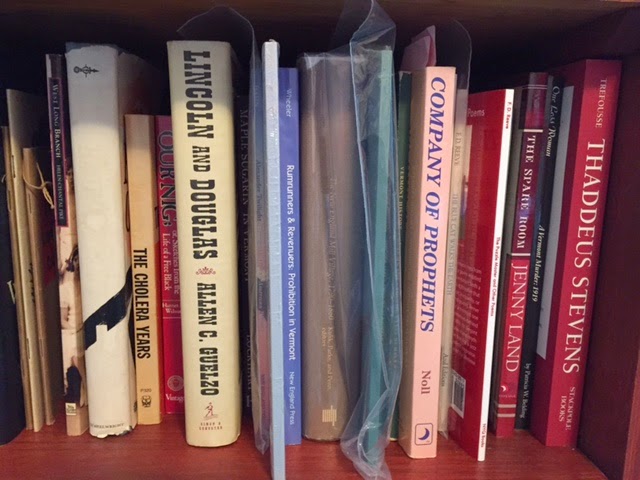
Part of the research behind The Long Shadow (done, done, done -- for now!)
Last night at about 8 pm, in the little writing room at the far end of the house with one lamp on and deep winter darkness outside, I finished the revisions for an 1855 historical novel, an adventure/mystery set in northern Vermont: THE LONG SHADOW.

This journey included years of research, as well as asking a professional editor to help me prune an early draft in order to accelerate the pace and open the adventure further. Now, of course, the book moves to the part of the process where I feel much less skilled: looking for the right publisher. But I can do this!

And while that takes place, I have two more books in process that involve historical research (thank you, Dave!). Gathering the books and documents makes up maybe half of that -- and the rest is legwork and photos and thinking. For instance, here are some of the town record pages from the earliest settlement years in Barnet, Vermont. Look closely and the first one and you'll see shillings and pence! The second suggests the town was keeping track of people's work hours on some collaborative projects in 1789. Who would have guessed? There's no better way to put the late 1700s into perspective than to search for, find, gently touch, and think about pages like these. Right?


So I'm taking my vitamins, making sure to get out in the crisp January air for a bit each day, and reading the best material I can find by other authors, to keep myself overflowing into this writing life I've chosen. And, oh yes, I need to schedule a bit of work in the "reference room" to open up a new bookshelf. There's more research piling up, and it needs to be sorted, stacked, filed, and omigosh, kept in mind all the time. That's where the plot twists take root.

So, if you are reading this week -- what are you choosing to put into your own creative soil?

Thursday, January 8, 2015

Research = Stories. Which is what I love about this stage of the book.

It's pretty cold up here in the Northeast Kingdom of Vermont today. Morning began around minus 24 degrees (F), full of bright sunshine, and I pulled out my "long johns" and layered up for an excursion to the nearest frozen pond -- and also to deliver a book to a neighbor, and pick up our mail. It's good to realize, after more than half my life spent here, that I really do know how to dress for comfort, even in such extremes.

Plus, of course, it puts me back into the mind of Almyra, the young woman in the book I've just started writing (no title yet, but the first chapter begins right after a snowstorm: "The silence woke her. That, and the cold."

Almyra would be outdoors on a day like this -- she had little choice! And she'd add layers the way I did, although I doubt that she would have worn the pair of brightly striped Ecuadorean knitted legwarmers that made my final-layer fashion statement of the morning. But she would have loved my fuzz-trimmed hood! I already know that she seeks comfort, at the hardest moments of her life, in going to a quiet place outdoors and letting her heart become calm. Me, too.

But other than her personality, everything else about Almyra's story, set in 1899, depends on research to frame it. So I walk a lot in the nearby towns, looking for signs of the "old days" along the way. The "Gold Medal Flour" advertisement on an upper wall of the "Brick Diamond" building in Lyndonville (better known locally as the building where Edmund's Drug Store used to be) captures a bit of that 1899 commercial feeling.

The Census from 1900 also provides details that I need -- here is one of its pages showing my "target of reseacrh," Albert Stern, still living at home with mom and dad even though he's 19 -- but then again, so is his older brother Samuel, 23, and their sister Clara, 25 ... or was it just something like a family meal that brought them together with the younger teens at home, Isabelle (17) and Benjamin (15)? Here's where the author's choices take over from the facts.

Also on target this week: the Poor Farm in St. Johnsbury, Vermont, as mentioned in an article from the Vermont Historical Society; Census pages describing the Dolgin family, which didn't arrive in the area until 10 years later; an oral history project with a couple of the Dolgin family members, giving the feel of the early century; and photos of trains in snowstorms.

What's next? Well, I know it's hard to imagine, but in the next post here, I'll show you something with shillings and pence ... from Vermont!

Sunday, December 21, 2014

Outside the Writer's Room: Writing in the Kitchen on a Snowy Day in Vermont

I know writers are supposed to barricade themselves in private soundproof rooms, where they can keep the outside world away while they create new worlds on paper. So, why do I find myself writing in the kitchen so often? Maybe it's the closeness of the tea kettle. Maybe it's the light. Or maybe the expectations loosen up and it's just more fun ...

At any rate, I was sitting at the kitchen counter scribbling a first draft of a poem (shown at the bottom), which kept getting changed each time I looked at it (multiple drafts; and can we still call it "scribbling" on a computer? well, why not?), and out of the corner of my eye caught something in motion outside the kitchen window. In one coordinated leap, I grabbed the binoculars and made it to the window, and then ran to the next one, pulling out my cell phone and adjusting its bold little camera to "zoom." And here's the result: a fox that wove back and forth along the field, then came right down to the edge of the yard where the gardens begin, where a mouse must have been traveling under the snow. I watched the fox pounce, dig down, and snap up its snack and chew (with mouth open, eeyew).

It paused to look toward me -- movement at the window drew its attention, I'm sure -- before heading back toward the woods at the top of the field.

And THAT is why writing by a kitchen window is a Very Good Idea. Forget the desk, for today.

***

Religion

I was seven, my brother five, my cute little sister
just three years old. We played tag
with lots of other kids in the neighborhood.
The Slaines were Catholic, lived across the street,
and their girl my age – was it Nancy? –
had a “wedding dress” when she turned seven
and made her First Communion. How envious
I was of her cuteness, and her day of lacy
beauty. The little girl who lived on our other side,
Eileen, sat on the wooden edge of our sandbox
and edged her words with scorn:
“Nancy’s Catholic,” she emphasized in a new way,
a pout of her rosebud lips indicating
a form of disgust. Even then, I knew it must be
something she’d learned from her parents.
Then she announced, with pride,
“I’m Protestant!” – sure, we had heard that label in our house.
My brother grinned, bobbed his crewcut head, agreed.
I had curly hair (too curly said my mother),
which bounced even with my neutral nod.
Then my little sister, rising to the call,
stood up, saluted, and said, “I’m American!”

-- BK

Monday, December 15, 2014

Things Change: In Small Towns in Vermont, Often via Disaster

When my husband Dave and I began investigating the people and events indicated by an 1880 postcard mailed from one small town near us, to another, I opened up a resource that I'd purchased a few years ago, knowing it would be significant -- but at the time, I'd finished one project related to it, and didn't need the details. It was a doctoral dissertation by Northeast Kingdom historian Allan Yale, and gave details of operations at E. and T. Fairbanks, or, as it was locally called more often, the Mill -- or today, "Fairbanks Scale."

Thanks to Scott Wheeler, editor/publisher of Vermont's Northland Journal, I pulled together all the research around the postcard into a story of discovery, with some suprises in it. And that will be an article in the February issue of Scott's magazine.

I gave to Scott images of the front and back of the postcard. I really wanted to also send along images of a building that has an important role in the story, the company store that the Fairbanks factory operated. But I got frustrated, trying to find a good image. This shows the structure at that location, more or less "today," in brick with the name FAIRBANKS inset up high on the building. But I wasn't sure it fit with the 1880s, and didn't know how to find the right version of the building.
Left to right: St Johnsbury Athenaeum, St. J. Fire Dept., "Fairbanks" building, dental office. Circa 2005.


Well, you know how "collecting" can be -- my puzzle inspired Dave to keep searching in his own "ephemera" (the fancy name for items that have a very short lifetime, especially old paper). He found a lovely old stapled booklet of photos of the town, and called me to his work space in triumph: there it was, the Fairbanks company store, probably photographed around 1880 to 1900.

But what a difference from today's lineup of structures! In fact, it's clearly made of wood, not brick, and even the "St. Johnsbury House" next door is not the same building we see today.

Fairbanks company store, left; St. Johnsbury House, right. 1880-1890?


More or less today's St. Johnsbury House. Photo postcard about 1950.
What happened?

Sadly, we know the answer is likely to have been: Fire.

Next task -- find the record of the local disaster that wiped out those earlier structures, and put a date to the change. Even in the past 15 years, St. Johnsbury has seen more than its share of fires in the wooden or wood-framed downtown structures. Someday, the idea of towns that are forced to change via fire, or even via flood (more on that at another time), will seem quaint to us. But today it's still very real. We wish our extended neighborhood a safe winter, and hope this will be a year when fire does not escape its proper place.

Wednesday, November 26, 2014

Butternuts: A Kitchen Story

butternut tree


We have an enthusiastic Waterford History group that meets at the local library, the Davies Memorial Library, here in Vermont. Part of our tradition is to consider all of us to be "amateur historians," and we all make discoveries -- in the attic, in old books, behind stone walls suddenly glimpsed through November's bare woods. So each meeting begins with going around the circle, making sure anyone bursting with a new discovery (or, more likely for us, reservedly admitting they've made one) can speak up.

Somehow, last summer, we got onto talking about the old trees that are vanishing. Elms are one of them, of course; every New England town used to have some of these giants, but most were felled by a parasite known as Dutch elm disease, and few remain. Another one (I am sure it was Helen who mentioned it) is the butternut -- and people put their memories and ideas together to talk about where they might have seen a butternut tree in the past decade.

Then, of course, memories of cracking open (actually, smashing with a hammer) the tough nuts came from the oldest among us, who remembered what hard work it was! "I had a recipe for a chocolate butternut cake that was wonderful," Geneva mused. Her relatives asked, "Do you know where it it?" "No," Geneva said with a smile.

(see top recipe)
After the meeting, I went searching for butternuts online, and discovered Native Nuts, a small local firm about an hour away, up by the Canada border (website here). Brigitte at Native Nuts allowed me to reserve two pounds of butternuts from the fall harvest. Then one of Geneva's daughters asked for a two-pound addition. "They should be ready around November first," Brigitte advised.

Next came the recipe question. I didn't find a butternut cake in my own books, so I asked Lois, who has a lot of old recipes from her family. She sent me this one, from Hood's Practical Cook's Book for the Average Household, published around the end of the 1800s. "Add two squares of melted chocolate to turn it into a chocolate cake, she advised.

Today the nuts arrived! As soon as you touch one of the ridged, hard, tough exteriors, you understand why they are smashed with hammers, not politely cracked over a bowl. I'm looking forward to trying this, but ... not alone! I'll save my half of the nuts for the next meeting of our history group, which is in February, weather permitting. It clearly takes a village to prepare a cup of butternut nutmeats for this recipe!

"The Young Elderly": No Way, No Way!

My "day job" is still editing journals -- that is, sets of articles written by researchers in various fields, from engineering to ...