Wednesday, November 26, 2014

Butternuts: A Kitchen Story

butternut tree


We have an enthusiastic Waterford History group that meets at the local library, the Davies Memorial Library, here in Vermont. Part of our tradition is to consider all of us to be "amateur historians," and we all make discoveries -- in the attic, in old books, behind stone walls suddenly glimpsed through November's bare woods. So each meeting begins with going around the circle, making sure anyone bursting with a new discovery (or, more likely for us, reservedly admitting they've made one) can speak up.

Somehow, last summer, we got onto talking about the old trees that are vanishing. Elms are one of them, of course; every New England town used to have some of these giants, but most were felled by a parasite known as Dutch elm disease, and few remain. Another one (I am sure it was Helen who mentioned it) is the butternut -- and people put their memories and ideas together to talk about where they might have seen a butternut tree in the past decade.

Then, of course, memories of cracking open (actually, smashing with a hammer) the tough nuts came from the oldest among us, who remembered what hard work it was! "I had a recipe for a chocolate butternut cake that was wonderful," Geneva mused. Her relatives asked, "Do you know where it it?" "No," Geneva said with a smile.

(see top recipe)
After the meeting, I went searching for butternuts online, and discovered Native Nuts, a small local firm about an hour away, up by the Canada border (website here). Brigitte at Native Nuts allowed me to reserve two pounds of butternuts from the fall harvest. Then one of Geneva's daughters asked for a two-pound addition. "They should be ready around November first," Brigitte advised.

Next came the recipe question. I didn't find a butternut cake in my own books, so I asked Lois, who has a lot of old recipes from her family. She sent me this one, from Hood's Practical Cook's Book for the Average Household, published around the end of the 1800s. "Add two squares of melted chocolate to turn it into a chocolate cake, she advised.

Today the nuts arrived! As soon as you touch one of the ridged, hard, tough exteriors, you understand why they are smashed with hammers, not politely cracked over a bowl. I'm looking forward to trying this, but ... not alone! I'll save my half of the nuts for the next meeting of our history group, which is in February, weather permitting. It clearly takes a village to prepare a cup of butternut nutmeats for this recipe!

Sunday, November 16, 2014

"The silence woke her." New Book in Progress! And a Contest!!!

It's that time of year. Snow filters onto the back field. Birds visit the feeders. Deer leave tracks at night. And I start a new book.

Except. Gulp. This time I'm starting three of them. It can't be helped. They are all whispering to me and the time to get the words into place is NOW.

The one I want to talk about today doesn't have a title yet. As I've worked on the research over the past few years, I've just called it "the Lyndonville (Vermont) mystery." But a few weeks ago the main character suddenly waltzed into my life and I had to start ... her name is Almyra, and she's 16, in November of 1899, in East St. Johnsbury, Vermont. And yes, the action up ahead will take place in Lyndonville.

People often ask about a writer's "process." Mine has less to do with what time of day I write, and more to do with how I prepare. I do literally years of historical research. Part of the background of Almyra's story is this information sifted from the 1910 version of Walton's Vermont Register:
In Lyndon, millinery, Mrs. E. M. Swett; in Lyndon Center, none; in Lyndonville, tailor, J. C. Stevens; clothing and gents' furnishings, S. Stern; millinery, Mrs. E. Bigelow, Mrs. F. J. Willey, Mrs. H. Duston, Mrs. W. Barber.
But I also prepare in "five or six senses," and this time one of the necessary elements is a necklace of amber beads. Amber isn't a stone -- it's a fossilized resin. And amber comes particularly from the Baltic (those now-reappearing nations of Latvia, Lithuania, and Estonia -- which have sometimes been part of Russia), but there is also a noted deposit of amber in Kansas, the state where so many pro-Abolition Vermonters made their homes in the mid 1800s to try to sway the new territory toward becoming a "free state."

So, here I am, happily at work, with an amber necklace in place. I love the variety of colors in it. Even more, I am enjoying knowing the role that amber will play in Almyra's story.

Last bit of process: I've purchased paperback copies of two books (well, one is a 10-book series, repackaged in one volume) that I enjoyed reading years ago, and in their titles is the word "Amber." 

CONTEST!! To the first person who can correctly guess BOTH the book titles (for the series, you can either name the first book OR the series, but you have to also name the other book), and place them here as a comment, I will mail a signed copy of my most recent mystery, Cold Midnight. Looking forward to your replies.

Sunday, November 2, 2014

ALWAYS Read the Book Before the Movie ...

This is a rule I learned from my parents when I was a kid. Why do it this way? Because you get to have your own images of the characters, savor the plot without being pushed by the music (or, even worse, laugh track), and know much more in detail than the film will ever be able to tell you.

But that said, I've been laughing at myself as I realized that on top of all the book release dates I'm watching for, I'm also excited about three movies in the next few weeks based on books that I love.


November 21, first half of the third (last) book in the Hunger Games trilogy from Suzanne Collins. (And now, the final performance by Philip Seymour Hoffman; what a heartbreak.)


December 5, the real-life adventure that Oprah's Book Club pulled into bestseller land ... and I could not put the book down, WILD by Cheryl Strayed.


December 17, the final in the three (!) films made from one Tolkien book, THE HOBBIT -- The Battle of the Five Armies -- and by the way, when are we going to see female characters take on quests as powerfully written as Frodo and Sam's?


What about you? Are you marking your calendar with any books-to-screen adventures this season?

Saturday, November 1, 2014

November: Month of Gray Poems and New Writing Projects

On this first day of November 2014, I'm celebrating -- most especially, the gift of photography that a smartphone makes so accessible. Here is the vista from the end of our road:


And here is a lovely detail from the little cemetery that I walk past, in order to get there. It's the edge of the stone for George Russell, at the Cushman Cemetery in Waterford, Vermont. I love the detailing, making even the edge of the stone cared for and lovely. I hope Mr. Russell's life felt that way too, at least from time to time.


Writers have fresh reason to look forward to November 1, as it's the start of Nanowrimo, a brilliant way to encourage us to start new work and perhaps even finish a first draft by the end of the month. Really! Check out the details at the official website. I haven't signed up on the site (I tried it once but it rubs my introvert nature in the wrong direction!), but I'm starting another adventure novel today, with much exhilaration. I'm happy the outside world is a bit less exciting in this month! (Yes, this means I'm working on two novels, one poetry collection, and one Christmas book this month. And then there's my day job ... and cooking for Dave.)

Finally, for all of us who know tidbits of this poem, the full version from London poet Thomas Hood, dated 1844:

NOVEMBER by Thomas Hood (1799-1845)

No sun - no moon!
No morn - no noon!
No dawn- no dusk - no proper time of day -
No sky- no earthly view -
No distance looking blue -

No road - no street! -
No "t'other side the way" -
No end to any Row -
No indications where the Crescents go -

No top to any steeple -
No recognitions of familiar people -
No courtesies for showing 'em -
No knowing 'em!

No mail - no post -
No news from any foreign coast -
No park - no ring - no afternoon gentility -
No company- no nobility -

No warmth, no cheerfulness, no healthful ease,
No comfortable feel in any member -
No shade, no shine, no butterflies, no bees,
No fruits, no flowers, no leaves, no birds,
November!

Wednesday, October 29, 2014

Galway Kinnell: It's the poem ... it's the story ... it's the poet


Word online is that our "neighbor" (about 30 miles distant) and gentle friend Galway Kinnell died yesterday -- and since The Poetry Foundation and Wikipedia have already closed his entry with that date, I suppose there is no real chance that the word is wrong.

What a loss ...

These photos (thank you, St J Academy -- were these taken by Denise? Jean?) are from the last time we helped create an event at St. Johnsbury (Vermont) Academy for Galway, in November 2007. He read just five poems -- but braided them together with generous stories about each one that kept the students (and the rest of us) captivated. I learned a lot that day about what it is to care about your audience: the people you write for, and the people you read your poems to.

There will be many longer pieces written in the days to come about this great poet who has left us with such treasures. I wish he could have stayed longer ... and with my husband Dave, we offer sympathy to his family and to his many friends and readers around the world.

If you don't yet know the poems of Galway Kinnell, here's a place to start.

Friday, September 19, 2014

Rhymes for Young Ghouls: When Fiction Turns Fierce

These are "stills" from the Canadian award-winning movie RHYMES FOR YOUNG GHOULS, coming to our local "arts cinema," Catamount Arts, on October 31 (through Nov. 6). The Halloween timing will fit the photo you see above -- but this movie has a lot more to do with Vermont, and my book The Darkness Under the Water, than you might have guessed.

Discovering the horrors of Vermont's home-grown eugenics project, which targeted Vermonters of Abenaki (Native American) heritage in the 1930s, pushed me to write The Darkness Under the Water. What was difficult for me to confront -- the betrayal and medical crippling inflicted by our own mostly fair-minded state -- remains much more terrible and present for those whose families suffered in person from this. It was also the reason Vermont's tribal presence became silenced for decades. Census takers in 1980 recorded the state as "empty" of Native Americans; in 1990, when some measure of safety had been restored, so people could answer more honestly, the Census takers (naive!) asked, "Where did all these Native Americans come from all of a sudden?!"

Back to the movie: Filmmaker Jeff Barnaby confronts the parallel racism and oppression that were taking place in Canada, with a very up-to-date and eerily believable "revenge fantasy" film, as a pot-dealing "native" teen takes aim at the Indian Act and the local Indian agent who is threatening to place her in a residential school. If you like your history served up current, with a generous dash of dark humor and good performance, this could be your film. I know it's one I'm going to see (with thanks to Mr. Aldredge at Catamount for the effort of bringing it through the international network).

And if it makes you angry in the long run, about the treatment of Canada's "First Peoples" and our own -- I'll be glad.

Trailer here.

Globe and Mail review here.


Sunday, September 14, 2014

A Visit to the Library -- by Five of Us! Are You Coming, Too?

Sometimes Vermont is a very, very small state. Vermont authors run into each other often -- at tea or coffee, or online, or at the library or the town clerk's office.

Peacham, Vermont, memoir writer Gary Schoolcraft found the same idea in this that I found at about the same time: Let's get together on purpose.

So, half a dozen of us (changing in number depending who's available when) are jointly providing author events, selling books at yard sales and county fairs, and even marketing online sometimes (Gary has his Green Mountain Books Sales site just warming up).

And this coming week, on Thursday, we'll be at the best library in the state -- well, it's my own town library, so it means a lot to me! -- the lovely Davies Memorial Library in the "White Village" of Lower Waterford, Vermont. (You can learn more about the White Village and other local treasures here: http://waterford-vt-history.blogspot.com.) 

Here's the info -- hope you can join us!

Thursday, September 18th at 6:30 pm -- Local Author Round Table

History.  Mystery. Nature and the environment.  Fiction. Non-fiction. Poetry.  All set in our very own backyard!  Join us on Thursday, September 18th at 6:30 for a Local Author Round Table!

Authors Gary Schoolcraft, Tanya Sousa, Beth Kanell, Jerry Johnson and Alec Hastings will be on hand to discuss their writing- what, why and how they write followed by a discussion between author and reader alike.  Their books will be available at the event- read below for a brief bio of each of our guests.  All are welcome- see you there!

Gary Schoolcraft's book "When Kids Were Allowed to Be Kids" is a best-seller in our area. He describes his collection of remembered adventures as "a humorous look at life in the small Vermont town of Peacham during the late ’50′s and all of the ’60′s as seen through the eyes of a kid that was there." He shares snips from the book at his Facebook page, and has a website, http://www.greenmountainbooksales.com.

Tanya Sousa of Coventry is an award-winning author of environmental and agricultural children's books, novels, stories and essays. She specializes in topics focusing on human interaction with other living things/the environment - her most recent work is the ecological novel, "The Starling God", which has received five-star reviews to date from readers from all walks of life and around the country. Readers' comments and more may be found on the publisher's website page for the book: http://www.forestrypressproducts.com/the-starling-god-by-tanya-sousa/.

Beth Kanell of Waterford writes Northeast Kingdom adventure novels, with a touch of both mystery and history. So far, they've been set in North Danville, St. Johnsbury, and Waterford, and this year she finished a Barnet book and a "teen sleuth" book set in Montpelier. She shares her research and writing life at bethkanell.blogspot.com, and visits schools and libraries to tell tales of the true (and often criminal!) history behind her novels.

Jerry Johnson of Craftsbury is a well-published poet whose wish came true when he wrote "Up the Creek Without a Saddle": His dream was fulfilled when Vermont’s legendary master musicians, Jon Gailmor and Pete Sutherland, took 16 of his book’s 99 poems and set them to music. A beautiful CD of their songs comes with the book for free. It is Jerry’s gift back to Vermont, those who love the Green Mountain State, and people anywhere who love the natural world. Jerry’s books and background can be found at his website, www.vtpoet.com.

Alec Hastings just retired from teaching in Bethel, Vermont. To encourage adventurous reading among his students, especially the boys, he wrote the novel "Otter St Onge and the Bootleggers," which he describes as "a rip-snorting tale of Vermont moonshine smugglers during the Flood of '27." His connections to the area include his father's grandparents, who farmed in McIndoe Falls.

Contact the library at 748-4609 or davieslibraryvt@gmail.com for more information.


Sunday, September 7, 2014

What the Young Squirrel Showed to Me

Walking uphill on our dirt road on Friday, I noticed a very large and long "pinecone" that had been run over -- still mostly attached together, but fringed and shattered along its edges. Ten minutes later, headed back down the hill, I found this very young squirrel digging into it, extracting the protein-rich seeds.

The little squirrel (a red one) stayed on task and let me get closer than most adult squirrels permit. But finally he/she grabbed the biggest chunk of the cone and bounded off into the scrub and woods next to the road.

The squirrel's attention to the cone pushed me to wonder more about it. I looked up the cone today -- and that's why I put the term "pinecone" into quotation marks, as these fibrous seed carriers come on spruces and even birches, not just pines. But it does seem from my Audubon Society Field Guide to be a cone from a white pine.

I was really surprised to see the "cones" on birch twigs in the book. All these years admiring birches, and I've never looked at them closely enough to see what carries their seeds! A few pages later are photos of acorns; why didn't I even stop to notice that different kinds of oaks present different shapes and colors of acorns? Guess I was always just pleased to be able to say "oak" and "acorn."

As I look at the neighboring town of Lyndonville with intent to frame a YA mystery there (probably in 1898), I'm finding the same surprise at what I've walked or driven past without questioning, noticing, or naming. Lyndonville suffered two devastating fires in the first part of the 1900s, wiping out one side of its main street, then the other. Yet there are structures that date to 1898 on most of the "town center" streets. And only recently, my husband Dave (who lived in that town for two decades and has a great collection of postcard images of it) and I realized how many portions of the massive railroad complex from, say, 1855 to 1950 linger in town, repurposed or quietly shuttered and overgrown.


Soon I'll choose names for the teen and the two older women who'll make up the main characters of this book-being-planned. While those details come together, I'll also look around the town for traces that remain of the people I'm envisioning. I've already seen evidence of their lives (the real ones, not my fictional versions) in Census documents and 1890s advertisements.  Crafting a good story from these "seeds" means paying attention to the names and existence of what's already there.

Thanks, Red Squirrel. You've got me asking questions and seeking answers. Way to go.


Saturday, August 30, 2014

Falling in Love Again ... With a Covered Bridge

History may be global -- but I'm convinced the start of a love for history is almost always personal and local. In grades kindergarten through grade 4, I often look for investigation projects that connect with what kids already know: their homes, their neighborhoods.

Now and then, it's also nice to go back to that kind of moment. In the last couple of years, I've become very fond of the Sanborn covered bridge in Lyndonville. It helps, of course, to know that the original bridge owner was a very, very distant cousin of mine (my mom would have been thrilled). But also I find the construction and the bridge's long life satisfying. My next novel (the first draft will start at the end of September) is set in Lyndonville, a mystery of course, and I may have to include the bridge as a symbol of how much easier it is to get along with "things" than with people!

Floods and age have taken a toll, and the bridge is under repair. (You can help save it -- click here.) Here are a couple of recent photos of it -- as well as a postcard that includes it, found by my intrepid researcher husband Dave. Do you think he can bear to share my love with the bridge? (Smile.)


Tuesday, July 15, 2014

Multimedia, Hyperlinks, and a Village Event in Peacham, Vermont

Peacham is considered one of Vermont's most photographed towns -- in part because at least one Vermont Life photographer lives there, and many more have visited. It's not just the hill-and-vale arrangement of church, town center, and farms that's drawn photographers here, but also the strands of local tradition and history. The Peacham Historical Society is constructing new climate-controlled storage space for its archives; the Peacham Library hosts a weekly coffee hour; and the town's small school is neighbor to a professional-level astronomy observatory.

Seven of us "local authors" joined the Peacham Library on July 4, to focus some interest on books. There was a sale of used books inside the library, and outside, under a tent, we seven offered copies of our creations, along with signatures of course. Since business was slow, we also had plenty of opportunity to share aspects of both research and the writing life with each other -- for instance, we listened to Jerry Johnson's poems set to music and performed (on CD) by Jon Gailmore, while archivist Lynn Bonfield described the Gold Rush-era diary that brought her from California to Peacham, children's authors Lynda Graham-Barber and Tanya Sousa compared notes on their paths, Alec Hastings confirmed that he's now writing a teen adventure based on the river logging of the early 1900s, and memoirist Gary Schoolcraft and I planned more author collaborations.

But equally of interest to me, especially as I reflect on overheard conversations that day, is how many media had roles in the day's offerings. Not only were we authors discussing printed books, e-books, and audio books, but we shared Internet research techniques and access. Young reporter Caleigh Cross (a novelist herself) captured images of the famous Peacham tractor parade for the local newspaper's advance website coverage. And visitors pointed to the village store buildings and talked about the films that have used them as backdrops, like Ethan Frome and The Spitfire Grill.

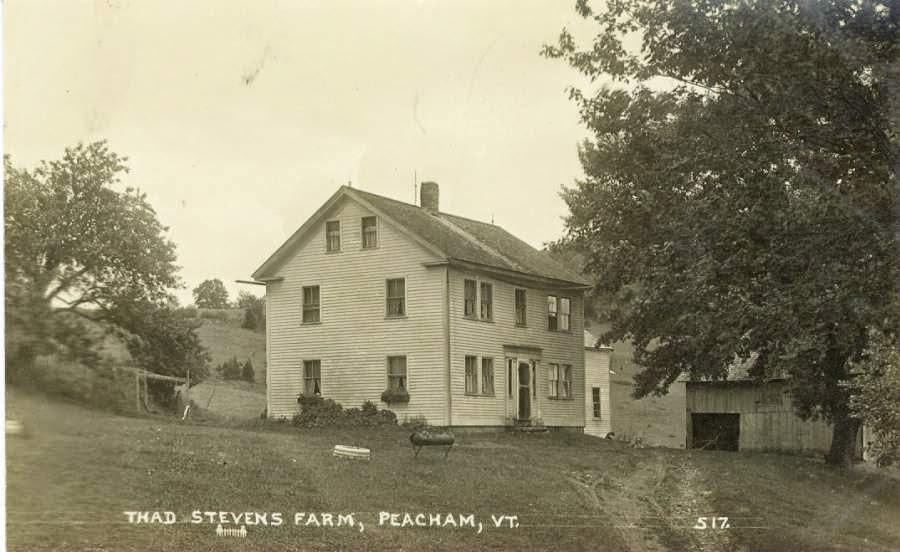
As for me, I was also thinking about Peacham history, "then" and now. I'm particularly pleased with the fresh interest locally in Thaddeus Stevens (1792-1868), who lived in Peacham as a child and became an ardent abolitionist and legislator based in Pennsylvania. The recent film Lincoln gave him a memorable face and role, played by Tommy Lee Jones. Just as important to me are the postcards Dave and I recently acquired, one showing an earlier view down "South Main Street" from where we authors stood, and the other of the house labeled here "Thad[deus] Stevens Farm."* These old postcards were the "social media" of their time, half Facebook-ish with their images, half Twitter-esque with the limited space for a message. As I collect these, along with memories of a congenial community event, I feel like a human version of a hyperlink, myself.


Our future is rooted in our past; how lovely to savor the present, and look in both of those directions.

*Note from archivist Lynn Bonfield: "The Stevens house on the hill (seen from the village) was the one he bought for his mother—he never lived there.  He was raised in a house on the Peacham–Barnet border, up the hill from the West Barnet church."

Saturday, June 14, 2014

Buzzards at the Cemetery

We made a delivery to friends in North Monroe, New Hampshire, this morning, then headed home on the "scenic route" -- which immediately had me slowing the van and stopping in the middle of the road, to watch the unusual sight of a large turkey buzzard perched on top of some "road kill" (a crushed and furry heap of smashed animal) and refusing to move. I wanted to take a photo but Dave was concerned that we were a target for other cars arriving, so I let the car roll slowly forward, and with a clearly resentful shrug, the buzzard left its prey and allowed us to pass. I parked just beyond the spot as I realized what I was seeing where the buzzard had landed: THREE enormous turkey buzzards sitting together on the stones of the North Monroe cemetery, waiting for another chance to consume their meal.

As I eased the car door open, stepped out, and closed the door most of the way, more buzzards landed in the field on the other side of the road. I have never seen such a large group of turkey buzzards -- I usually see them as two to four in a group, wheeling in the sky. What was drawing them?

Next I realized that between the flock of birds of prey and the road, a small fox sat with its ears twitching. Fox kit (young one)? Or mama? I think probably the mama, since it watched the road intently. I raised the camera and caught a photo, but clearly was one threat too many, as the fox then stood up and trotted toward the road bank -- and vanished. Must be the fox den was under the edge of the road.

So, what was holding the flock of buzzards in place? It can't have been the small tattered mound on the road. It was barely enough for one buzzard to consume. I'm thinking cow ... the field is part of a dairy farm, and either a cow went down, or a calf didn't survive the birthing process and is tucked under the green growth where I can't see it, but the turkey buzzards can.

The birds perched on the cemetery stones became restless; you can see one here, toward the right, wings raised. I decided we should move on, and let them get back to bird business.

What an unusual morning!

And that is how writers get distracted. But fear not: Sue Tester and I finished our "semifinal" draft of Charlie's Place a week ago, and my editor at the publishing house is taking a look. Two more sets of revisions to complete, before I can let myself launch into writing The Fire Curse. Chug, chug, chug, puff. I think I can ...

The Poetry of Transitions: What Is Poetic Language?

On Thursday July 16 at 6:30 pm in the Davies Memorial Library in Lower Waterford, Vt., I'll be chatting about my new book THRESHOLDS (fr...