Sunday, March 25, 2012

March Rewards: Maple Sugar, Parsnips, Writing Time

Spring veggies for sale; sign in Barnet, Vermont, today.
Rain, steady and soaking. The "pond" (really a good-sized lake) down at the foot of the ridge is slowly releasing its layer of ice, from the north side first (because that gets the steadiest sunshine across the open space). If we get a bit of wind, I think it will all collapse today. "Ice out" is a significant marker of the season, and in the old logging days it would mean the winter's worth of treetrunks, coming down the Connecticut River in flotillas big enough to clog the river for weeks at a time, sometimes longer.

The unusual March warmth this year didn't do any favors for the maple sugaring season. To gather maple sap that can be boiled to the sweet syrup, you need the seasonal "up and down" surge of sap through the trunk, and that only happens when days linger above freezing temperatures, and nights fall below freezing. Too much warmth causes the trees to start to bud instead, and that changes the sap and makes it "buddy" tasting -- no good for syrup.

In The Secret Room there's plenty of information about what the Underground Railroad "looked like" in Vermont in the 1850s. (Hint: It wasn't underground. Jane Williamson, director of Rokeby, the Quaker-inspired farm in North Ferrisburgh, Vermont, where the farmers documented the fugitive African Americans passing through, says it ought to be called the "Aboveground Railroad" in Vermont!)

In a separate novel, The Long Shadow (not yet published), I followed the action during 1850 in the lives of three teenaged girls living nearby. The book actually begins in sugaring season. The little town of Danville, Vermont, had a wide-open market for the maple sugar made there, because of the politics of the time: Conventional sugar was made from molasses, which required "slave labor" then. Maple sugar, though, was made locally, without abusing or oppressing people (or animals). So if you lived in 1850s Vermont and felt strongly about the abolition of slavery, you could take a stand in your own kitchen by demanding maple sugar and banning store-bought "cane" sugar.

I've declared a sugar-free day today in my kitchen, to honor that 1850s decision by local cooks.

As you can see from today's photo, there's another "spring crop" being offered locally: parsnips. This root crop sweetens significantly over the winter, if you can save it that long, and it makes a great March vegetable. I'm waiting for my lower garden to thaw, so I can dig up another root crop: horseradish.

More on that, another day. Today I've got more writing to do, and need to take advantage of the rainy afternoon!

Friday, March 23, 2012

Interlude: Slowly Planning a Later Novel


One part of my own "writing process" is that there's always another novel coming together in the background. Driving in today's lovely springy weather took me through East Barnet, Vermont -- where the depot in the days of the passenger trains was named "Inwood." Here are three postcard views from the wonderful Northeast Kingdom postcards site provided by Janice Boyko -- one showing a railroad washout, and the other two, views of East Barnet village. Thanks to Marvin Roy, I also have a copy of a scrapbook from a family connected with the huge mill structure you can see in the postcards, home to the Roy Brothers croquet factory.

Weather and wooden structure conspired to destroy the factory three times, and the railroad only runs a freight train now (twice a day). The village is more of a whisper, a bend in the road with a cluster of homes closer together. But there's a story lurking there, and each time I drive through, a little more of it will come clearly. In a few years, I'll know the characters and the plot.

But for today, I know the title: Inwood.

Wednesday, March 21, 2012

Charles Dickens and 17 Pages Per Week: Serial Fiction

Publishing a novel in chunks in a newspaper turns out to have been a tax dodge -- by printing on a different paper size, newspapers in Victorian England could claim they were issuing "brochures" and thus dodge a special tax assessment that would have struck them as ordinary news publications. What a break for Charles Dickens! Plus, the author of Great Expectations, Oliver Twist, and The Christmas Carol, as well as A Tale of Two Cities, had three necessary skills for releasing his books chapter by chapter: (1) He could write roughly equal-sized chapters, necessary for the nuts and bolts of such publishing. (2) He was a master of the end-of-chapter cliffhanger. (3) He could reliably write 17 pages per week.

This month I'm doing be best to follow in Dickens' footsteps. I'm writing a detective novel, featuring Vermont's own "Nancy Drew"-style character, college freshman Felicity "Lucky" Franklin, called home to probe the shooting of her father (and her mother's arrest on suspicion of murder). It's called ALL THAT GLITTERS. I'm doing it on a public website, Wattpad, where hundreds (maybe thousands) of other authors are also writing chunks of fiction -- many of them paranormal romances. I can see how audiences would treat such books sort of the way the Americans did the work by Dickens, most especially chapters from The Old Curiosity Shop, in which readers knew in their hearts that the beloved character Nell was probably going to die. A Time Magazine review of The World of Charles Dickens by August Wilson began:
When Fyodor Dostoevsky was sentenced to four years in a Siberian labor camp, he requested only one kind of reading matter: books by Dickens. In mid-19th century New York, ships arriving with the latest installment of Dickens' The Old Curiosity Shop were met by anxious cries from the dock: "Is Little Nell dead?" 
Anyone who's written for a daily newspaper, or a demanding college English professor, knows that writing 17 pages per week isn't that unusual. Especially if you're getting paid for it, and you don't have to do much of anything else in your days/nights.

The challenge is when you're not getting paid a bit, so your "day job" has to keep taking most of your time -- you're still cooking for your family -- you've got car appointments and doctor visits and the yard needs your care ... Heavens, it gets interesting that way!

Still, I'm carving out my couple of hours every three days, to write the next chapter and post it. I've complete six of them this way.


And I've discovered the catch: I'm starting to realize the things I should have added to the earlier chapters. I've got notes on envelopes, napkins, grocery lists -- "Go back and put in ..." -- and I'm trying to hold in my mind, very gently so they won't go stale, all the twists and deepenings that I want to add in chapters 12, 24, 33. How the dickens did Dickens pull it off?

Don't stop now. Check in for chapter 7 on Friday evening. Oh, you haven't read the first six yet? Don't panic -- just slip on over to Wattpad and get reading. I promise what one of my correspondents is now calling Kanell Kliffhangers. How long will Lucky Franklin's luck hold out, as she investigates criminal behavior that's already blown a bullet through her own dad?? More soon ...


Sunday, March 18, 2012

"Write Like a Writer": Strong Sentences

Pussywillows and forsythia rooting at the east window.
Many thanks to students and teachers at the St. Johnsbury (VT) school, where three groups joined me last week for a session of "Write Like a Writer" focusing on strong opening and closing sentences. Students prepared ahead of time, using their writing notebooks to pull this together:
Consider yourself a collector of important sentences. Please bring ON PAPER to our workshop:

A. Two "chapter opening sentences" that you like -- one from The Secret Room and one from another book that you like.

B. Two "chapter ending sentences" that give you a hint of what's coming next -- one from The Secret Room and one from another book that you like.

C. Two sentences from a piece of your own writing that you'd like to make stronger.

D. A three-sentence description of what breakfast was like at your house recently. You can be "factual" or "fictional" in your description, but it should be interesting in some way! We won't get to look at all of these, but we'll do our best. [We only did this in one classroom, and we turned it inside out to create fiction instead, around the idea of foreshadowing the rest of the story, which would involve a sibling leaving for military service. Thanks, Mr. Shepley!]
After sharing readers' choices of strong opening and chapter-ending sentences, we used a "white board" (actually we used "smart boards," my first experience of them -- need some practice to have better handwriting on these!) to test a couple of sentences that students suggested as "needing to be stronger."


Among the techniques we used were testing adverbs to see whether they could be replaced with more detailed material; looking at "weak" verbs like forms of "to be" and "to go"; and an exercise called "See the Puppy."


You can try "See the Puppy" yourself: Present your (imaginary) puppy to an onlooker or group of students. React to what the puppy is doing in ways that make it clear there's a live, squirmy, adorable animal there. Recruit students to name the puppy and to describe its appearance. Amazing how quickly these details mount up!

And this is ... exactly the process for developing a character in your writing that you can "see."

By the way, this set of exercises can be adapted to writing nonfiction, too. The underlying idea is: As a writer, you're looking for an effect on the reader. It's OK if the reader is the teacher, or your BFF.  But this isn't a diary that's just for the writer -- it's part of a communication process. And it's fun!


[PS -- Special thanks to librarian Beth Mallon, who pulled everyone together and made the schedules work!]

Wednesday, March 14, 2012

Happy PI Day! March 14, 2012

That's "pi," as in, the Greek letter used for the amazing "irrational" number that forms the ratio between the diameter of a circle and its circumference. If you love math and numbers, you probably already know about Pi Day, too -- today, March 14. It's not a new celebration, since it was invested two decades ago. But it's a lot more fun today, as math becomes one of the pleasures and fun activities of both classrooms and careers.

For more information on Pi Day, check out the Pi Day website; you can also connect with others having fun with this, on the Pi Day Facebook page!

Because I love both math and Vermont traditions, I plan to bake an old-fashioned apple-blackberry pie for supper tonight -- and then carefully measure its diameter and circumference, and see how close to "pi" I can get with the tools on hand.

How about you?

Monday, March 12, 2012

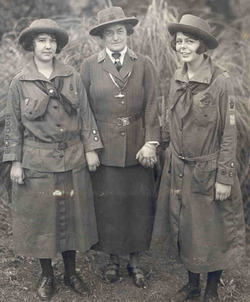
The Power of One Woman's Actions: Juliette Gordon Low

Today, and all year really, we get to celebrate the commitment and focused actions of Juliette Gordon Low of Savannah, Georgia, who brought the English notion of Girl Guides (thank you, Lady Baden Powell) to America and organized the first Girl Scout troop here.

I was briefly a Brownie, and loved being a Cadette. My mom grew up in hard times, took a two-year degree in nursery-school teaching, and as a mother herself, was committed to making sure her kids got the opportunities she'd missed. She made sure I got to all of my Cadette meetings (at the little brown stone church -- Presbyterian? -- in Montclair, NJ). And in those meetings and my Girl Scout Handbook, I learned how to talk about honor, commitment, and balance: all things that my parents were trying to teach, but without the verbal framework. It shaped my life and still does.

Here's a great site to visit today in honor of 100 years of "growing girls" and service to community, as well as carefully nurtured friendships: http://www.girlscouts.org/gsforevergreen/

And her's the song I've been humming this morning
Girl scouts together that is our song
Winding the old trails, rocky and long
Learning our motto, living our creed
Girl scouts together in every good deed.
Girl scouts together happy are we
Friendly to neighbors far o're the sea
Faithful to country loyal to home
Girl scouts together wherever we roam.
Girl scouts together onward we go
Joining as sisters stronger we grow
Mothers and lawyers, women in space
We know no boundaries, the future's our place. 
 For more on Juliette ("Daisy") Gordon Low, click here. And here's a wonderful photo:

Sunday, March 11, 2012

Sisters in Crime, Vermont -- March 11, 2012

Jim DeFilippi read from his "work in progress," a new "Speedo" crime novel, this afternoon in Montpelier, VT, at the first (annual) gathering of Vermont mystery writers via Sisters in Crime, New England. Great reading, Jim! Seven other authors also read new work -- fabulous gathering! 28 people on hand. Major thanks to Nancy Means Wright for taking the initiative to pull this together.

In fact, as you can see here, Nancy (left) and I had a great time -- Nancy read from her new Mary Wollstonecraft novel, and I aired the second chapter of the adventures of Montpelier, Vermont's, own Nancy Drew: Felicity "Lucky" Franklin.  

Thursday, March 8, 2012

Start of a New Mystery: "All That Glitters," Began in Public Today!

I feel like a first grader. No, honestly, I do: trying to learn dozens of new things on the first day.

The reason: I just started presenting a brand new novel of mine on a social writing/reading site called Wattpad. In the past 24 hours, I've created an account, read some stories on the site written by other people (and applauded them!), created a draft cover for the book (it will get better when I can get a pro to help on it), and uploaded the first chapter of the novel.

If you're willing to sample the adventure, take a look at the chapter, right here: http://www.wattpad.com/3668250-all-that-glitters-chapter-1/intro

And, oh yes, I've written chapter 2, to upload in a few days (running out of breath by now!).

Here's a short description of All That Glitters:
Nancy Drew for today? If you loved the old series, or have longed to see a "girl detective" that makes sense today -- at college, smart, driven to solve mysteries, tech-savvy, and with friends who'd (almost) die for her -- you'll enjoy the adventures of Felicity "Lucky" Franklin. 
Plus, in the true spirit of Nancy Drew, I'm doing my research with a "chum" -- yesterday my friend Pam and I toured the State House in Montpelier, courtesy of the very knowledgeable and courteous David Schütz, curator of state buildings. I took notes like crazy, and Pam took photos. If you peek here, you can see Mr. Schütz sitting in the center of the House Chamber at the magnificent Capitol building. And that person madly scribbling down the details? Yours truly.

Sunday, March 4, 2012

Time Travel in Fiction: THE HUNGER GAMES and LORD OF THE RINGS

Every author has a different way to "get into the mood" for writing. Today I pulled on my new "Team Katniss" sweatshirt and the words flowed well, until time-to-make-breakfast interrupted.

Katniss, in case you haven't followed recent YA adventures or you don't have a TV where the movie trailers are airing (for the March 23 film release), is the protagonist of The Hunger Games and its fierce sequels, Catching Fire and Mockingjay. She lives in a post-disaster America called Panem, and, as in Eliot Pattison's detection series also set in the future (first book is Ashes of the Earth), her society has been knocked back to primitive in many ways. Katniss's most obvious skill is hunting with a bow and arrows; her more important one is sorting out right from wrong, I think.

I'm not always comfortable with the way books blend the skills of the past with the robotics, computer life, and communications of the future. But I had no trouble "suspending disbelief" for The Hunger Games. I've just enjoyed my third time reading the trilogy.

It's also a good counterbalance to the trilogy that haunted my teens, The Lord of the Rings. When I re-read this threesome recently, it hit me for the first time that there were no strong personalities among the women there -- I didn't really notice before, because I've always identified fully with Frodo in Tolkien's trilogy, ignoring his gender and instead connecting with his sense of being way too deep in something he doesn't understand, yet determined to somehow go forward and meet his own commitments to justice. (Well, let's emphasize that I try.)

So it's a relief really to be able to identify directly with Katniss and at the same time with her gender and her hesitations around whether "love" is going to work for her, and how to define it. The most important part of The Hunger Games is fighting for survival and then for freedom. But a story's not going to be much good unless the people in it matter to the reader, and Katniss matters to me.

Let me wrap up this post with on off-topic but heartfelt shout of thanks to Flamingnet Teen Book Reviews Blog, where The Secret Room (set firmly in "today") made an appearance on Friday. Many thanks for the perceptive analysis of the book! And yes, there is a sequel on the way, that picks up where Shawna left off at the end of The Secret Room. More about that, another time.

Wednesday, February 8, 2012

Threats Against Immigrants in Vermont: The Ku Klux Klan

As we head toward Vermont's Town Meeting Day on the first Tuesday of March, we can expect to hear mention of who is "from here" and who is "from away." There are real differences involved: People who live in Vermont for a long time develop ways to connect and cope with seasons, distances, geography. Families who have generations of experience to rely on develop some of the best skills -- as well as treasured traditions. As I listen to my house creak and ache during subzero nights, I remember especially Mrs. Lucille Poutre of Irasburg, who taught me the importance of "banking" the house foundation for winter.

At the same time, those who arrive in Vermont "from away" bring perspectives and experiences that are often helpful in finding a way to survive other challenges: economic, technological, and the growing pains that associate with more obvious diversity in the state. If you grow up in a more diverse area, you can bring those skills with you as you arrive in the Green Mountains. They matter especially at Town Meeting, when our commitment to working democracy means finding ways to hear each other.

But it's an oversimplification to say that Vermont is "becoming diverse." The state has always had people from varied backgrounds, and the human tendency to divide them into "us" and "them" has dogged us all along. The Darkness Under the Water, my young adult novel of 1930 that walks with 16-year-old Molly Ballou through some of the challenges of that time, portrays the casual bigotry that was present, and some frightening -- and sometimes heroic -- results.

In the upcoming issue of Vermont's Northland Journal, editor/writer Scott Wheeler presents an interview of a 97-year-old resident of Newport, Vermont, who mentions the Ku Klux Klan burning "fiery crosses of hate" on a hill above the town. To many, the "KKK" is associated with terrorizing African Americans in the Deep South, especially in the early 1900s before Civil Right legislation took hold. It can be a shock to realize that the KKK was also present in New England, including in Vermont.

The Vermont Historical Society describes some KKK activity within its Freedom and Unity exhibit, for which much of the material is still available online; the poster shown above is from that exhibit.

State-sponsored bigotry disguised with the "scientific process" became the Vermont Eugenics Survey, documented by the University of Vermont, again with material available online (read the letters exchanged on the Eugenics Commission).

For a look at a KKK threat to Catholics during the 1920s, check this page from St. Augustine Church in Montpelier.

And I hope the webpage on the Vermont Eugenics Survey at "Abenaki Nation" will interest many readers in listening to the voices of Vermont's Native Americans, whose persecution during the 1920s and 1930s led directly to their invisibility in the state in the 1940s, 1950s, 1960s ... the enabling legislation for sterilization of the "unfit" was not repealed in Vermont until 1971.

It may indeed be human to say "them" and "us" -- but it's dangerous, can be cruel, and, like the burning crosses of the Ku Klux Klan, leaves us a legacy of pain and discrimination that takes generations of activity to heal, restoring justice.

Saturday, February 4, 2012

Strep Throat, Telephones, and the Eugenics Movement

photo by Stephanie Krishnan
I've been learning about Alexander Graham Bell today. Until recently, all I really knew about him was that he "invented the telephone," and that he'd taken part in the eugenics movement that lies behind the story in my book The Darkness Under the Water.

When I worked on the background history for the book, I read the massive nonfiction work War Against the Weak: Eugenics and America's Campaign to Create a Master Race, by Edwin Black. More than 500 pages long, including 50 pages of footnotes, this book contains the results of decades of research by Black and his team.  I especially paid attention to the sections in the book that detailed the Vermont Eugenics Project (given at more length in Nancy Gallagher's book Breeding Better Vermonters). And although I noticed Bell's participation nationally, it didn't interest me much at that time.

But yesterday I finished up an article for one of my other blogs (http://kingdombks.blogspot.com) in which I mentioned a historical mystery by Victoria Thompson called Murder in Chinatown. My husband Dave reminded me that he had another Victoria Thompson mystery for me to read: Murder on Lexington Avenue. In this one, Detective Inspector Frank Malloy and trained midwife Sarah Brandt, in turn-of-the-century (that is, around 1900) New York City, discover the havoc created in a family where Alexander Graham Bell's ideas about deafness affect how the father makes decisions for his deaf teenage daughter.

And those ideas, in Thompson's story, are expressed as part of the eugenics ideas -- the ideas about "cleaning up" or "improving" the genetic basis of humans through choices in who has babies with whom. Oh, it's easy to shudder now -- we can see the terrible flaws in those ideas, especially when we know what Adolf Hitler's ideas on the subject did in the world -- but many well-meaning people missed the danger and thought they were making "right decisions" by stepping in and controlling, in one way or another, who would be able to have children. And in Thompson's book, Bell's ideas are in favor of teaching the deaf to lip-read and speak (even if their speech sounds odd), in order to be part of society -- and Bell felt that deaf people should not marry each other, because they could then produce more deaf children and increase the pain in the world.

Bell's passion for enabling the deaf to be part of the social world around them came partly from his love for his own deaf mother, and partly from his marrying a woman who was deaf -- and who had become deaf at age five, from being ill with scarlet fever (caused by the same organism that causes strep throat).

One of his most famous students was Helen Keller, now well known for her success in moving beyond her own blindness and deafness to become a leader among Americans and worldwide. And Bell's efforts to assist hearing led to the telephone's invention. (Video here!)

But Bell turned out to be mistaken about deaf parents inevitably having deaf children, and as Edwin Black confirms, Bell also did not like the way the eugenics movement began to concentrate on "eliminating" the "negatives" in people -- he wanted instead to see a focus on encouraging positives.

At any rate, the eugenics movement went on without Bell's support, and provided the reasoning for terrible events in America, as well as in Germany. Just last month, the state of North Carolina received a report from its governor's Eugenics Task Force, recommending that the state give $50,000 per victim to people who could show that North Carolina's government had forcibly done surgery on them or their families between 1929 and 1974, under the "eugenics" ideas ("stop the wrong people from having children").

I am so glad that this beginning of justice, and of admitting that government makes terrible mistakes sometimes, has started for North Carolina.

North Carolina wasn't the only state where this happened, though. In Vermont, where the very real effects of a state eugenics law are part of the historical fiction in The Darkness Under the Water, apologies for the state's treatment of its Native Americans have only just begun. And there were 29 more states where laws focused on "sterilizing" -- forcing surgery that would prevent people from having children -- during those years.

In North Carolina about 7,600 people were sterilized; in Virginia about 8,000; and in California, about 20,000, with a national total of some 60,000 people.

What can we do about the evidence of so much injustice? I think we each have a responsibility to try to make things right.

Interested in learning more about how American views of deafness and actions among both the deaf and hearing communities have changed over the years (and Alexander Graham Bell's role, too)? Consider watching the PBS film Through Deaf Eyes. The DVD is easy to purchase, and there's a lot of free and interesting information on the film's website.

The Poetry of Transitions: What Is Poetic Language?

On Thursday July 16 at 6:30 pm in the Davies Memorial Library in Lower Waterford, Vt., I'll be chatting about my new book THRESHOLDS (fr...