Showing posts with label North Danville. Show all posts

Tuesday, September 2, 2025

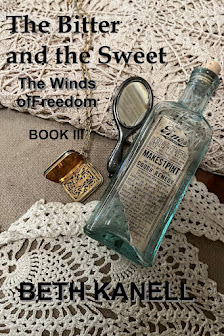
How the WINDS OF FREEDOM Series Reached Book 3


Both softcover and ebook available!


Blame it on that heirloom gold locket that my dad gave to me, after my house burned to the ground. The midwinter fire devoured all the jewelry my mother gave me over the years, all her knitting projects, a half-made crocheted bedspread for my youngest brother that I claimed after her sudden death a few years earlier, saying, “I’ll finish it for you.” Raging on a twenty-three-degrees-below December night, the fire took our clothes, my work, the children’s new Christmas toys. None of that compared to the importance of the three of us escaping, with burns on our faces and frostbite on our toes, from sock-footed hike a third of a mile to the nearest neighbor.


Dad drove north to check on us, a day later. He brought some family photos, thoughtfulness that impressed me; he brought my youngest brother the contractor, who’d never receive that bedspread after all, but who brought me boxes of his spare tools; and he brought the locket. Gold, shaped like a tiny box on a short chain, it opened to emptiness. No photo of anyone inside, but I saw an intricate gold grating that flipped outward. “It’s a hair locket,” he explained. “You put a lock of hair of your beloved into it.”


During the night of the fire, a mile from where my ex-husband lived, the only “boyfriend” in my life was playing music in New Orleans. He got a busy signal when he tried to phone me, and bitterly assumed I’d taken the phone “off the hook” to silence it during a date with someone else. Days later, he’d finally phone a neighbor and learn that a fire burns through phone and electric lines. I didn’t put a lock of his hair into the locket; he left not much later, for a dancer he’d formed a crush on.


When I turned fifty, in accordance with the answer a prayerful friend of mine had received, I met and fell joyously in love with my soulmate. By then, the kids were grown and gone, but on their rare visits home, they agreed I’d finally found the right partner. Next time my darling got his hair trimmed, I collected a curl and popped it into the locket.


Historical fiction already meant a lot to me; a lifelong history writer, and a fumbling novelist, I found the combined threads satisfying. And I wanted very much to give readers a vicarious experience of Vermont’s approach to the Abolition movement and to diverse settlers (setting aside for the moment the state’s sometimes cruel treatment of Native Americans; I’d addressed that in my first work of historical fiction, and the book is a classic, The Darkness Under the Water, but also controversial). I figured, if readers followed along with the teens in my new story, they’d discover for themselves that Black people in Vermont in the 1850s were “free and safe,” as one of the state’s great historians puts it.


If you haven’t yet written a novel, this might surprise you: Often the characters stubbornly diverge from where you thought they were going. So did the girls in The Secret Room: One morning, halfway through writing, I realized at least one of them would head into a dark collapsing tunnel, in a desperate rescue effort. As dirt fell into her eyes and mouth and she moved resolutely forward, one hand landed on an object that she reflexively tucked into a pocket. Later, in daylight, she discovered it was an antique locket.


Yes, there you have it: Dad’s little locket had crept right into my story. So it felt obvious, later, that I’d write another novel, this time set in 1850, when that locket first hung at the throat of a Vermont teen. That turned into The Long Shadow, a book I’d never imagined would be the first of a series.


Yet when I turned it in for publication, the cheerful editor said, “I hope we’ll be hearing more from these characters!” Shaken, I asked, “You mean a series? How long?” She replied, “How about until everyone is free?”


It doesn’t take a lot of American history to recognize that “when everyone is free” probably means the end of our Civil War: 1865. If I wrote a book for each year from 1850 until then, there’d be 15 books in the series. A nifty idea! However: My teenaged characters from the first book would be in their thirties. That wasn’t an age I wanted to write about – I love the voice of a teen observing her world. How could I solve this?


It took another week for the idea to arrive: If the teens had a reason for vanishing from the village at the end of each book, or maybe each second book, and the next book’s protagonist became a girl who’d been younger at the start, and I kept passing it along that way — well, you see how it would work, right? Sort of a relay race, passing along the Vermont fight for human liberty to each new girl, or set of girls. Yes! On the spot, I decided (since I’m far from young) that there would be two-year jumps between the books in the series. That meant seven or eight titles, which seemed workable, as long as I took my vitamins and avoided any repeat of the disastrous housefire.


Now we are in book 3 in what the editor and I decided to call the Winds of Freedom series. Almyra Alexander, who showed up in book 2 as a fashionable girl from Boston, longs to be a minister, a difficult if not impossible path for a woman in 1854. The Vermont village, with its changing ideas about people and their roles, may give her a way forward toward her dream.


But first she’ll have to puzzle out several newly arrived women at the local tavern, what they are carrying around the county, how to handle an aging criminal who arrives while her uncle the minister is out of town, and whether she can effectively assist the cause of Abolition.


If you’re ready to find out whether Almyra is up to those challenges, and what the risks are, and what allies she’s recruiting — get ready to read The Bitter and the Sweet.

Wednesday, October 16, 2024

Three Teenaged Girls in 1850s Northern Vermont: My Protagonists for The Winds of Freedom


When I wrote THE LONG SHADOW, the story of Alice Sanborn's discovery of injustice and loss in her home village of North Upton, Vermont, I reached for integrity: not just for Alice and her family as they continue their commitment to the abolition of American enslavement, but also for how we see that time, that piece of our past. I wanted to give readers an experience of aromas and tastes as much as possible, along with the binding constraints of the layers of women's garments at the time, and the ways family could be both supportive and harsh. When Alice's uncle rages about the politics of the time, I want you to feel with Alice the scary and exhilarating moment of seeing someone take a stand for a difficult position.

In fact, I was so immersed in this 295-page novel that when I completed it. I was startled to hear the editor at Gale/Five Star, the publishing house, say "I hope we'll be seeing more of Alice!" "How much more are you thinking?" I asked. She responded, "Until everyone is free." That is, from 1850 to 1865.

Well, why not? Alice's interactions with her younger Black friend Sarah and the innkeepers' daughter Jerushah came to a natural end at the end of that novel. But as we all know, when one friendship ends or changes, another often comes along.


For THIS ARDENT FLAME, I chose a very different sort of new friend for Alice: Caroline Clark. Because of her inability to hear, Caroline's spent her school years in a boarding school for the deaf and hearing impaired, in another state. Returning to North Upton for Caroline could be far more traumatic if it weren't for Alice. As the two teens learn to communicate in a layered set of "languages," they learn more about the diverse people around them, and develop their own fierce commitment to abolition, as well as to the linked issue of women's roles and rights.

Readers may have been startled by the decision of these characters at the end of the book: They are headed West, to a place where their presence may be critically important to how America develops the laws and freedoms of its added territories, soon to be states. How could the Winds of Freedom series continue? Was it moving West?

Not at all. When the editor invited me to develop a series for this "young adult crossover" genre -- that is, one that features young adults (teens) as protagonists, but is read enthusiastically and with curiosity by adults, including parents and grandparents -- I saw right away that pushing the sequence by a year at a time, all the way to 1865, would mean a much longer and slower sequence than I wanted to write ... and, more urgently, it would mean that after the first few titles, the main characters would no longer be teens. Not only would that break the genre, it would take me into a kind of novel that didn't interest me. I really like writing "YA crossover."

So I came up with a plan: Each book would jump forward two years, not one; and the protagonists would shift with the timing, like a relay race, passing the action to another girl growing into the responsibility of working for a more moral nation and for the freedoms of those around her.


That's why book 3 in the Winds of Freedom series, THE BITTER AND THE SWEET, features would-be minister in training Almyra Alexander, whose Boston mother has passed away and whose politically active father is far too busy to raise a teenager (other than perhaps planning a marriage for her!). Readers met Almyra in book 2, when she was a pesky newcomer, dressed in city fashions and ignorant of rural ways, but already interested in the role she embraces in book 3: to become qualified to lead her own church. What about the push for abolition, a necessity for a moral person of her time -- will that get in the way of becoming a minister? And who ever heard of a woman leading a church??

I'm eager to learn what you think of Almyra's choices and adventures (including with a notorious counterfeiter) in THE BITTER AND THE SWEET. Please do let me know.

And when you've finished the book, tell me who you think the next young woman (teen!) is that I've chosen for the focus book 4. Think carefully, and remember the two-year jump involved. Can you guess the right one? I want to hear your thoughts, of course!

Monday, July 18, 2022

North Danville Family Stories: Updates from Gerard Lamothe, July 5, 2022


There are so many details in each story about our families and our pasts, and sometimes people don't see the details in the same way. Although two of the people interviewed for my 2022 North Star Monthly article on North Danville went over the manuscript before I turned it in -- because I was aware that the connections were complicated and the photos a generation or two way from us -- Gerard Lamothe found that the final article didn't fit what he meant to say, and he expressed some doubts about what others told me.

Here are Gerry's notes of correction; he says his own speaking style may have led to many of the confused items from his own research.

"Original dam at the bottom ... flood of '27." Gerry says North Danville's big flood took place in 1897 instead. The dam was rebuilt after 1897.

bridge ... sawmill: Gerry says this was the gristmill, not sawmill, and related  bridge, also severely damaged in 1897. He notes that Arthur Sanborn bought both the dam and the gristmill so he could use both dams to run his sawmill.

He wants to make it clear that Aunt Addie was his great-aunt.

The image of the blacksmith shop and triplet houses: Gerry emphasizes that General Chamberlain was one of several early settlers, although he was the first in the village. He refers to a Tennie Toussaint article.

Gerry thinks the name McFarland was used without a D.

Rather than banning both dancing and billiards, he says the band was against both dancing and cards.

The bell mentioned, he clarifies, was a handbell.

Gerry says Arthur Sanborn's house is not in the photo; the unpainted building is the blacksmith shop, and the white Cape-style house belonged to Elgin Gates. Arthur Sanborn built his house on the former site of the blacksmith shop.

Gerry says Arthur bought the sawmill and Elgin's shop and home, and the dance hall, a building just below Elgin's blacksmith shop.

Gerry says the house was not sheathed in brick, but in wood.

Where Arthur's brother is mentioned, Gerry said that should be brother-in-law, Addie's brother Al.

Gerry says the lunches carried by Addie were not for the workers but for the students.

Gerry says Addie owned the mill and ran it with the help of Charles Sanborn.

Gerry believes Arthur's passion focused on the second mill (Walden Mountain) after he sold his own mill.

Gerry corrects the shooting of Charles in the leg, saying it took place instead in the ballroom at his house.

Gerry says Addie's sense of propriety affected the driving lessons of daughter Louella, not of Sharon.

Gerry corrects the dance hall shooting to take place at the Sanborn dance hall.

Gerry believes the mill pond did not rise to dangerous levels; instead, those waters came from the other dam by the town shed and the third dammed pond.

Gerry corrects the mention of poor flooring, saying it was to be put into the new school, not the old one.

Gerry's description of the outhouses was intended to say "limed," not "lined."

Charles was Arthur's uncle, not brother, Gerry says.

Gerry says that Elgin's blacksmith shop was built on the site of an earlier store, and that the store photo shown is not the Weeks store.

This page of Gerry's corrections should be considered in future historical writing about North Danville village.

Sunday, December 2, 2018

My Brain Is Back in 1852 (Writing THIS ARDENT FLAME)

Dishes are stacked a little higher than usual. There's dust under the bed. But the chapters are unfolding, each page a marvel as I "discover" where the new book is going. My feet and my brain are in 1852 (fear not, my heart's still with my honey in 2018, and I can still cook).

Just so you can see what it's like -- at one moment I'm tapping out dialogue and moving the characters to the next scene. And then, quick, it's time to dash back into the research, like these marvelous pages from the 1854 edition of Walton's Register -- a business directory for Vermont that reveals much, much more than who owns what.


Wednesday, April 17, 2013

African Americans in 19th-Century Vermont: Fresh Resources

Rokeby's new and exciting exhibit opens May 19, 2013.
Rokeby, Vermont's principal verified "Underground Railroad" historic site, will open its new exhibits on May 19, inaugurating the freshly constructed building that the site's team will use for group visits, teaching, and especially making history accessible to young students (say, fourth grade). I'm a fan -- and here's a news interview with director Jane Williamson as the space gets its finishing touches: http://www.wcax.com/story/21390215/a-new-exhibit-at-rokeby-museum

Williamson has quipped that the Vermont version of the decades just before the Civil War should be called the "above-ground" railroad years instead, and her exhibit title is "Free & Safe" -- a good description for Black Americans who arrived in the Green Mountains in the 1830s through 1850s. Elise Guyette's book "Discovering Black Vermont: African-American Farmers in Hinesburgh, Vermont 1790 - 1890" won a 2010 Award of Excellence from the Vermont Historical Society and offers an extensive exploration.

I just realized that there's a phenomenal hour-long presentation by Guyette available on the Net, thanks to Marlboro College: http://www.youtube.com/watch?v=1GCGu0AsDgk -- a great way to catch up on her work and catch some of the flavor of this lively presenter.

If you're teaching or gathering in Vermont and want to check whether a site near you with an Underground Railroad reputation is historically significant, I recommend the State of Vermont report "Friends of Freedom: The Vermont Underground Railroad Survey Report." This 1996 document peels open the evidence for (and against) 174 of the 19th-century individuals and sites that have been mentioned in this context. I still have a few copies available at $15 each (postage included); let me know if you'd like one.

This year Vermont provides a heritage trail to explore the lives and impact of Black Vermonters of the 19th century, too -- as noted in this Burlington Free Press article (I contributed information on the Coventry location). With this comes fresh attention to Alexander Twilight, probably the first mixed-race Vermonter to graduate (in a remarkably short time) from Middlebury College in 1822. There's a good VPR interview on Twilight and his "race" in Vermont's Census records: http://www.vpr.net/episode/55438/groundbreaking-history-alexander-twilight

These are great resources for classroom use and for a break from books and paper, as spring makes the classroom -- or home office! -- seem a bit confined.

PS -- If you're new to this blog: One reason my writing-room reference shelves keep filling with more materials about Vermont's Black residents is my 2011 novel, THE SECRET ROOM. Signed copies are at several Vermont bookstores or you can order them at www.BethKanell.com; video support on this history-mystery set in North Danville, Vermont, can be found here: http://www.thesecretroombook.com/the-author.html

Thursday, September 20, 2012

A Picture Tells a Story With Heart


I love this image, which began with a photo I took a week ago inside the farm shop at the Langmaid farm in North Danville. You can see the rows of jellies and jams (I'll re-show, below, my other photo from that day, which shows the baked goods -- the donuts were flying out of there at 3 for a dollar).

And here are some parts of the story that come with the photo:

* North Danville, Vermont, is the location that inspired -- and really is the home of -- my 2011 mystery adventure THE SECRET ROOM. This little farm store is roughly where the imagined village store is, in the novel. And each time I'm in North Danville, I'm haunted by Shawna and Thea (from the novel) moving back and forth to each other's homes and discovering the secrets there.

* The jelly-jar labels include "Curtis Vance Memorial Orchard" as their first line. Curtis Vance lived in North Danville; he was a cousin of teacher and librarian Mary Prior, who insisted that I place a book in this place! The community that gathered around Curtis Vance during his long illness (familial ALS) was wide, deep, and loving. I enjoy seeing his name on the jars, even though I can't ever see him in person again.

* Autumn is my favorite season (is it yours, too?) -- my birthday is at the start of September, and I always have that "first day of school" excitement in my chest too. Most of all, I love the crispness, the scent of the air, the colors of the leaves, and the activities of harvest. "Putting food up" as jams, jellies, pickles, applesauce -- what could be a better statement of faith in the future?

* Last but not least, I just took a class (yes, you can take classes from home, when you're a writer who loves to be at her desk) on Pinterest (ultimate in "new" -- contrast with the eons-old skills of preserving foods!) and figured out how to add this blogsite as an insert on my photo. It's still a bit basic; I'll be better next week. But I'm happy to be learning, and joyful to open the window and smell Autumn, and -- full circle -- thinking quietly again about Curtis Vance and Mary Prior. Life passes, and we are fortunate to preserve some of the "good food" to sample again later.

The Poetry of Transitions: What Is Poetic Language?

On Thursday July 16 at 6:30 pm in the Davies Memorial Library in Lower Waterford, Vt., I'll be chatting about my new book THRESHOLDS (fr...